The Evolution of a Vision
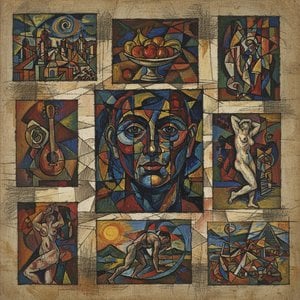
Born in Kiev, Ivan Kliun entered the art world during a period of profound transition. His early years were shaped by the traditions of Russian Post-Impressionism and Symbolism, following the paths of contemporaries like Alexandre Benois and Victor Borissov-Mussatov. After refining his skills through studies in Kiev, Moscow, and Warsaw, he moved away from these established modes. By 1910, a new direction emerged as he aligned himself with the younger, more radical generation of the Russian avant-garde.
This shift brought him into the orbit of figures such as Kasimir Malevich, Natalia Goncharova, and Vladimir Tatlin. Kliun embraced the energy of Cubism and Futurism, seeking the most daring expressions available to his era. His work became a site of experimentation, where he explored the formal implications of Western movements through inventive paintings, reliefs, and sculptures. He contributed to significant group exhibitions, including those organized by the Union of Youth and Knave of Diamonds.
The Art of Color
By 1916, Kliun had moved into the realm of abstraction. His sketches from the period between 1916 and 1922 reveal a focused pursuit of truth through simple, colored shapes. While often associated with the broader movements of his time, he sought to establish a distinct identity. In 1919, he articulated his own philosophy, which he termed the art of color, a concept he intentionally separated from the Suprematism of Malevich.
His technical approach relied on specific structural devices to create tension and balance within a composition:
- Diagonally directed and off-centered arrangements.
- The use of irregular, multicolored shapes.
- Sharp tonal contrasts.
- A precise management of the depth, weight, and density of colored masses.
In these works, a large red circular segment might bisect a black bar, held in place by the strength of the underlying color. This method allowed him to manipulate the perceived weight of each element on the surface. His later mature abstractions moved toward a softer, more cosmic imagery, reflecting an intuitive connection to color and a commitment to his personal aesthetic ideals.
Questions & Answers
In which historical period did Ivan Kliun work?
Ivan Kliun worked in the Modern period. The period situates the artist's activity in history.
Where are Ivan Kliun's artworks grouped by art movement?
Ivan Kliun's works can be browsed by movement on the artist's All Movements page.
Where can I see Ivan Kliun's artworks in chronological order?
A timeline of Ivan Kliun's works exists: the artist's Artwork Timeline page orders the artworks by creation date.
What are the birth city and country of Ivan Kliun?
Ivan Kliun was born in Bolshiye Gorki, in Russia.