
Figurative Expressionism · 1881
Self-Portrait (Edvard Munch, 1881)
Self-Portrait was made by Edvard Munch (1863–1944). It dates from 1881. It belongs to the Figurative Expressionism movement. It is made in acrylic on canvas. It is kept at Munch Museum in Oslo, Norway.
- 1881
- Acrylic On Canvas
- Munch Museum, Oslo

 Preview

 Print
 Send
 Share
 Fact sheet


 Download
 Similars
 X-Ray
 Diaporama
 Q&A

 Stats
Self-Portrait in a nutshell
- Title
- Self-Portrait
- Artist
- Edvard Munch (1863–1944)
- Artist born in
- Ådalsbruk, Norway
- Date
- 1881
- Medium
- Acrylic On Canvas
- Where to see it
- Munch Museum, Oslo, Norway
- Movement
- Figurative Expressionism
- Period
- Modern
- Subject
- self-portrait, expressionism, munch, norway, anxiety, distortion
What is Self-Portrait about?
Introduction to Expressionism and Figurative Expressionism
Expressionism is a modernist movement that emerged in the early 20th century, characterized by its emphasis on emotional experience and subjective interpretation. The movement encompassed various artistic styles, including painting, sculpture, literature, music, and theater. In this article, we will focus on the art of painting and explore the Figurative Expressionism style, which is best exemplified by the Self-Portrait by Edvard Munch.Edvard Munch: The Artist Behind the Painting
Edvard Munch (1863-1944) was a Norwegian painter who is best known for his painting "The Scream." He was a pioneer of Expressionism and is considered one of its most important representatives. Munch's work is characterized by its emotional intensity, bold use of color, and distorted forms.Self-Portrait: A Masterpiece of Expressionism
The Self-Portrait was created in 1881 when Munch was just 18 years old. The painting is a remarkable example of Figurative Expressionism, as it presents the world solely from a subjective perspective and distorts physical reality for emotional effect. In this self-portrait, Munch portrays himself with a serious expression, staring directly at the viewer. The background is blurred, drawing attention to the artist's face and emphasizing his emotional state.The Legacy of Edvard Munch and Expressionism
Munch's work has had a profound impact on the art world and continues to be celebrated today. His paintings are held in museums around the world, including the Munch Museum in Oslo, Norway. The Self-Portrait is one of Munch's most famous works and serves as an excellent example of Figurative Expressionism.Conclusion
Expressionism is a modernist movement that emerged in the early 20th century and encompassed various artistic styles, including painting, sculpture, literature, music, and theater. The Self-Portrait by Edvard Munch is an excellent example of Figurative Expressionism, as it presents the world solely from a subjective perspective and distorts physical reality for emotional effect. Munch's work has had a profound impact on the art world and continues to be celebrated today. Discover more about Edvard Munch and his masterpieces on our website:- Painting by 'Edvard Munch' | Edvard Munch:Landscape, maridalen about Oslo (Expressionism,)
- Painting by 'Edvard Munch' | Edvard Munch:The old church of Aker (Expressionism,)
- Painting by 'Edvard Munch' | Edvard Munch:The Kiss (Expressionism,)
- Painting by 'Edvard Munch' | Edvard Munch:02 Self-Portrait (Expressionism,)
Where can I see Self-Portrait in person?
Munch Museum
Oslo, Norway
The History of the Munch Museum The Munch Museum began in 1963 at Tøyen, Oslo. It was established to commemorate what would have been the 100th birthday of Edvard Munch. The institution grew from a desire to preserve the artist's legacy, supported by donations from the artist himself and his sister, Inger.


Self-Portrait, up close
We check the colours against the real painting and tidy up the file, so it looks like the artwork, not a scan.
Get the high-res imageThings people wonder about Self-Portrait
Where can I see the original "Self-Portrait" by Edvard Munch?
The original "Self-Portrait" by Edvard Munch is held at the Munch Museum, Oslo, Norway. A reproduction allows the work to be displayed at home.
In what year was "Self-Portrait" by Edvard Munch created?
"Self-Portrait" dates from 1881. The date places the work within Edvard Munch's career and its era.
What technique was used for "Self-Portrait" by Edvard Munch?
"Self-Portrait" is executed in acrylic on canvas.
What subjects appear in "Self-Portrait" by Edvard Munch?
"Self-Portrait" by Edvard Munch depicts: self-portrait, expressionism, munch, norway, anxiety, distortion, subjectivity, portraiture.
Is "Self-Portrait" by Edvard Munch in the public domain?
Regarding copyright, "Self-Portrait" is in the public domain - its copyright has expired.
Who created "Self-Portrait"?
The artist behind "Self-Portrait" is Edvard Munch. The work is catalogued under Edvard Munch's name.
Which artistic current is "Self-Portrait" by Edvard Munch part of?
"Self-Portrait" by Edvard Munch belongs to the Figurative Expressionism movement. This movement provides the stylistic context of the work.
Where does "Self-Portrait" fall in Edvard Munch's career?
"Self-Portrait" belongs to the Early Period of Edvard Munch's career. This classification relates the work to the artist's development.
At what age did Edvard Munch make "Self-Portrait"?
Edvard Munch was 18 years old when creating "Self-Portrait" in 1881. The age is computed from the artist's birth year, 1863.
Meet Edvard Munch

1863–1944, Norway
Edvard Munch
The Life and Identity of Edvard Munch Edvard Munch was a Norwegian painter whose life was deeply tied to the landscapes and the heavy atmosphere of his homeland. Born on 12 December 1863, he spent much of his existence navigating the complexities of the human psyche through his brush and printmaking tools. His work often felt like a direct extension of his own internal struggles, turning private emotions into something visible and shared. He remained an active presence in the art world until his death on 23 January 1944.
Every Edvard Munch you can hang at home, with prices → Get to know Edvard Munch The Edvard Munch works everyone loves
More by Edvard Munch you might love
 The Scream1893
 Vampyren nasjonalgalleri oslo
 Puberty1914
 Anxiety 21894
More to read about Self-Portrait
 Norwegian artworks of the 1900sNorwegian Expressionism and Edvard Munch's masterpieces like The Scream and Anxiety define the 1900s. View the full collection at ArtsDot.c…
 Edvard Munch: Anxiety, Modernity & the Dawn of ExpressionismExplore the profound world of Edvard Munch, pioneer of Expressionism. Discover the origins of 'The Scream' & his haunting depictions of anx…
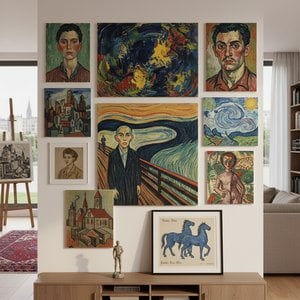 Expressionism's Soul: 10 Masterpieces for Your Home |Journey into the soul of Expressionism! Explore 10 iconic paintings by Munch, Kirchner, Kandinsky & more. Discover their stories, bold colo…