


1


Updated October 2026 · ranked by our popularity score (searches, visits and orders for each work) · 36 works by Victor Brauner in our catalogue
In short
Victor Brauner's best-known piece is Codex d'un Visage (1962). Next on the list are Turning Point of Thirst (1934) and Gemini (1938). We have 36 works by Victor Brauner in our catalogue; this guide picks out the 36 best known, with the year, the museum and the story of each piece.

The gaze meets Turning Point of Thirst, a symbolic painting that emerges from the mind of Victor Brauner. Created in 1934, this work carries the weight of a vision captured during a transformative period in the artist's life. Brauner, a Romanian artist, pours a sense of profound solitude into the canvas, crafting a scene that feels less like a depiction and more like a sudden, startling revelation of the subconscious.


 Prelude to a Civilization1954
12
 Metasigne1958 · Art Institute of Chicago
13
 Firebird (Nietzschean Complex)1959
14
 Double Head1963
15
 Talisman1943 · MOMA - Museum of Modern Art
16
 Untitled (936)
17
 Untitled (540)
18
 Untitled (340)
19
 Untitled (551)
20
 Untitled (555)
21
 Composition with Portrait1935
22
 Autobiographical Painting - Biosensible Ultrapainting1948
23
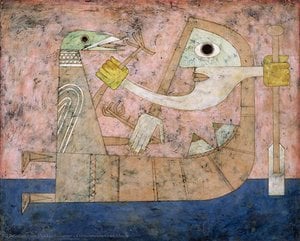 Consciousness of Shock1951 · Peggy Guggenheim Collection
24
 The Boyar1958
25
 Untitled (762)
26
 Untitled (598)
27
 File 5122
28
 Untitled (704)
29
 Untitled (182)
30
 File 5123
31
 File 5119
32
 File 5124
33
 File 5120
34
 File 5121
35
 File 5125
36
 Portrait of the poet Ilarie Voronca1925
The four subjects that come up most often in these pieces, each with its best-known example.
The 5 museums that hold the most of the paintings on this page.
| Museum | City | Works by Victor Brauner | Paintings from this list |
|---|---|---|---|
 Israel Museum |
Jerusalem | 4 | Woman, Mountain, The Object Gives Life |
 Art Institute of Chicago |
Chicago | 3 | Turning Point of Thirst, Gemini, Metasigne |
 Centre Pompidou |
Paris | 1 | Wolf-Table |
 MOMA - Museum of Modern Art |
New York City | 1 | Talisman |
 Peggy Guggenheim Collection |
Venice | 1 | Consciousness of Shock |
Pick a decade to see its standout piece.

The gaze meets Turning Point of Thirst, a symbolic painting that emerges from the mind of Victor Brauner. Created in 1934, this work carries the weight of a vision captured during a transformative period in the artist's life. Brauner, a Romanian artist, pours a sense of profound solitude into the canvas, crafting a scene that feels less like a depiction and more like a sudden, startling revelation of the subconscious.
Top of the list is Codex d'un Visage (1962). Right behind it: Turning Point of Thirst (1934) and Gemini (1938).
59 years old. Victor Brauner was born in 1903, and Codex d'un Visage dates from 1962.
Codex d'un Visage, Turning Point of Thirst, Gemini, Woman, Mountain, The Object Gives Life, Wolf-Table, There, The Alchemist (L'Alchimista) and Origin of Poetry. You'll find the year and the museum of each in the list above.
We have 36 works by Victor Brauner in our catalogue, dated 1925 to 1963.
You'll find most of them in Israel Museum (Jerusalem), Art Institute of Chicago (Chicago) and Centre Pompidou (Paris). The museum list above has the full breakdown.
In 1940s, more than any other time: 7 of the 36 pieces on this page date from then, Woman among them.
The earliest piece here is Portrait of the poet Ilarie Voronca (1925); the most recent is Double Head (1963).
Fragmented figures (2), Symbolic imagery (2) and Abstract composition (2), out of the 36 pieces on this page.
Surrealism, as you can see in the pieces on this page.
You can see 4 of the pieces on this page at the Israel Museum, Jerusalem, including Woman, Mountain and The Object Gives Life.
Victor Brauner, born in Piatra Neamt, Romania, in 1903, embarked on an artistic journey deeply intertwined with spiritual currents and a restless exploration of form. His father’s interest in spiritualism cast a long shadow over young Victor's formative years, fostering a fascination with the unseen realms that would later permeate his canvases. The family’s relocation to Vienna introduced him to new cultural landscapes, followed by a return to Romania where he attended school in Brăila and developed an early passion for zoology – a curiosity about living forms that would subtly inform his artistic vision. Formal training at the National School of Fine Arts in Bucharest provided a foundation, but Brauner quickly proved himself a nonconformist, eager to break free from traditional constraints. Early landscapes, reminiscent of Paul Cézanne’s structured compositions during visits to Fălticeni and Balcic, were merely stepping stones; he was destined for more radical territories. He swiftly declared allegiance to Dadaism, Abstraction, and Expressionism before finding his true home within the burgeoning Surrealist movement. His first solo exhibition in Bucharest in 1924 at the Mozart Galleries signaled the arrival of a unique voice, one poised to challenge conventional perceptions of reality.
The pull of Paris proved irresistible, and Brauner made his first journey there in 1925, returning again in 1927. This period marked a crucial phase in his artistic development, fueled by intellectual exchange and collaboration. Co-founding the avant-garde magazine *75HP* with poet Ilarie Voronca allowed him to articulate his theories on “pictopoetry” and "surrationalism," concepts that sought to bridge the gap between visual art and poetic expression. Works like *Christ at the Cabaret*, a biting commentary on societal structures influenced by George Grosz, and *The Girl in the Factory*, echoing Ferdinand Hodler’s solemnity, demonstrated his early critical engagement with the world around him. A pivotal encounter occurred with Constantin Brâncuși, who mentored Brauner in art photography, refining his eye for composition and form. Friendships with Benjamin Fondane and Yves Tanguy further cemented his connection to the Parisian Surrealist circle. This was a time of intense experimentation, culminating in works like *Self-Portrait with Enucleated Eye*, a haunting premonition of loss and a recurring motif that would define much of his later work. André Breton’s enthusiastic introduction to Brauner's 1934 Paris exhibition at the Pierre Gallery highlighted pieces such as *Mr. K's Power of Concentration* and *The Strange Case of Mr. K*, drawing parallels to Alfred Jarry’s absurdist masterpiece, *Ubu Roi*.
Brauner’s return to Bucharest in 1935 was marked by brief involvement with the Romanian Communist Party, but his artistic focus remained firmly rooted in Surrealism. An exhibition at the Mozart Galleries sparked debate about the role of avant-garde art within Romanian society. However, it was a personal tragedy that profoundly altered the course of his life and work: in 1938, during an altercation between Oscar Domínguez and Esteban Francés, Brauner intervened to protect Francés and lost his left eye. This devastating event seemed to confirm the prophetic nature of his earlier paintings featuring eyes—symbols of vision, perception, and vulnerability. He married Jaqueline Abraham that same year and began creating a series of paintings known as *Lycanthropic* or *Chimeras*, exploring themes of transformation, hybridity, and the primal forces within the human psyche. The outbreak of World War II forced Brauner to flee Paris in 1940 with Pierre Mabille, seeking refuge first in Perpignan and then in the remote Eastern Pyrenees, where he endured a period of enforced seclusion at Saint Feliu d'Amont. Despite these hardships, he maintained contact with fellow Surrealists in Marseille, sustaining his artistic practice amidst chaos and uncertainty.
After gaining permission to settle in Marseille in 1941, Brauner continued painting despite serious illness, demonstrating remarkable resilience. *Prelude to a Civilization*, completed in 1954 and now housed at the Metropolitan Museum of Art, exemplifies his mature style—an intricate encaustic on masonite that showcases his mastery of texture and symbolic layering. He participated in the Venice Biennale and traveled to Italy after the war, further expanding his artistic horizons. Victor Brauner’s work is characterized by its unique blend of Surrealist imagery, mythological references, and a deeply personal exploration of prophecy and spirituality. His distinctive visual language, incorporating symbols from diverse sources like Tarot cards, ancient codices, and tribal art, established him as a significant figure in 20th-century art. He died in Paris on March 12, 1966, leaving behind a body of work that continues to fascinate and inspire viewers with its enigmatic power—a testament to an artist who dared to delve into the hidden depths of the human subconscious and translate his visions onto canvas.