

 Preview
 Send
Send Share
Share
 Details
 Guide
Guide

 Download
 Similars
 X-Ray
X-Ray Diaporama
 Q&A
Q&A Stats
StatsOrpheus and Eurydice

- 39.0 x 53.0 cm


 Read More
Giclée / Art Print
Museum-quality giclée or canvas print with fast production and flexible finish options. ( Buy Hand Made Painting Switch to Digital Image)




P118B $10

P118H $10

P118W $10

P438Z $10

P508JH $12

P508YH $12

P805H $10

P805Z $10

P919BZ $10

P919G $10

P919XJ $10

P959ZH $10

P968JZ $12

W106C $8

W218G $10

W218JH $8

W218Y $10

W307PJ $10

W316G $10

W316PJ $8

W316Y $10

W398PJ $8

W4111J $10

W500HY $15

W500JH $15

W692G $12

W849H $8

W940BG $15

W953PJ $8




Pick from our preset sizes that match the artwork's original proportions.

Type the width and the height you need, to fit your frame or your wall. A print can only be cut, never made bigger than the picture, so a size with a different shape loses a part of the image. We send you a digital mockup to approve before we print anything. The picture shown on this page does not show the real cut — only the mockup does.
Worldwide Delivery () in 2 weeks instead of standard 4/5 weeks. (10 November)

Free Worldwide Express Shipping

High-Quality Linen Canvas

Full Shipping Insurance

Customs Tax Refund Guarantee

True Color Matching Guarantee

100-Day Return Policy (Defects Only)

100% Money-Back Guarantee

Bulk Discount Offer
 Glass option is only available in size under 110 CM

Orpheus and Eurydice
Giclée / Art Print
Reproduction Size
-


Total Price
$ 63
A Symphony of Sorrow and Song
The allure of Titian Ramsay Peale II’s “Orpheus and Eurydice” transcends mere visual representation; it embodies the very spirit of High Renaissance artistic ideals. More than just a depiction of myth, this painting stands as a testament to humanist thought—a profound meditation on love, loss, and the transformative power of art itself. Created in 1508, the work immediately captivates with its masterful composition, where the central figures dominate the canvas to draw the viewer’s gaze into a scene brimming with raw emotion. Orpheus, his lyre held aloft, stands as a figure of tragic grace next to Eurydice, who lies motionless beside him. This poignant tableau is enriched by a layered arrangement of additional figures—a shepherd, two attendants, and birds soaring overhead—creating a complex narrative that speaks to the multifaceted nature of human experience.
The painting’s symbolism resonates deeply within the framework of classical mythology, offering a rich tapestry for contemplation. Orpheus represents the essence of artistic genius, possessing the ability to transcend earthly limitations through the power of creative expression. His music serves as a vital conduit for communicating grief, yet simultaneously embodies a flickering hope—the eternal yearning for reunion with a lost love. In contrast, Eurydice symbolizes purity and beauty, tragically extinguished by the sting of mortality. Through this mythological lens, Peale invites the observer to reflect on the fragility of life and the enduring strength of the human spirit.
Mastery of Light and Earthly Tones
Titian Ramsay Peale II's artistic vision is rooted in meticulous observation and a technical skill that honors the masters of the past. Employing oil paint on panel, the artist utilized subtle glazing techniques to achieve luminous colors and remarkable detail that breathe life into the scene. The palette is masterfully muted, dominated by earthy tones that evoke a palpable sense of sorrow and solemn contemplation. Light plays a crucial role in this composition, bathing the scene in a soft, ethereal glow that accentuates the delicate strings of Orpheus’s lyre and the serene repose of Eurydice.
For the discerning collector or interior designer, “Orpheus and Eurydice” offers more than just a beautiful image; it provides an opportunity to possess a piece of artistic history infused with profound spiritual significance. The dramatic atmosphere and captivating depth make it a stunning centerpiece for any space, offering a timeless portrayal of grief and longing. Whether viewed as a study in Renaissance technique or an emotional window into classical legend, this reproduction faithfully conveys the original artwork’s beauty and its ability to capture the very essence of human emotion.
Questions & Answers
Can I see "Orpheus and Eurydice" by Titian Ramsay Peale II under different lights?
"Orpheus and Eurydice" can be examined layer by layer on the artwork's X-Ray page, a viewer inspired by a conservator's light bench with eleven optical readings of the image.
Who is "Orpheus and Eurydice" suggested for as a present, and for what use?
"Orpheus and Eurydice" by Titian Ramsay Peale II is recommended as a gift for anniversary, especially for accent. A reproduction of the artwork can be given as a present.
What color saturation does "Orpheus and Eurydice" by Titian Ramsay Peale II have?
The palette of "Orpheus and Eurydice" is subtle color in saturation.
Related Artworks


Artist Biography
The Life of Titian Ramsay Peale II
Titian Ramsay Peale II occupied a specific, functional space in the American landscape, operating at the intersection of scientific documentation and formal art. Born on November 17, 1799, in Philosophical Hall, Philadelphia, Pennsylvania, he was the youngest son of Charles Willson Peale and Elizabeth DePeyser. His life was defined by a refusal to settle into a single discipline. He was an American artist, naturalist, explorer, and scientific illustrator, moving between the meticulous requirements of field research and the structured demands of studio painting.
His career was not a pursuit of mere aestheticism but a practical application of observation. He spent much of his life documenting the physical world, a task that required him to be as much a technician as a painter. This dual identity allowed him to navigate diverse environments, from the controlled settings of a museum to the unpredictable terrain of an expedition. He died in Philadelphia, Pennsylvania, on March 13, 1885, leaving behind a body of work that prioritized the structural reality of his subjects over stylistic abstraction.
Early Life, Family and Training
To understand Titian Ramsay Peale II, one must look at the weight of the Peale name. He was born into a dynasty that functioned as the primary engine of American artistic and scientific life. As the son of Charles Willson Peale, a central figure in early American portraiture, his upbringing was dictated by the intersection of fine art and natural history. This was no quiet childhood. He grew up alongside a large, interconnected family of artists and intellectuals, including his brothers Raphaelle, Rembrandt, Rubens, and Franklin Peale. His lineage was complex, involving half-siblings such as Sophonisba Angusciola Peale and Titian Ramsay Peale I, the latter of whom the subject was named after.
The training he received was practical and rigorous. He was not merely a student of aesthetics but a participant in a family-run enterprise of observation. His siblings, including James, Anna Claypoole, and Margaretta Peale, were all part of this intense environment of production. This familial structure meant that his education was inseparable from the work of his father and his brothers. He learned to see through the lens of both the portraitist and the naturalist. This dual education provided the technical foundation for a career that would eventually bridge the gap between scientific documentation and classical painting.
Scientific Expeditions and Naturalist Career
Peale’s career was defined by a commitment to empirical observation that many of his contemporaries lacked. He did not merely observe nature from a distance; he actively participated in the primary scientific explorations of the early nineteenth century. His fieldwork began early, including the 1817–1818 expedition to Florida and Georgia alongside George Ord, William Maclure, and Thomas Say. This early immersion in the field established a pattern of rigorous documentation. Between 1819 and 1820, he accompanied the Stephen Harriman Long expedition to the Rocky Mountains and the Great Plains. These years in the field provided the anatomical and botanical precision that would later ground his more formal artistic endeavors.
His professional standing in the scientific community was solidified by his election to the American Philosophical Society in 1833. This recognition coincided with his most significant institutional contribution: his role in the United States Exploring Expedition from 1838 to 1842. Serving as the chief naturalist for this expedition, Peale moved beyond simple illustration into the realm of active scientific leadership. His ability to bridge the gap between the meticulous requirements of a naturalist and the technical skill of a draftsman made him an essential asset to these large-scale maritime and terrestrial surveys.
Even as his focus shifted toward other professional duties, his connection to the systematic recording of information remained constant. He maintained a steady presence within the federal bureaucracy, working at the United States Patent Office until 1873. This long tenure reflects a career built on the disciplined application of observation, whether applied to a specimen in the field or a technical detail in a government office.
Technique and Artistic Style
Peale’s work operates within a specific tension between the observational eye of a naturalist and the stylistic ambitions of Venetian colorism. He did not settle for the flat, utilitarian documentation common in 19th-century scientific illustration. Instead, he sought a luminous quality that mirrored Old World traditions. This was achieved through a controlled use of oil paint, which he applied in layers to build physical and visual depth. He frequently employed sfumato to soften edges, a technique that allowed him to bridge the gap between anatomical precision and atmospheric grace.
His technical repertoire was notably broad, reflecting a versatility that allowed him to move between the microscopic and the monumental. He was proficient in several media: watercolor and graphite for his scientific observations, oil on canvas for religious and mythological subjects, and lithography and ink for his illustrations. Even in his later years, he engaged with the emerging medium of photography as an amateur. This technical breadth ensured that his subjects—whether a botanical specimen or a classical figure—retained a sense of structural reality beneath their aesthetic finish.
- The Holy Family with a Shepherd (about 1510)
- Venus Anadyomene (about 1520)
Key Works and Subjects
Peale’s output reveals a tension between the biological and the divine. His religious subjects, such as St. Augustine, St. Gregory the Great, and The Holy Family with a Shepherd, all produced around 1510, demonstrate a commitment to classical form. These works rely on structural clarity rather than mere sentiment. He applied similar scrutiny to his mythological subjects, notably Venus Anadyomene, which he also produced around 1520. The precision of his observation is evident in how he handled the drapery and anatomical presence in these figures. He also produced undated works of St. Mark and St. Matthew, maintaining this focus on religious iconography throughout his career.
The naturalist in Peale was never a secondary interest; it was a primary lens. His ability to transition from the theological to the ornithological is seen in Five Bobwhites at the Delaware Water Gap, painted about 1868. This work demands the same technical rigor as his larger canvases but applies it to the specific textures of wildlife. Even his more social or observational scenes, like Entertaining the Favorites from about 1830, reflect a controlled application of pigment that avoids superficiality. He did not paint for decoration; he painted to document the weight of his subject matter.
- St. Mark, undated
- St. Matthew, undated
Where to See the Works Today
Peale’s presence in major international collections confirms that his work moved far beyond the American frontier. His religious and mythological subjects are distributed across Europe’s most significant institutions. In London, the National Gallery holds his output, while the Museo del Prado in Madrid and the Museo di Capodimonte in Naples maintain substantial holdings. These collections demonstrate that his technical approach to light and form resonated with European standards of the time.
The reach of his oeuvre extends into Central and Southern Europe. The Kunsthistorisches Museum in Vienna and Santa Maria della Salute in Venice both house his paintings. In the Netherlands, the Mauritshuis in The Hague preserves his work, alongside the Scottish National Gallery of Modern Art in Edinburgh, which holds his Venus Anadyomene. These locations provide the necessary context to see how he applied Venetian colorism to classical themes.
- Entertaining the Favorites (1830)
- Five Bobwhites at the Delaware Water Gap (1868)
- The Holy Family with a Shepherd (about 1510)

Titian Ramsay Peale II
1799 - 1885
Quick Facts
- Artistic Movement Or Style: High Renaissance Revival
- Artists Who Influenced This Artist:
- Rubens
- Venetian masters
- Full Name: Titian Ramsay Peale II
- Nationality: American
- Notable Artworks:
- Entertaining the Favorites
- Five Bobwhites at the Delaware Water Gap
- St Ambrose
- St Augustine
- St Mark
- St Matthew
- St Gregory the Great
- Venus with an Organist and a Dog
- Doge Andrea Gritti
- Portrait of Emperor Charles V
- St Luke
- St John the Evangelist
- St Jerome
- Alfonso d'Este
- Place Of Birth: Philadelphia, USA
- Date Of Birth: 1799
- Date Of Death: 1885
Related Articles

Echoes of Olympus: Mythological Narratives in Western Art Through the Ages
Explore the captivating history of mythological narratives in Western art! From ancient Greece to modern masterpieces, discover iconic artworks & symbolism. Expert analysis and high-quality reproductions at ArtsDot.

The High Renaissance: A Flourishing of Artistic Innovation & Humanist Ideals
Explore the High Renaissance's artistic brilliance! Discover Da Vinci, Michelangelo & Raphael’s masterpieces, humanist ideals, and groundbreaking techniques. Learn about patronage & its lasting impact on art history.

High Medieval Art: 10 Masterpieces That Shaped an Era | ArtsDot
Journey through High Medieval Art! Explore 10 iconic masterpieces – from Giotto's frescoes to stunning Gothic cathedrals. Discover the stories behind these timeless paintings, sculptures & illuminated manuscripts. Find museum-quality art reproductions at ArtsDot.com.

Playful Masterpieces: Top 10 Artworks for a Joyful Home | ArtsDot
Find joy & inspiration! Explore 10 playful masterpieces by Monet, Matisse & more. Discover art history, vibrant colors & uplifting stories behind these iconic paintings. Museum-quality reproductions at ArtsDot.com – explore the full collection online!
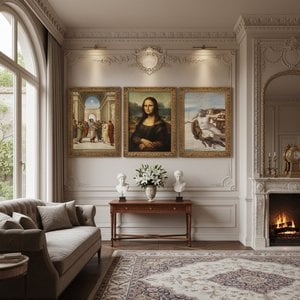
High Renaissance Masterpieces: Iconic Art for Your Home |
Journey through the High Renaissance! Explore 10 iconic masterpieces by Leonardo da Vinci, Michelangelo & Raphael. Discover art history, techniques & find museum-quality reproductions to elevate your home decor on .


