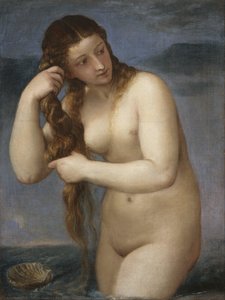
The intersection of science and classical form
To look at the work of Titian Ramsay Peale II is to see a deliberate attempt to reconcile the rigorous demands of 19th-century natural history with the aesthetic weight of the High Renaissance. Born in Philadelphia in 1799, he did not merely inherit a famous name as the son of Charles Willson Peale; he inherited a specific way of seeing. His early years were defined by this dual focus. He was an explorer and a scientific illustrator long before he was purely a painter. During the Stephen Harriman Long expedition to the Rocky Mountains between 1819 and 1820, his task was documentation. He recorded flora and fauna with a precision that required anatomical accuracy. This period of fieldwork provided the technical foundation for his later canvases. He understood how light hit a wing or how texture defined a specimen.
This scientific training prevented his later religious and mythological works from becoming mere abstractions. When he turned to subjects like St. Augustine, he applied the same scrutiny to the folds of a garment as he would to a botanical specimen. He utilized techniques such as sfumato to soften edges, yet the underlying structure remained grounded in physical reality. His work exists in the tension between the observational eye of a naturalist and the stylistic ambitions of Venetian colorism.
A technical bridge between eras
Peale’s development was marked by an refusal to adhere to the purely utilitarian trends of American art in his era. While many contemporaries focused on straightforward portraiture or landscape, he looked backward to the principles of artists like Rubens and the Venetian masters. This is most evident in his handling of color and light. He sought a luminous quality that mirrored the Old World traditions. His religious paintings, such as The Holy Family with a Shepherd, demonstrate a controlled use of oil paint to build depth through layers. He did not rely on superficial beauty; he relied on the structural application of pigment.
His technical repertoire was broad and functional. He worked across several media to achieve his goals:
- Watercolor and graphite for scientific documentation
- Oil on canvas for religious and mythological subjects
- Lithography and ink for illustration
- Photography, which he adopted as an amateur later in life
This versatility allowed him to move between the microscopic detail of a Cicada watercolor and the atmospheric scale of a landscape. He was not interested in style for its own sake, but in how specific techniques could communicate the weight of his subject matter.
The legacy of an overlooked naturalist
For much of the 20th century, Peale’s significance was obscured by the sheer scale of the Peale family's broader impact on American culture. He did not fit the mold of the purely commercial portraitist. His career included roles as a chief naturalist for the United States Exploring Expedition from 1838 to 1842 and work within the United States Patent Office. These were not distractions from his art; they were the source of it. The precision found in his wildlife drawings informed the dignity he brought to his classical subjects.
Today, the value of his work lies in this specific synthesis. He represents a moment when American identity was being formed through the simultaneous exploration of new territories and the reinterpretation of ancient artistic values. His paintings, now held in institutions such as the Uffizi Gallery and the Scottish National Gallery of Modern Art, remain relevant because they refuse to separate the intellect from the aesthetic. He proved that scientific observation and classical reverence could occupy the same canvas.
Questions & Answers
What colors did Titian Ramsay Peale II use most often?
Titian Ramsay Peale II's use of color across the works listed on this website can be studied on the artist's Palette Genome page.
How is Titian Ramsay Peale II's career divided into periods?
A chronological account of Titian Ramsay Peale II's work is available on the artist's Chronicle page, where the artworks pass in order of creation, chapter by chapter.
What moods do Titian Ramsay Peale II's artworks express?
Titian Ramsay Peale II's works can be browsed by mood on the artist's Mood Room page, which arranges the artworks by their recorded moods.