Early Life, Family and Training
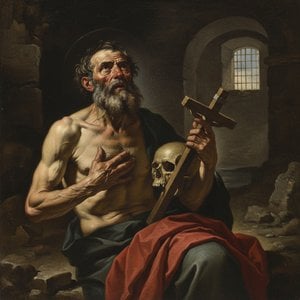
Naples, 1634. Luca Giordano enters a world of pigment and oil as the son of the painter Antonio Giordano. The household is one of craft. By around 1650, the boy moves from his father's immediate circle into the studio of Jusepe de Ribera. This apprenticeship defines his early years. The influence of Ribera is heavy, visible in the dramatic chiaroscuro and the realistic, often stark, portrayal of figures that characterize his first efforts. He absorbs the master's dark manner, a style rooted in the intense shadows of the Neapolitan tradition.
Speed becomes his defining trait. As his hand moves across the canvas with increasing velocity, a nickname takes hold: Luca fa presto. It translates to "Luca paints quickly." This is no mere compliment; it is a recognition of a frantic, productive energy that sets him apart from his contemporaries. He is a whirlwind of execution. While the shadows of his training remain, a sense of movement begins to push against the heavy stillness of his early lessons.
- The St. Luke Painting the Virgin (about 1652)
A Career Across Italy and Spain
Giordano’s movement across the Italian peninsula is a series of rapid shifts. He establishes himself in Rome before moving toward the north. In 1667, he is active in Venice, absorbing the local light and color. His presence in Florence follows, where he undertakes significant decorative projects. The pace of his career is dictated by the demand for his speed; he moves from city to city as commissions arise, never remaining static for long.
The trajectory shifts decisively toward the Iberian Peninsula. In 1692, he arrives in Spain at the invitation of Charles II. His arrival marks a decade of intense activity at the heart of the Spanish court. Appointed as court painter, he tackles massive decorative schemes, including work for the Buen Retiro Palace and El Escorial. He navigates the complexities of the Spanish court, eventually earning the title of caballero from the king. This period of Spanish service lasts until 1702, when the death of Charles II prompts his return to Naples.
- The Apotheosis of the Medici, Palazzo Medici-Riccardi, Florence
- Frescoes for Palazzo Medici Riccardi, 1682–85, Florence
Technique and Artistic Style
The heavy, dark shadows of the early 17th-century Neapolitan tradition begin to recede as Giordano’s hand moves. By the late 1650s, a shift occurs. He moves away from the somber, tenebrist manner of his early training toward a light, airy, and delicately colored style. This transition introduces a new sense of light and glowing colour into his compositions. He replaces deep, murky tones with a luminosity that defines his mature period.
Speed defines his process. Known as Luca fa presto, his ability to execute works with remarkable velocity and versatility allows him to move between oil painting, fresco, and etching with ease. His compositions are never static; they rely on dynamic movement to drive the narrative. This energy, combined with exuberant color, transforms the canvas into a space of constant motion. He does not merely paint a scene; he orchestrates a visual event through rapid, confident brushwork.
Major Commissions and Patrons
The late 17th century in Naples finds its leading painter in Giordano. His reputation for speed and versatility attracts a steady stream of high-level patrons, but his reach extends far beyond the Neapolitan borders. In Florence, between about 1682 and 1685, he undertakes the massive task of decorating the Palazzo Medici Riccardi. He prepares the project through a series of detailed oil studies, creating modelli to map out the complex ceiling frescoes that would eventually transform the space.
The momentum of his career shifts toward the Spanish court when Charles II issues an invitation. Giordano arrives in Spain, beginning a decade-long residency that places him at the center of royal artistic life. His ability to execute large-scale decorative schemes in palaces and churches earns him significant status; the Spanish king eventually grants him the title of caballero. His presence in Madrid and the surrounding territories ensures his influence permeates the Spanish courtly aesthetic.
Notable Works and Masterpieces
The canvas of The Fall of the Rebel Angels, painted around 1666, captures a moment of celestial upheaval. In the upper register, the saintly figure of Michael descends with a sword and red cape, while the lower section descends into a chiaroscuro struggle of defeated demons. This work marks a transition where the dark, heavy shadows of his early training meet a new, lighter Venetian influence. In the Museo de Arte de Ponce, The St. Luke Painting the Virgin offers a glimpse into his formative years, echoing the realistic, somber style of his mentor, Jusepe de Ribera.
Giordano’s ability to handle mythological and religious subjects allowed him to move between the sacred and the profane with ease. The Judgment of Paris presents a display of classical mythology through a dynamic composition. Meanwhile, The Triumph of Galatea in the Hermitage Museum demonstrates his command over large-scale narrative scenes. Even within the halls of The Louvre, his presence is felt through The Marriage of the Virgin, a work that highlights his capacity for managing complex, multi-figure arrangements.
- The Fall of the Rebel Angels (c. 1666)
- The St. Luke Painting the Virgin
- The Marriage of the Virgin
- The Triumph of Galatea
- The Judgment of Paris
Legacy and Artistic Influence
Giordano’s output was immense. With an estimated production of over six hundred paintings, his hand moved through the late Baroque with a speed that earned him the moniker Luca fa presto. This productivity did more than fill galleries; it shaped the trajectory of Neapolitan art. He acted as a bridge between the heavy, dramatic High Baroque and the lighter, more playful Rococo period. His ability to transition between these styles allowed his influence to ripple through the 18th century, affecting developments in Naples and across the Italian peninsula.
The artist’s studio functioned as a training ground for a new generation. He mentored numerous pupils, most notably Paolo de Matteis, who carried these stylistic shifts forward. This lineage ensured that Giordano’s approach to light and movement remained embedded in the Neapolitan school. His presence in the art market was so dominant that he helped define the visual language of the era, influencing a wide generation of painters who sought to balance theatricality with a new sense of luminosity.
Where to See His Works Today
The physical presence of Giordano’s output remains scattered across the major repositories of Europe. In Paris, The Louvre holds a significant concentration of his paintings, with 14 works preserved within its walls. The reach of his hand extends to Saint Petersburg, where the Hermitage Museum maintains a collection of 6 paintings. These works represent the scale of an artist whose productivity once rivaled the most prolific figures in history.
In his native Naples, the Museo di Capodimonte preserves 4 of his paintings, offering a direct link to his Neapolitan roots. The Royal Collection in London also maintains 4 works, while the Palazzo Medici-Riccardi in Florence houses 3. These collections provide the primary sites for observing the evolution of his style, from the dramatic chiaroscuro of his early years to the lighter, more fluid compositions of his maturity.
- The Judgment of Paris (Berlin Museum)
- The Fall of the Rebel Angels (Kunsthistorisches Museum, Vienna)
- The Marriage of the Virgin (The Louvre, Paris)
- The Flight into Egypt (Szépművészeti Múzeum, Budapest)
Questions & Answers
Where can I see the color profile of Luca Giordano's work?
The Palette Genome of Luca Giordano is a page that presents the color profile of the artist's body of work.
Where is Luca Giordano from?
Luca Giordano was born in Italy.
What aliases or alternate names does Luca Giordano have?
Luca Giordano appears under the alternate names Fa Presto, Luca Jordanus, Lucas Jordan, Luca Jordano, Lucca Giordano.