

The Lens of Social Conscience
Lewis Wickes Hine was far more than a mere observer behind a camera; he was a sociologist and a muckraker photographer whose work served as a vital pulse for the American conscience. Born in Oshkosh, Wisconsin, his early life was marked by profound hardship following the accidental death of his father. This personal encounter with struggle forced him to undertake various jobs to support his widowed mother and sisters, an experience that likely forged the deep empathy found in his later documentation of the human condition. Hine did not simply capture images; he acted as a witness to the grit, the struggle, and the profound triumphs that often remained unseen by the casual observer during the Progressive Era and the Great Depression.
His photographic practice was inextricably linked to his sociological mission. Rather than pursuing the staged grandeur of classical portraiture, Hine utilized the camera as a tool for social reform. He possessed a unique ability to move through the arteries of the early twentieth-century American city, capturing the raw, unvarnistic truth of industrial life. His work is perhaps most historically significant for its role in documenting the harsh realities of child labor. Through his lens, the faces of young children working in factories and mines became visual manifestos that were instrumental in triggering the passage of the first child labor laws in the United States.
A Master of Documentary Truth
The technical mastery of Hine’s work lies in its ability to transcend simple documentation to become a powerful meditation on resilience. Whether capturing the heavy atmosphere of an industrial site or the hopeful anticipation of immigrants at Ellis Island, his compositions often utilized a stark black-and-white palette to amplify the somber mood and strip away any potential romanticism. In works such as "Steamfitter," he found a way to depict the dignity and strength within overlooked labor, creating a dialogue between man and machine that resonated with the evolving relationship of the era.
His artistry was characterized by several defining elements:
- The Power of Contrast: Using light and shadow to sculpt figures and define the textures of urban decay or industrial machinery.
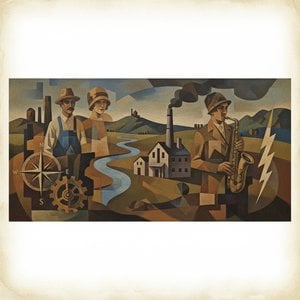
- Social Commentary: Transforming a single moment, such as his "Self-Portrait with Newsboy," into a profound statement on the realities of childhood labor and urban commerce.
- Humanity in Detail: Focusing on the individual—such as the young girl Sadie Pfeiffer in a cotton mill—to turn a news report into an emotional encounter.
Hine’s legacy remains etched in the history of photography as a pioneer of the documentary movement. He proved that the camera could be a weapon for justice, capturing the fleeting and the overlooked to demand that society look closely at its own failings. His work stands as a silent testimony to an era of immense change, preserving the heartbeat of a nation in transition.
Questions & Answers
Can I browse Lewis Wickes Hine's works by color palette?
To find works by Lewis Wickes Hine in a specific palette, use the artist's By Palettes page.
Where can I see Lewis Wickes Hine's artworks in chronological order?
The artist's Artwork Timeline page presents Lewis Wickes Hine's works ordered by date, year by year.
In which historical period did Lewis Wickes Hine work?
Lewis Wickes Hine worked in the Modern period. The period situates the artist's activity in history.





![[self-portrait With Newsboy] — Lewis Wickes Hine](/media/artworks/images-thumb/4b/25/4b254aa0d60e3a85f58cd7f0e967d9ff.jpg)


