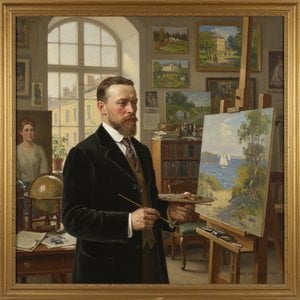
Early Life, Family and Training
Born on 13 October 1873, Jonas Heiska entered a world of farming in Jyväskylän maalaiskunta. His early years were marked by a physical struggle that would ultimately shape his destiny. Frequent and serious illnesses plagued his childhood, eventually leading to the development of a curved spine known as kyphosis. These health challenges kept him from the heavy agricultural labor expected of a son in a farming family, but they provided him with the quiet solitude necessary to discover his innate artistic abilities.
In 1890, his path moved toward formal education when he was sent to study at the Lyceum in Jyväskylä. It was during these formative years that his interests began to branch out beyond the visual arts. While navigating his studies, he learned to play the violin, a skill that would remain a part of his life. For a time, he found himself torn between the pull of music and the calling of the brush, a tension that defined his youthful spirit.
His formal training reached a significant milestone in 1898 when he enrolled at the Academy of Fine Arts in Helsinki. There, he entered the studio of Eero Järnefelt, refining the skills that would eventually establish him as a painter and graphic artist. This period of rigorous study in the capital provided the foundation for the impressionist sensibilities that would characterize his later work.
Artistic Career and Style
A significant turning point arrived when he was chosen to represent Finland at the Exposition Universelle in 1900. This exposure to international currents sparked a deep interest in impressionism and pointillism, which would begin to shape his visual language. His brushwork moved toward capturing the fleeting qualities of light and atmosphere, a direction that defined much of his later output. He became a painter of twilight, often seeking to capture the subtle, shifting moods of the Finnish landscape.
His canvases frequently focused on the landscapes of Central Finland, the quiet scenes of everyday rural life, and the various views of his hometown, Jyväskylä. There was a lyrical quality to his compositions, earning him the reputation of a poet of lonely traces. He possessed a particular talent for rendering the atmosphere of a place, creating works that felt deeply connected to the spirit of the land. Even in his more somber or quiet pieces, a distinctive sense of warm humour would emerge, most notably in his interpretations of the themes found in the classic tale The Seven Brothers.
- Duck Hunters (1934)
- From Cozy Shores (1936)
Professional Activities and Commissions
After finding his footing, Heiska eventually settled in Jyväskylä. There, he established a studio that became a quiet center for local creativity. He did not merely paint in isolation; he shared his knowledge with the next generation, providing drawing lessons to the young Alvar Aalto while the latter was a student at the Lyceum. This period of teaching allowed him to remain deeply connected to the academic and artistic life of the region.
His hand was called upon for matters of national identity as well. In 1918, he was tasked with designing the first flag for the Republic of Karelia. Though his specific design was later replaced in 1920 by a version by Akseli Gallen-Kallela, the commission spoke to his standing within the Finnish artistic community. He moved between these formal responsibilities and the intimate work of a graphic artist, often finding his most expressive voice through illustration.
In 1930, he turned his attention to the literary soul of his country by creating an extensive series of illustrations for the classic Finnish novel Seven Brothers. He approached these works with a warm sense of humor, capturing the spirit of the characters through his unique lens. While the high cost of production meant these deluxe prints were never published as originally intended, they remain a significant part of his creative legacy.
Later Years and Death
The final chapter of Heiska's life saw him continuing his presence in the Finnish art scene until very near the end. In 1936, he held his last exhibition at the Strindberg Gallery in Helsinki, a moment that preceded his passing by only a short time. He died in Jyväskylä on 3 March 1937, leaving behind a legacy that extended into his own household. His daughter, Vappu, followed in his footsteps to become an artist herself, ensuring the family's creative spirit endured through her own work.
The physical space where he lived and worked remains a significant part of the local history. The family home was eventually given to the city of Jyväskylä to serve as a museum. Today, this residence is integrated into the Museum of Central Finland complex, preserving the environment that once nurtured his artistic vision and provided a gathering place for the musicians of his community.
Questions & Answers
Where can I find statistics about Jonas Heiska's works?
Statistics about Jonas Heiska's works are available on the artist's Stats page.
Can I browse Jonas Heiska's works by color palette?
The By Palettes page groups Jonas Heiska's artworks by their color palettes.
Can I browse Jonas Heiska's works by mood?
The Mood Room of Jonas Heiska is a page that arranges the artist's artworks by mood.
Can I explore Jonas Heiska's works by keyword?
To find works by Jonas Heiska on a specific theme, use the artist's By Keywords page, which groups the artworks by keyword.