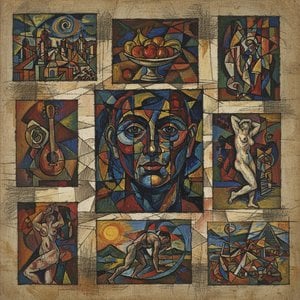
The Life and Artistic Journey of Fritz Faiss
Fritz Wilhelm Faiss was a German-American abstract expressionist artist born in Furtwangen im Schwarzwald, Germany. His early education included studies at the Bauhaus and the Stuttgart Academy of Fine Arts, and he also received training as a medical doctor. During his career in Germany, he was viewed by the government as a degenerate artist, facing harassment from the Gestapo and being forbidden from working. This period included a year spent in a forced labor camp, which left him very sick. Following the war, he returned to his art and teaching before emigrating to the United States in 1951, eventually settling in Pasadena, California.
Technique and Academic Legacy
Faiss became renowned for his use of encaustic painting, a method involving hot wax. His technical expertise extended to many other mediums, including:
His works often explored
biblical, mythological, and mystical themes. Beyond his studio practice, Faiss was a dedicated educator, teaching at UCLA and the Otis Art Institute. He eventually served as a tenured professor of art at California State University, Northridge, where he held the rank of professor emeritus until his retirement in 1973.Questions & Answers
Can I explore Fritz Faiss's works by color spectrum?
The Spectral Index of Fritz Faiss is a page that organizes the artist's artworks by their colors.
Where is Fritz Faiss from?
Fritz Faiss was born in Germany.
How can I follow Fritz Faiss's work year by year?
The artist's Artwork Timeline page presents Fritz Faiss's works ordered by date, year by year.
In which historical period did Fritz Faiss work?
Fritz Faiss worked in the Modern period. The period situates the artist's activity in history.