


 Preview
 Send
Send Share
Share
 Details
 Guide
Guide

 Download
 Similars
 X-Ray
X-Ray Diaporama
 Stats
StatsThe Forth Bridge


 Read More
Hand Made Oil Reproduction
Hand-painted oil on canvas in your size and frame, made to order by our artists. ( Switch to Print Switch to Digital Image)




P118B $10

P118H $10

P118W $10

P438Z $10

P508JH $12

P508YH $12

P805H $10

P805Z $10

P919BZ $10

P919G $10

P919XJ $10

P959ZH $10

P968JZ $12

W106C $8

W218G $10

W218JH $8

W218Y $10

W307PJ $10

W316G $10

W316PJ $8

W316Y $10

W398PJ $8

W4111J $10

W500HY $15

W500JH $15

W692G $12

W849H $8

W940BG $15

W953PJ $8




Pick from our preset sizes that match the artwork's original proportions.

Type the width and the height you need, to fit your frame or your wall. This is hand-painted, so for a size with a different shape the artist can paint a bit more around the picture, or cut a bit — you choose. We send you a digital mockup to approve before the painting starts. The picture shown on this page does not show the real result — only the mockup does.
After order, ArtsDot.com team will email client for instructions and provide a mockup preview
Worldwide Delivery () in 3/4 weeks instead of standard 5 weeks. (26 October). No compromise on quality.

Free Worldwide Express Shipping

High-Quality Linen Canvas

Full Shipping Insurance

Customs Tax Refund Guarantee

True Color Matching Guarantee

100-Day Return Policy (Defects Only)

100% Money-Back Guarantee

Bulk Discount Offer
 Glass option is only available in size under 110 CM

The Forth Bridge
Reproduction Medium
Reproduction Size
-


Total Price
$ 263
The Forth Bridge by John Lavery: A Study in Scottish Impressionism & the Portraiture of a Generation
Sir John Lavery’s “The Forth Bridge” stands as more than just a depiction of an iconic engineering marvel; it embodies the spirit of Edwardian Scotland—a period marked by both grand ambition and profound contemplation. Completed in 1914, amidst the escalating tensions leading up to World War I, this monumental canvas captures not merely the bridge’s physical form but also its atmospheric presence, reflecting Lavery's masterful grasp of Impressionist principles.Subject Matter & Composition: Bridging Tradition and Modernity
The artwork centers around the Forth Bridge itself—a colossal cantilever structure spanning the Firth of Forth between Edinburgh and Fife. Lavery skillfully employs diagonal lines to emphasize the bridge’s dominant position, creating a dynamic tension that draws the viewer's eye across the expansive canvas. Below, the turbulent waters mirror the sky’s muted hues, establishing a harmonious interplay between nature and human endeavor. Foreground elements—a grassy bank dotted with buildings—provide crucial scale, anchoring the scene and grounding it in its immediate surroundings. This deliberate compositional choice speaks to Lavery’s desire to portray not just what is seen but how it feels – a sense of grandeur tempered by the subtle beauty of the Scottish landscape.Style & Technique: Impressionistic Brushstrokes Capture Light and Emotion
Lavery's artistic style firmly aligns with Impressionism, prioritizing capturing fleeting moments of light and color rather than meticulous detail. Visible brushstrokes dominate the surface of the canvas, conveying a palpable sense of movement and atmosphere. The artist skillfully blends pigments to achieve soft tonal gradations, particularly evident in the sky—a wash of blues and greys suggestive of an overcast day. Metallic hues subtly illuminate the bridge’s steel structure, hinting at the brilliance of sunlight reflecting off its intricate lattice work. These techniques are characteristic of Lavery's approach, mirroring Whistler’s influence and establishing him as a pivotal figure in British art during his time.Color Palette & Symbolism: Cool Tones Reflect Tranquility Amidst Uncertainty
The predominant color palette utilizes cool tones—blues and greys—creating an ambiance of serenity despite the looming shadow of war. These hues dominate the water and sky, reflecting Lavery’s sensitivity to mood and emotion. Warmer shades of green and brown are employed for the land in the foreground, providing a visual counterpoint to the coolness of the upper regions. The bridge itself is rendered in muted metallics—primarily greys—accentuated by highlights that capture the play of light on its steel framework. Symbolically, the bridge represents connection – bridging the gap between Edinburgh and Fife, but also perhaps symbolizing the aspirations of Scotland as it navigated the turbulent currents of the early 20th century.Historical Context & Legacy: Lavery's Vision Amidst a Changing Era
Painted in 1914, “The Forth Bridge” encapsulates Lavery’s artistic vision during a period of significant social and political upheaval. The impending outbreak of World War I casts an inescapable pall over the scene, subtly informing its contemplative mood. Yet, Lavery transcends mere documentation; he transforms the bridge into a symbol of resilience—a testament to human ingenuity and perseverance in the face of adversity. His artwork continues to resonate with audiences today, serving as a reminder of Scotland’s artistic heritage and its enduring fascination with grand landscapes and monumental structures. It exemplifies Lavery's ability to convey profound emotion through masterful technique and composition, securing his place among Britain’s most celebrated portraitists and landscape painters.Additional Research: Exploring Lavery's Artistic Influences & Wider Oeuvre
Sir John Lavery (1856-1941) was a painter who effortlessly captured the spirit of his age – an era defined by both opulent Edwardian society and the somber realities of wartime. His journey from humble beginnings to becoming one of Britain’s most sought-after portraitists is a testament to his talent, ambition, and ability to navigate the complex social currents of his time. Orphaned early in life, Lavery found himself transplanted to Scotland, where he received foundational training at Haldane Academy in Glasgow during the 1870s. This initial exposure ignited a passion that would lead him to further studies at the Académie Julian in Paris in the early 1880s, immersing him in the heart of European artistic innovation. Upon his return to Glasgow, Lavery quickly became associated with the influential Glasgow School movement, absorbing its aesthetic principles and forging connections that would shape his early development. He was particularly influenced by Whistler’s ethereal landscapes and tonal harmonies, mirroring these stylistic choices in numerous paintings throughout his prolific career. His work spanned portraiture, landscape painting, and mural commissions, reflecting a diverse artistic sensibility and cementing his reputation as one of Scotland's foremost artists.Questions & Answers
What mood would "The Forth Bridge" bring to a space?
With its calm mood, "The Forth Bridge" is suggested for a living room.
What size and orientation are recommended for a print of "The Forth Bridge" by Sir John Lavery?
A print of "The Forth Bridge" by Sir John Lavery is recommended at a large size in landscape orientation.
Where can I see a preview of "The Forth Bridge"?
To preview a reproduction of "The Forth Bridge" by Sir John Lavery, open the artwork's Preview page.
Related Artworks


Artist Biography
A Life Immersed in Portraiture and Society
Sir John Lavery, born in Belfast in 1856, was a painter who effortlessly captured the spirit of his age – an era defined by both opulent Edwardian society and the somber realities of wartime. His journey from humble beginnings to becoming one of Britain’s most sought-after portraitists is a testament to his talent, ambition, and ability to navigate the complex social currents of his time. Orphaned early in life, Lavery found himself transplanted to Scotland, where he received foundational training at Haldane Academy in Glasgow during the 1870s. This initial exposure ignited a passion that would lead him to further studies at the Académie Julian in Paris in the early 1880s, immersing him in the heart of European artistic innovation.
Upon his return to Glasgow, Lavery quickly became associated with the influential Glasgow School movement, absorbing its aesthetic principles and forging connections that would shape his early development. A pivotal moment arrived in 1888 when he secured a prestigious commission: painting Queen Victoria’s state visit to the Glasgow International Exhibition. This marked a turning point, catapulting him into the orbit of high society and prompting a move to London shortly thereafter. The commission wasn't merely a professional triumph; it signaled Lavery’s arrival as a painter capable of capturing not just likeness but also the grandeur and authority of his subjects.
Influences and Artistic Development
Lavery’s artistic sensibilities were profoundly shaped by several key influences, most notably James McNeill Whistler. He admired Whistler's emphasis on tonal harmony, atmospheric effects, and a refined aesthetic sensibility – qualities that would become hallmarks of Lavery’s own style. The influence is visible in the delicate brushwork and subtle color palettes found throughout his oeuvre. Beyond Whistler, Lavery absorbed lessons from French Impressionism, incorporating elements of its broken color and emphasis on capturing fleeting moments of light. However, he never fully embraced Impressionism's radical departure from traditional form; instead, he synthesized these influences into a uniquely personal style that balanced elegance with modernity.
His early work often featured scenes of everyday life and landscapes, but it was his mastery of portraiture that truly established his reputation. Lavery possessed an exceptional ability to capture the essence of his sitters – their personality, social standing, and inner lives – on canvas. He skillfully blended Impressionistic techniques with a keen eye for detail, creating portraits that were both aesthetically pleasing and psychologically insightful. He wasn’t simply recording appearances; he was interpreting character.
Wartime Depictions and National Recognition
The outbreak of World War I brought a new dimension to Lavery's artistic practice. Like William Orpen, he was appointed an official war artist, tasked with documenting the conflict. However, persistent ill-health and a harrowing car accident – a consequence of a Zeppelin bombing raid – prevented him from serving on the Western Front. Undeterred, Lavery focused his attention on scenes within Britain, capturing the atmosphere of wartime life through depictions of boats, aeroplanes, and airships. These works offer a unique perspective on the war effort, focusing not on the horrors of trench warfare but on the technological advancements and logistical challenges that defined the conflict on the home front.
Following the war, Lavery’s contributions were formally recognized with a knighthood in 1921 and election to the Royal Academy. His life became increasingly intertwined with the social and political elite, particularly the Asquith family. He spent considerable time at their Thames-side residence, creating portraits and idyllic scenes that offered glimpses into their privileged world. He also found himself drawn into the turbulent events surrounding Irish independence, providing his London home as a neutral ground for crucial treaty negotiations.
Legacy and Lasting Impact
Sir John Lavery’s legacy extends beyond his impressive body of work. He was a charismatic figure who moved effortlessly between artistic circles and high society, becoming a symbol of the era's cultural dynamism. His portraits remain highly prized for their elegance, technical skill, and insightful characterizations. Notably, his allegorical figure of Ireland appeared on Irish banknotes from 1928 until 1975 – a testament to his enduring national significance.
Lavery’s artistic style, characterized by its blend of Impressionistic techniques and meticulous detail, continues to inspire artists today. His ability to capture the essence of his subjects, combined with his mastery of light and color, ensures that his work will continue to captivate audiences for generations to come. He was a painter who not only documented his time but also helped define it, leaving an indelible mark on British art history.
Key Characteristics of His Art
- Impressionistic Techniques: Incorporated elements of Impressionism in his work, particularly in his use of light and color.
- Portraiture Expertise: Known for capturing both physical likeness and psychological depth in his portraits.
- Key Themes: Portraits, society scenes, wartime depictions, landscapes.
- Elegant Style: His paintings are often characterized by their elegance, vibrancy, and refined aesthetic sensibility.

Sir John Lavery
1856 - 1941 , Ireland
Quick Facts
- Artistic Movement Or Style: Impressionism, Portraiture
- Artists Who Influenced This Artist: ['James McNeill Whistler']
- Date Of Birth: 1856
- Date Of Death: 1941
- Full Name: Sir John Lavery
- Nationality: Irish
- Notable Artworks:
- Mrs Lavery
- Michael Collins
- Summer on the River
- Place Of Birth: Belfast, Ireland
Related Articles

George Paul Chalmers: Rediscovering the Angus Rembrandt & Scottish Colourist Roots
Explore the captivating world of George Paul Chalmers (1833-1878), a pivotal Scottish painter. Discover his landscapes, portraits & connection to the Aesthetic Movement and Colourists. Learn about this 'Angus Rembrandt's' legacy with ArtsDot.

Cézanne's Masterpieces: 25 Iconic Artworks to Transform Your Space
Journey through 25 iconic artworks by Paul Cézanne – a master of Impressionism and Post-Impressionism. Explore his landscapes, still lifes, and the stories behind these timeless masterpieces. Discover museum-quality reproductions & curated decor at ArtsDot.com.

Sir John Watson Gordon: A Study in Scottish Landscape Painting & Tonal Impressionism
Explore the captivating portraits of Sir John Watson Gordon, a leading Scottish master. Discover his evolution from neoclassical style to atmospheric Tonalism and influence on 19th-century British art. Learn about his iconic sitters & legacy.

Impressionism's Masterpieces: 10 Paintings That Defined a Movement | ArtsDot
Journey through Impressionism's heart with 10 iconic paintings by Monet, Renoir & Degas. Explore light, color & the stories behind these masterpieces. Find museum-quality art reproductions and elevate your home decor on ArtsDot.com.
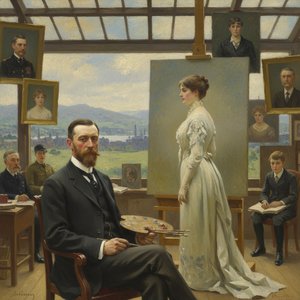
Sir John Lavery: A Study in Scottish Impressionism & the Portraiture of a Generation
Explore the life & art of Sir John Lavery, a master of Scottish Impressionism and renowned portraitist. Discover his captivating works, Irish heritage, and lasting legacy with ArtsDot.


