Early Life, Family and Training
Sir John Lavery was born in inner North Belfast on 20 March 1856. He was the son of Henry Lavery and Margaret Lavery, née Donnelly. His childhood was marked by a sudden and heavy loss when his father, Henry, drowned in April 1859. The accident occurred during the sinking of the packet ship Pomona off the coast of Co. Wexford, Ireland, while the vessel was en route to New York. This tragedy left the young boy to be raised in the wake of such a sudden departure.
His path toward art began in Scotland. During the 1870s, he attended the Haldane Academy in Glasgow, where he first began to develop his technical skills. This training provided the foundation for a life spent observing the world through a lens of light and form. After his time in Glasgow, he moved to London to study at Heatherley's School. This period of study was followed by a move to the heart of European art, where he spent time at the Académie Julian in Paris during the early 1880s. These years of formal instruction in different cities helped shape the way he would eventually approach his subjects.
A Career in Glasgow and London
After his early training, Lavery found himself deeply connected to the artistic energy of Scotland. He became associated with the Glasgow School and the Glasgow Boys, groups that were shaping the direction of art in the region. During this time, he worked as a photographer's assistant, a job that helped him develop a practical understanding of how light interacts with a subject. This period of his life was defined by a growing reputation and a steady connection to the creative circles of Glasgow.
A significant shift occurred in 1888 when he received a major commission to paint Queen Victoria's state visit to the Glasgow International Exhibition. This task changed the course of his professional life. The success of the commission made him a sought-after painter for high society, and he moved to London shortly after. In the capital, his ability to capture the people of the upper classes helped him secure a place among the most prominent artists of the era.
- The Dutch Coffee House, Glasgow International Exhibition (1888)
- Woman Painting a Pot at the Glasgow International Exhibition (1888)
Patrons, Commissions and Notable Subjects
Success in the art world often depends on the people who believe in a painter's vision. For Lavery, this support came from influential figures like William Burrell, a wealthy shipowner who became a faithful patron of Scottish artists. This connection helped sustain his career as he moved through the social circles of London. His ability to capture the likeness of the era's most powerful figures led him to paint men who shaped history, including Winston Churchill, H. H. Asquith, and Lord Derby. He also painted political leaders such as John Redmond and Edward Carson, documenting the faces of a changing political landscape.
His relationship with the Asquith family allowed him to move within their private, privileged world, providing a glimpse into the lives of the political elite. Beyond these public figures, his most constant subject was his wife, Hazel. He painted her in more than 400 works, capturing her presence throughout many years of his life. This deep familiarity with his sitter allowed for a level of intimacy that few other subjects received.
When the First World War broke out, his role shifted from the drawing rooms of the upper class to the official documentation of a nation in conflict. He was appointed an official war artist, a commission that tasked him with recording the realities of the war effort. While his health and a serious accident prevented him from reaching the front lines, he focused his attention on the logistical and technological aspects of the war within Britain.
- The Right Honourable William Kenrick (1907)
- Lady Firth (1910)
- Hazel in black and gold (1911)
- Sir Lionel Henry Cust (1912)
- The Wounded at Dover (1918)
Technique and Artistic Style
Lavery’s brushwork reveals a man deeply attuned to the shifting qualities of light and color. His approach was shaped by the French en plein air movement, a practice that encouraged artists to step out of the studio and face the elements directly. This connection to the natural world allowed him to capture the immediate, fleeting effects of atmosphere. He was particularly influenced by James McNeill Whistler, adopting a sense of tonal harmony that brought a refined, quiet elegance to his compositions. Rather than following a single school of thought, he found a way to weave together the broken color of Impressionism and the structural sensibilities of Post-Impressionism into a style that was entirely his own.
While his technical skill was evident in his landscapes, his true strength lay in his ability to look past a sitter's social standing to find their actual character. He did not merely record a face; he sought to interpret the person within. This psychological depth made him a favorite among the elite, as he could balance a sense of modern life with a meticulous attention to detail. His portraits often feel lived-in, capturing a specific moment of personality rather than a stiff, formal pose. Whether painting a quiet interior or a bustling social scene, he maintained a focus on how light defines the human form and the space around it.
- A Visitor
- Hazel in black and gold
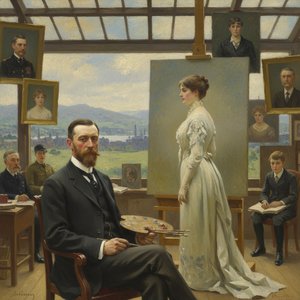
- The Artist's Studio: Lady Lavery with her Daughter Alice and Step-Daughter Eileen
Wartime Depictions and Later Years
The outbreak of the First World War brought a shift in Lavery's focus. He was appointed as an official war artist, tasked with documenting the realities of the conflict. While his health and a serious car accident prevented him from serving on the Western Front, he found ways to record the era's massive logistical and technological shifts. He turned his attention to the home front, capturing the atmosphere of life in Britain during the struggle. His work from this period includes depictions of aeroplanes, airships, and the movement of ships, offering a perspective on the war that focused on the machinery and the people supporting the effort.
His interest in the sea was particularly evident in his naval pictures. He spent time painting the fleet at Scapa Flow, documenting the presence of the navy in those waters. These works provided a record of the naval strength and the quiet, heavy presence of the fleet during such a turbulent time. Even as he navigated the complexities of the Irish War of Independence and the Civil War through his social connections and his home, his brush remained focused on the changing world around him.
In his final years, Lavery lived away from the busy social circles of London. He passed away on 10 January 1941 at Rossenarra House in Kilmoganny, County Kilkenny. He was interred in Putney Vale Cemetery.
Legacy and National Significance
By the time of his death, Lavery had become a central figure in the British art scene. His standing was cemented through formal recognition, including his election to the Royal Academy and a knighthood in 1921. These honors reflected a career that had moved from the studios of Glasgow and Paris to the very heart of London's social and political circles.
His connection to his roots remained a quiet but powerful force throughout his life. This was most visibly seen in his influence on Irish identity; an allegorical figure of Ireland, which he had painted, appeared on Irish banknotes from 1928 until 1975. It is a rare thing for an artist's vision to move from the canvas into the pockets of a nation, becoming a part of the everyday landscape of a country.
His influence can still be traced through the collections that hold his work, from the National Portrait Gallery in London to the galleries in Glasgow and Edinburgh. His ability to document the shifting faces of his era ensures his place in the history of the period.
Where to See the Works Today
Finding his paintings today often means visiting the institutions that helped shape his career. In London, the National Portrait Gallery holds several of his studies and portraits, capturing the faces of the people who moved through his social circles. The Imperial War Museum also preserves his perspective on the conflict, keeping his depictions of the home front and naval scenes within its collections.
His connection to Scotland remains visible through the collections in Glasgow and Edinburgh. The Glasgow Art Gallery and Museum houses many of his early works, including pieces from his time with the Glasgow School. In Edinburgh, the Scottish National Gallery holds works that reflect his technical skill and his ability to handle light. You can also find his paintings in the Birmingham Museum and Art Gallery, which provides a glimpse into the breadth of his output.
- A Quiet Day in the Studio (1883)
- The Dutch Coffee House (1888)
- Lady Lavery (1922)
- Ramsay MacDonald (1931)
Questions & Answers
Where can I see all artworks by John Lavery?
Every work by John Lavery on this website can be browsed from the artist's All Artworks page.
Where can I see John Lavery's artworks in a 3D gallery?
A virtual visit is possible: the 3D Museum page of John Lavery presents the artist's works in a three-dimensional gallery.
Can I browse John Lavery's works by movement?
The All Movements page groups John Lavery's artworks by art movement.