


 Preview
 Send
Send Share
Share
 Details
 Guide
Guide

 Download
 Similars
 X-Ray
X-Ray Diaporama
 Stats
StatsTriumphal Procession of Bacchus
 Oil On Panel
- WallArt
- Northern Renaissance
 1537
1537- Renaissance
 56.0 x 107.0 cm
 Kunsthistorisches Museum
 Read More
Hand Made Oil Reproduction
Hand-painted oil on canvas in your size and frame, made to order by our artists. ( Switch to Print Switch to Digital Image)




P118B $10

P118H $10

P118W $10

P438Z $10

P508JH $12

P508YH $12

P805H $10

P805Z $10

P919BZ $10

P919G $10

P919XJ $10

P959ZH $10

P968JZ $12

W106C $8

W218G $10

W218JH $8

W218Y $10

W307PJ $10

W316G $10

W316PJ $8

W316Y $10

W398PJ $8

W4111J $10

W500HY $15

W500JH $15

W692G $12

W849H $8

W940BG $15

W953PJ $8




Pick from our preset sizes that match the artwork's original proportions.

You may enter your own dimensions to fit a specific frame or space. If your selected size does not match the original image's proportions, we will either crop the artwork or extend the painting with additional hand-painted elements. A digital mockup will be sent for your approval before production begins.
Please note that the on-screen preview does not reflect the actual cropping or extension. Only the mockup will accurately show the final composition.
While custom sizes are available, we recommend selecting a dimension from the predefined list to preserve the original proportions.
After order, ArtsDot.com team will email client for instructions and provide a mockup preview
Worldwide Delivery () in 3/4 weeks instead of standard 5 weeks. (23 September). No compromise on quality.

Free Worldwide Express Shipping

High-Quality Linen Canvas

Full Shipping Insurance

Customs Tax Refund Guarantee

True Color Matching Guarantee

100-Day Return Policy (Defects Only)

100% Money-Back Guarantee

Bulk Discount Offer
 Glass option is only available in size under 110 CM

Triumphal Procession of Bacchus
Reproduction Medium
Reproduction Size
-


Total Price
$ 263
A Divine Revelry in Oil: The Majesty of Heemskerck
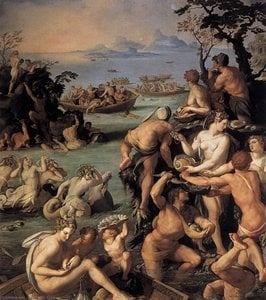
In the grand tapestry of the Northern Renaissance, few works capture the intoxicating blend of classical myth and humanistic fervor quite like Maerten van Heemskerck’s Triumphal Procession of Bacchus. Painted in 1537, this monumental oil on panel serves as a breathtaking window into a world where the boundaries between the earthly and the divine are blurred by celebration. As the eye first meets the canvas, one is immediately swept up in the rhythmic energy of Dionysus’ triumphant return to Athens. The composition is anchored by the central figure of Bacchus, depicted with a regal yet exuberant dignity, perched atop a chariot that seems to surge forward through time itself. It is not merely a depiction of a parade; it is an invitation to witness the very pulse of life, rendered with a precision that commands the attention of any discerning collector or lover of classical antiquity.
The technical mastery displayed by Heemskerck is nothing short of extraordinary, making this piece a cornerstone for those who appreciate the meticulous detail of the Dutch Renaissance style. The artist employs a rich, sophisticated palette dominated by warm, earthy tones—ochre, umber, and sienna—which bathe the entire procession in a golden, nostalgic light. This warmth is contrasted by the incredible textural realism found in every corner of the work. One can almost feel the heavy weight of the draped fabrics, the rugged musculature of the chariot bearers, and the succulent, glistening skin of the grapes held aloft by the god himself. For an interior designer, such a piece offers a profound sense of depth and luxury, providing a focal point that radiates both historical gravity and a vibrant, living energy.
Symbolism and the Spirit of Humanism
Beyond its surface beauty, the painting is a complex intellectual puzzle, reflecting the humanist inquiries of the 16th century. Every element within the procession carries a weight of symbolic meaning intended to resonate with the learned minds of Heemskerck’s era. The grapes and the overflowing cup are not merely festive accessories; they are potent emblems of fertility, abundance, and the divine indulgence that characterizes the Bacchanalian myth. As Bacchus moves through a landscape punctuated by Romanesque architectural flourishes, the viewer is reminded of the Renaissance obsession with reclaiming the glory of the classical past. This tension between pagan mythology and the burgeoning Christian sensibilities of the North creates a fascinating psychological depth, making the artwork much more than a simple mythological scene.
The emotional impact of the work lies in its ability to evoke a sense of movement and communal joy. The surrounding figures—satyrs, nymphs, and attendants—create a swirling, dynamic atmosphere that prevents the eye from resting too long on any single point, instead encouraging a continuous journey through the narrative. This sense of motion is balanced by the stability of the architectural backdrop, which provides a structured stage for the chaos of the revelry. For those seeking to adorn a space with art that inspires conversation and emotional resonance, this reproduction offers an unparalleled opportunity to bring the grandeur of the Kunsthistorisches Museum into a private collection, offering a timeless connection to the triumphs of human creativity and the eternal allure of myth.
Related Artworks




Artist Biography
early life and training
maerten van heemskerck, a prominent dutch portrait and religious painter, was born on june 1, 1498, in the village of heemskerk, north holland. his artistic journey began under the guidance of cornelius willemsz in haarlem, followed by a brief stint in delft with jan lucasz. eventually, he became a pupil of jan van scorel, adopting his teacher's italian-influenced style.career highlights
- maerten van heemskerck's work is characterized by its innovative blend of dutch and italian influences, as seen in his famous family portrait, considered the first of its kind in a long line of dutch family paintings.
- his collaboration with antonio da sangallo the younger, battista franco, and francesco de' rossi (il salviati) on the redecoration of the porta san sebastiano in rome, a triumphal arch in honor of charles v, showcases his rapid execution as a scene-painter.
- heemskerck's drawings of classical sculpture and architecture, now preserved in two sketchbooks at the kupferstichkabinett berlin, demonstrate his skill in capturing the essence of italian art.
notable works and legacy
- the donor and saint mary magdalene (view at ArtsDot)
- the virgin and saint john the evangelist (view at ArtsDot)
- samson shattering the pillars of the temple, maarten van heemskerck (view at ArtsDot)
conclusion
maerten van heemskerck's profound impact on the art world is undeniable. his works, now a part of various museum collections, including the rijksmuseum, continue to inspire artists and art enthusiasts alike. to explore more of his masterpieces, visit maerten van heemskerck's page on ArtsDot. for a deeper understanding of his life and works, refer to his biography on wikipedia.
maerten van heemskerck
1498 - 1574
Quick Facts
- Artistic Movement Or Style: Mannerism
- Artists Who Influenced This Artist:
- Jan van Scorel
- Antonio da Sangallo the Younger
- Date Of Birth: June 1, 1498
- Date Of Death: October 1, 1574
- Full Name: Maerten Jacobsz van Heemskerck
- Nationality: Dutch
- Notable Artworks:
- Lamentation on the Dead Christ
- Pieter Jan Foppeszoon and his Family
- Christ as the Man of Sorrows
- Place Of Birth: Heemskerk, Netherlands
Related Articles

Jan van Goyen: Master of Dutch Landscape & Atmospheric Perspective
Discover Jan van Goyen, the master of Dutch landscape painting. Explore his subtle technique, atmospheric realism & lasting influence on art history. Learn about this 17th-century pioneer at ArtsDot.

Adriaen van Ostade: A Master of Dutch Genre Painting & Social Commentary
Explore the life & work of Adriaen van Ostade, a leading Dutch Golden Age painter. Discover his realistic genre scenes, social commentary, and lasting influence on art history. Learn more at ArtsDot.

Rembrandt's Masterpieces: Explore 25 Iconic Paintings & Prints | ArtsDot
Journey through Rembrandt van Rijn's 25 most iconic paintings & etchings. Explore Dutch Golden Age masterpieces, dramatic chiaroscuro, and timeless portraits. Find museum-quality art reproductions to elevate your home decor on ArtsDot.com.

Maerten van Heemskerck: Bridging Mannerism & Renaissance Ideals
Explore the captivating world of Maerten van Heemskerck, a pivotal Dutch Renaissance painter bridging Mannerism & Italian influence. Discover his masterpieces and legacy with ArtsDot.
Cornelis van Poelenburch: Bridging Mannerism & the Dutch Baroque Landscape
Discover Cornelis van Poelenburch, a pivotal Dutch Baroque landscape painter bridging Mannerism & Italianate styles. Explore his life, key works, and lasting influence on 17th-century art with ArtsDot.


