

 Preview
 Send
Send Share
Share
 Details
 Guide
Guide

 Download
 Similars
 X-Ray
X-Ray Diaporama
 Q&A
Q&A Stats
StatsLes mendiants


 Read More
Giclée / Art Print
Museum-quality giclée or canvas print with fast production and flexible finish options. ( Buy Hand Made Painting Switch to Digital Image)




P118B $10

P118H $10

P118W $10

P438Z $10

P508JH $12

P508YH $12

P805H $10

P805Z $10

P919BZ $10

P919G $10

P919XJ $10

P959ZH $10

P968JZ $12

W106C $8

W218G $10

W218JH $8

W218Y $10

W307PJ $10

W316G $10

W316PJ $8

W316Y $10

W398PJ $8

W4111J $10

W500HY $15

W500JH $15

W692G $12

W849H $8

W940BG $15

W953PJ $8




Pick from our preset sizes that match the artwork's original proportions.

Type the width and the height you need, to fit your frame or your wall. A print can only be cut, never made bigger than the picture, so a size with a different shape loses a part of the image. We send you a digital mockup to approve before we print anything. The picture shown on this page does not show the real cut — only the mockup does.
Worldwide Delivery () in 2 weeks instead of standard 4/5 weeks. (10 November)

Free Worldwide Express Shipping

High-Quality Linen Canvas

Full Shipping Insurance

Customs Tax Refund Guarantee

True Color Matching Guarantee

100-Day Return Policy (Defects Only)

100% Money-Back Guarantee

Bulk Discount Offer
 Glass option is only available in size under 110 CM

Les mendiants
Giclée / Art Print
Reproduction Size
-


Total Price
$ 63
A Window into 17th-Century France: The Stark Realism of *Les Mendiants*
Sébastien Bourdon’s *Les Mendiants*, painted around 1645, isn't merely a depiction of beggars; it’s a meticulously crafted tableau that plunges the viewer directly into the heart of 17th-century France – a nation grappling with poverty, social injustice, and the lingering scars of war. This genre painting, housed within the hallowed halls of the Louvre Museum in Paris, transcends simple observation to become a poignant commentary on humanity’s vulnerability and the complexities of charity. Bourdon, deeply influenced by the artistic currents flowing from Rome – particularly the dramatic lighting and emotive storytelling championed by Caravaggio – masterfully utilizes composition, color, and line to evoke a powerful sense of empathy and social critique.
The scene unfolds within the ruins of an ancient structure, a deliberate choice that immediately establishes a mood of decay and transience. A group of mendicants—men, women, and children – are rendered with remarkable realism, their faces etched with hardship and desperation. They’re not idealized figures; Bourdon presents them as individuals, each bearing the marks of poverty and suffering. A subtle yet crucial element is introduced by a wheelbarrow positioned strategically in the foreground, hinting at labor, perhaps scavenging for scraps or transporting meager possessions – a visual representation of their struggle for survival. The composition itself is carefully balanced, drawing the eye towards the central archway that frames the crumbling backdrop, creating a sense of immediacy and inviting the viewer to contemplate the scene’s gravity.
The Language of Light and Shadow: Bourdon's Baroque Technique
Bourdon’s technical prowess is immediately apparent in his masterful manipulation of light and shadow. The painting is dominated by a diffused, natural light emanating from the left side, casting soft shadows that sculpt the figures and highlight certain areas of the ruins. This chiaroscuro effect – a hallmark of Baroque art – not only adds depth and volume but also intensifies the emotional impact of the scene. The muted earth tones—browns, grays, and creams—are skillfully blended to create a sense of atmospheric perspective, with distant elements appearing paler and less distinct. The brushstrokes are relatively smooth, contributing to a realistic representation of textures – from the rough fabrics of the beggars’ clothing to the weathered surfaces of the stone.
- Oil on Canvas: Bourdon's choice of medium—oil paint on canvas—allowed for rich color saturation and subtle gradations in tone, essential for achieving the painting’s nuanced realism.
- Linear Perspective: The use of linear perspective creates a convincing illusion of depth, drawing the viewer into the scene and emphasizing the vastness of the ruined landscape.
- Atmospheric Perspective: The subtle blurring of distant elements reinforces the sense of spatial recession and adds to the painting’s overall atmosphere.
Symbolism and Social Commentary
Beyond its technical brilliance, *Les Mendiants* is laden with symbolic meaning. The ruins themselves represent decay, loss, and the passage of time – a potent metaphor for the fragility of human existence. The mendicants, as figures soliciting alms, evoke feelings of pity, compassion, and social concern. Their presence serves as a stark reminder of the inequalities inherent in society and the responsibility of the wealthy to care for the less fortunate. The inclusion of the wheelbarrow subtly suggests the cycle of poverty and the constant struggle for survival. The painting’s overall mood is somber but not overtly tragic; it invites reflection rather than despair, prompting viewers to consider their own role in addressing social injustice.
A Legacy of Dramatic Realism
Bourdon's *Les Mendiants* stands as a pivotal work within the tradition of 17th-century Dutch genre painting and a significant precursor to later artistic movements. Its influence can be seen in works by Francisco Goya, who was known to have owned a copy of this painting. The scene’s stark realism, coupled with its powerful emotional resonance, cemented Bourdon's reputation as one of the most accomplished artists of his time – an artist capable of capturing not only the outward appearance of reality but also the underlying complexities of human experience.
Questions & Answers
How strong is the contrast in "Les mendiants" by Sébastien Bourdon?
"Les mendiants" by Sébastien Bourdon shows a bold contrast between its light and dark areas.
Which artist is "Les mendiants" attributed to?
"Les mendiants" was created by Sébastien Bourdon. The information on this page describes Sébastien Bourdon's original work.
How strong are the colors of "Les mendiants"?
"Les mendiants" by Sébastien Bourdon is recorded with a muted saturation and a monochromatic intensity.
Related Artworks


Artist Biography
A Master of Light and Versatility: The Life of Sébastien Bourdon
Sébastien Bourdon (1616–1671) remains one of the most captivating and multifaceted figures of the seventeenth-century French Baroque. Born in Montpellier into a family of Protestant artists, his early life was shaped by the vibrant, yet often turbulent, artistic traditions of southern France. His journey from a young apprentice to a foundational member of the Académie Royale de Peinture et de Sculpture is a testament to a profound, restless intellect and an unparalleled ability to absorb the stylistic currents of Europe. After early training in Paris, Bourdon’s path led him through Bordeaux and Toulouse before reaching the spiritual and artistic heart of the continent: Rome. It was in Italy that his talent truly ignited, as he immersed himself in the works of masters like Caravaggio, Nicolas Poussin, and Claude Lorrain. This period of intense study allowed him to develop a unique visual language—one that could pivot from the gritty, dramatic realism of the Caravaggisti to the luminous, classical elegance of the Venetian school.The Evolution of Style and Technique
What truly distinguishes Bourdon’s oeuvre is its remarkable stylistic fluidity, a quality that sometimes drew both admiration and criticism from his contemporaries. His development was marked by a series of transformative encounters with different European traditions. Following a pivotal visit to Venice, his palette underwent a profound metamorphosis; the starker contrasts of his early training gave way to a richer, more atmospheric use of color inspired by the Venetian masters. This evolution allowed him to masterfully navigate between disparate genres. In his portraiture, he often adopted a Rubensian approach or favored intimate, bust-length compositions that captured the psychological depth and elegance of his subjects, such as the Swedish noblewoman in Countess Ebba Sparre. Conversely, his religious works utilized a dramatic chiaroscuro to evoke spiritual awe, most notably in his monumental masterpiece, The Crucifixion of St. Peter, created for the cathedral of Notre Dame.Legacy and Historical Significance
Beyond his individual canvases, Bourdon played a crucial role in the institutionalization of French art. As a co-founder of the Royal Academy in 1648, he helped establish the standards of excellence that would define French painting for generations. His career was also characterized by an extraordinary breadth of service; his reputation as a premier portraitist led him to the court of Queen Christina of Sweden, where he served as court painter, bringing the sophisticated aesthetics of Paris and Rome to Stockholm. Whether depicting the harrowing tension of Moses and the Brazen Serpent or the serene grandeur of classical landscapes, Bourdon’s work embodies the dual spirit of the Baroque era: the intense emotional drama of the human condition and the balanced, intellectual pursuit of classical beauty. His ability to synthesize the naturalist traditions of France with the monumental styles of Italy ensures his enduring place in the pantheon of European art history.
Sébastien Bourdon
1616 - 1671 , France
Quick Facts
- Full Name: Sébastien Bourdon
- Nationality: French
- Date Of Birth: 1616
- Date Of Death: 1671
- Place Of Birth: Montpellier, France
- Notable Artworks:
- The Crucifixion of St. Peter
- The Deposition
- Artistic Movement Or Style: Baroque
- Artists Who Influenced This Artist:
- Nicolas Poussin
- Claude Lorrain
- Caravaggio
- Artists Or Movements Influenced By This Artist: ['French Baroque Art']
Related Articles

Genre Painting: A Window into Daily Life & Societal Values of the Dutch Golden Age
Explore the captivating world of Dutch Golden Age genre painting! Discover realistic depictions of daily life, masterful artists like Ostade & Metsu, and hidden symbolism. Learn about this influential art movement with ArtsDot.

Dutch Baroque Masters: 10 Paintings That Shaped an Era | ArtsDot
Journey through the Golden Age with our guide to the Top 10 Dutch Baroque masterpieces! Explore iconic paintings by Rembrandt, Vermeer & Frans Hals. Find museum-quality art reproductions and elevate your home decor at ArtsDot.com.

Illuminating Innovation: Exploring the Dutch Golden Age of Painting
Explore the Dutch Golden Age of painting with ArtsDot. Discover Rembrandt, Vermeer & other Masters. Learn about key characteristics, iconic artworks, and lasting influence. Expert insights for collectors & enthusiasts.
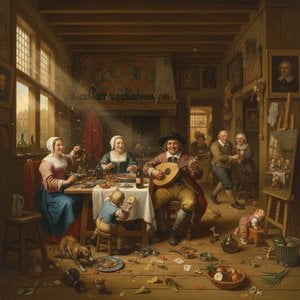
Jan Steen: A Master of Dutch Genre Painting & the Golden Age
Explore the life & art of Jan Steen, a leading Dutch Golden Age painter renowned for his humorous genre scenes & insightful social commentary. Discover his techniques, legacy, and collecting tips.

Golden Age Reflections: Dutch Baroque Painting & Cultural Innovation
Explore the Dutch Golden Age of painting! Discover key artists like Vermeer & ter Borch, their innovative techniques, and the rich cultural context behind these Baroque masterpieces. Learn about collecting & appreciating this iconic art period.


