A Life Cut Short: The Turbulent World of Adriaen Brouwer
Adriaen Brouwer, a name resonating with the vibrant energy of 17th-century Flemish and Dutch painting, remains an enigmatic figure despite his profound impact on genre art. Born in Oudenaarde, Belgium, around 1605 or 1606 – the exact year is debated – Brouwer’s life was tragically brief, ending before he reached forty in January of 1638. His father, also named Adriaen, worked as a tapestry designer, exposing the young artist to visual composition and design from an early age. However, hardship struck when Brouwer was just fifteen; his father's death forced him to leave home, embarking on a path marked by both artistic brilliance and personal turmoil. This early independence undoubtedly shaped his rebellious spirit and fueled his keen observation of life’s undercurrents, themes that would become central to his oeuvre.Pioneering Genre: Capturing the Essence of Everyday Life
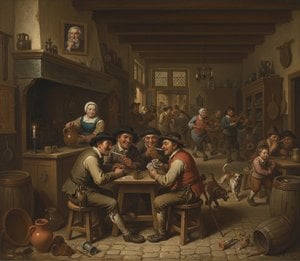
Brouwer swiftly established himself as a key innovator in genre painting – an artistic movement dedicated to depicting scenes from ordinary life. He didn't idealize or romanticize; instead, he presented raw, unvarnished glimpses into the world of peasants, soldiers, and common folk. Taverns became his favored stage, bustling with figures engaged in drinking, smoking, playing cards, brawling, and simply existing within the confines of their daily routines. Works like Poor Folk Drinking in a Tavern, Smallholders Playing Cards, and The Brawl are not merely depictions of activity; they are psychological studies, revealing character through gesture, expression, and the subtle interplay of light and shadow. He possessed an exceptional ability to capture fleeting moments of human interaction, imbuing his scenes with a sense of immediacy and authenticity that resonated deeply with contemporary audiences. The Smokers, for example, is believed to include a self-portrait within the lively group, showcasing Brouwer’s own participation in the boisterous social life he so often portrayed. His paintings weren't simply about *what* people did, but *how* they felt while doing it.Influences and Artistic Style: A Blend of Tradition and Innovation
Brouwer’s artistic development was shaped by a fascinating confluence of influences. He deeply admired the meticulous realism of the Flemish Primitives – artists like Jan van Eyck and Robert Campin – evident in his attention to detail and precise rendering of textures. However, he wasn't content with mere imitation. Brouwer embraced the dramatic lighting and emotional intensity characteristic of Baroque art, injecting a dynamic energy into his compositions. His style is characterized by a masterful blend of realism and humor, coupled with a remarkably lively observation of human behavior. He didn’t shy away from depicting the less savory aspects of life, but he did so with empathy and understanding, avoiding moral judgment. This unique approach set him apart from many of his contemporaries and paved the way for future generations of genre painters.Legacy and Historical Significance: A Lasting Impact
Despite his short career, Adriaen Brouwer’s influence on subsequent artists was substantial. He helped elevate genre painting to a position of prominence within the art world, demonstrating its potential for both artistic expression and social commentary. David Teniers the Younger, along with other Flemish and Dutch painters, drew significant inspiration from Brouwer's innovative approach to depicting everyday life. His focus on ordinary people offered valuable insights into the social customs and daily routines of 17th-century Flanders and the Dutch Republic, providing a window into a world often overlooked by more traditional forms of art. Today, his works are held in esteemed museums such as the Koninklijk Museum voor Schone Kunsten in Antwerp, Belgium, ensuring that his legacy continues to inspire and captivate audiences for generations to come. He remains a testament to the power of observation, the beauty of imperfection, and the enduring appeal of capturing life’s raw, unfiltered moments on canvas.Questions & Answers
Which artworks by Adriaen Brouwer are the most viewed?
The Stats page of Adriaen Brouwer presents statistics computed from the artist's artworks listed on this website.
Is there a 3D virtual tour of Adriaen Brouwer's works?
A virtual visit is possible: the 3D Museum page of Adriaen Brouwer presents the artist's works in a three-dimensional gallery.
What are the birth city and country of Adriaen Brouwer?
Adriaen Brouwer was born in Oudenaarde, in Belgium.