

- 39.0 x 56.0 cm


The picture follows your choices: , .
Collectible Description
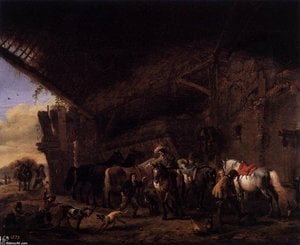
Experience the serene beauty of Philips Wouwerman's Dune Landscape (1645), a masterful depiction of Dutch Golden Age nature and maritime life housed at Vienna’s Kunsthistorisches Museum.
 Read More
Artist Biography
Explore the dynamic world of Philips Wouwerman (1619-1668), a Dutch Golden Age master! Discover his captivating hunting, landscape & battle scenes featuring skilled depictions of horses.
Hand Made Oil Reproduction
Hand-painted oil on canvas in your size and frame, made to order by our artists. ( Switch to Print Switch to Digital Image)
More about this painting
 Preview
 Send
Send Share
Share
 Details
 Guide
Guide

 Download
 Similars
 X-Ray
X-Ray Diaporama
 Q&A
Q&A Stats
StatsOrder your painting in four simple steps
Take your time. You can change any answer; the price in your order card follows each choice.
1 Step one of four
Which size would you like?
These sizes keep the proportions of the original painting. The drawing shows your choice on a wall, above a two-metre sofa.
Or give your own measurements
Pick from our preset sizes that match the artwork's original proportions.

Type the width and the height you need, to fit your frame or your wall. This is hand-painted, so for a size with a different shape the artist can paint a bit more around the picture, or cut a bit — you choose. We send you a digital mockup to approve before the painting starts. The picture shown on this page does not show the real result — only the mockup does.
2 Step two of four
How should it be prepared: rolled, stretched or framed?
The prices below are for the size you chose in step one.
Choose the edges of the stretched canvas
Choose your frame

White $1

Blurside $1

Extended $1

P118B $10

P118H $10

P118W $10

P438Z $10

P508JH $12

P508YH $12

P805H $10

P805Z $10

P919BZ $10

P919G $10

P919XJ $10

P959ZH $10

P968JZ $12

W106C $8

W218G $10

W218JH $8

W218Y $10

W307PJ $10

W316G $10

W316PJ $8

W316Y $10

W398PJ $8

W4111J $10

W500HY $15

W500JH $15

W692G $12

W849H $8

W940BG $15

W953PJ $8

H24-GOLD $30

H24-SILVER $30

H36-GOLD $45

H36-SILVER $45
Framed
Moulding: . Overall size with the frame: .
3 Step three of four
Would you like anything changed in the painting?
Most people answer no. Because each painting is made by hand, our artist can also adapt it for you.
After order, ArtsDot.com team will email client for instructions and provide a mockup preview
4 Step four of four
A few finishing options
All of them are optional. The answers already selected cost nothing extra.
Who paints it?
Worldwide Delivery () in 3/4 weeks instead of standard 5 weeks. (3 November). No compromise on quality.
A nameplate, as in a museum?
Engraved Bronze Plaque Details
This elegant plaque features the artist's name and the title of the artwork, finely engraved for a timeless presentation.
It is made from bronze with a refined, elegant finish. The text is precisely laser-engraved for a sharp and permanent result. Measuring 9x2 cm, the plaque is compact yet easy to read. It's built to be durable and scratch-resistant, offering a professional, museum-quality look. Mounting is simple thanks to the included adhesive backing.
Transparent Acrylic Plaque Details
The plaque includes essential engraved details such as the artist's name, the title of the artwork, the date it was created, the type of media used-like oil on canvas or watercolor-a brief description of the piece, and a QR code that links to the complete artwork information.
It is crafted from clear acrylic, offering a sleek, modern appearance. The text is UV-engraved in black to ensure strong visual contrast. With a size of 10x15 cm, it ensures optimal readability. It comes equipped with two metal hooks for secure wall mounting. The plaque is designed to be weather-resistant, making it suitable for various environments, and it includes interactive features that work seamlessly with smartphone scanning.
Black Acrylic Plaque Details
This elegant plaque includes engraved information such as the artist's name, the title of the artwork, the date it was created, the type of media used (like oil on canvas or watercolor), a short description of the artwork, and a QR code for quick access to more information.
The plaque itself is made from refined black acrylic with a premium finish. The text is laser-engraved in white for high contrast and readability. Its size is 10x15 cm, designed to be easy to read. It comes with two metal hooks for professional mounting. The design is sleek and fits any interior style. It is also weather-resistant and durable, with built-in digital integration for mobile compatibility.
A protective varnish?
When do you need it?
✓ Check and order
Your painting, as you ordered it

Dune Landscape
Reproduction Medium
Reproduction Size
-

Elite Senior Artist
More detail, finesse, and extra production time
-

Reproduction Frame
-
-
For artworks or reproductions larger than 105 cm (approximately 41 inches) on any side, the frame will be shipped as a kit, disassembled. This method ensures safe delivery and prevents damage during transport.
Professional assembly required - this is not a DIY product.
The kit must be assembled and the canvas stretched by an experienced professional framer, using wood glue (not supplied), a canvas stretching plier and clamps to hold the bars square while the glue dries. Incorrect assembly or uneven canvas tension can permanently damage the artwork and is not covered by our warranty.
 For artworks or reproductions larger than 105 cm (approximately 41 inches) on any side, the frame will be shipped as a kit, disassembled. This method ensures safe delivery and prevents damage during transport.
All solid wood bars are included, precisely cut to size.
Assembled with the screws provided, plus wood glue for the corner joints, which is not supplied and must be sourced by your framer.
Professional tools are required and not included: a canvas stretching plier (tensioner) and clamps to hold the bars square while the glue dries.
Important:
The corner joints require wood glue, the bars must be held with clamps until the glue is fully dry, and tightening the canvas on the assembled frame requires a canvas stretching plier. None of these are included in the kit. Please arrange an experienced professional framer before ordering this size.

Nameplate
-
-

Protective Varnish
Glossy Varnish (enhances colors, protects against light/moisture)
-

Customize My Artwork
Examples of what can be changed: Replace face with customer photo; Add pet (e.g., replace cat with dog); Include hidden message in background; Change background landscape or elements.
-

Urgent
Worldwide Delivery () in 3/4 weeks instead of standard 5 weeks. (3 November). No compromise on quality.
-
Express Shipping
Worldwide Delivery () in 5 weeks. (10 November).
Included
Total Price
$ 263
Glass option is only available in size under 110 CM
Included with every order
- Free Worldwide Express Shipping
- High-Quality Linen Canvas
- Full Shipping Insurance
- Customs Tax Refund Guarantee
- True Color Matching Guarantee
- 100-Day Return Policy (Defects Only)
- 100% Money-Back Guarantee
- Bulk Discount Offer


A Serene Vista of Dutch Tradition: Exploring Philips Wouwerman’s Dune Landscape
Philips Wouwerman (baptized May 24, 1619 – died May 19, 1668) was a prolific and remarkably adaptable Dutch painter who cemented his place as one of the most celebrated artists of the Dutch Golden Age. Unlike many contemporaries focused on portraiture—though he produced several notable portraits—Wouwerman dedicated himself primarily to capturing the dynamism of the natural world and the visceral thrill of hunting expeditions, establishing him as a pioneer in landscape painting and a master storyteller through visual representation. His Dune Landscape, completed in 1645, exemplifies his distinctive approach and offers a window into the artistic sensibilities of his era.The Painter’s Vision: Style and Technique
Wouwerman's style is characterized by an unparalleled realism combined with expressive brushwork that imbues his canvases with palpable energy. He eschewed idealized depictions favored by some artists, opting instead for meticulous observation and detailed rendering—a hallmark of the *luminist* movement gaining traction during this period. The Dune Landscape showcases this commitment to accuracy; every ripple in the water’s surface, every grain of sand on the dune, is rendered with painstaking detail. His technique involved layering thin glazes of oil paint over a preparatory underpainting, allowing for subtle gradations of color and creating an illusion of depth that transcends mere representation. This masterful manipulation of light—particularly its reflection off the water—is arguably Wouwerman’s greatest achievement, transporting viewers into the very heart of the scene.A Snapshot of Seventeenth-Century Life
The painting depicts a coastal dune landscape populated by figures engaged in leisurely pursuits – men observing the sea and contemplating the beauty of their surroundings. This wasn't merely an aesthetic exercise; it reflected the broader cultural preoccupation with humanist ideals prevalent during the Dutch Golden Age. The inclusion of boats adds another layer of significance, symbolizing trade routes and the economic prosperity that fueled this artistic flourishing. Furthermore, Wouwerman’s depiction captures a moment of quiet contemplation amidst activity, suggesting a harmonious relationship between humanity and nature—a sentiment deeply rooted in Calvinist theology which emphasized God's dominion over creation.Symbolism Within the Frame
Beyond its visual splendor, Dune Landscape carries symbolic weight. The dune itself represents stability and permanence against the backdrop of turbulent seas, mirroring the philosophical debates surrounding predestination and free will that dominated intellectual discourse at the time. The figures on the dune are not simply observers; they embody human intellect and moral contemplation—a deliberate choice by Wouwerman to elevate the subject matter beyond mere visual pleasure. The artist’s careful composition directs the viewer's gaze outwards, encouraging reflection on the grandeur of God’s creation and humanity’s role within it.Legacy and Emotional Resonance
Philips Wouwerman’s Dune Landscape continues to resonate with audiences today because it transcends its historical context. Its luminous palette, masterful brushwork, and evocative depiction of a tranquil seascape evoke feelings of serenity and wonder—qualities that endure across centuries. It stands as a testament to the power of art to capture not only what is seen but also what is felt, cementing Wouwerman’s reputation as one of the most emotionally compelling painters of his generation. Its current residence at the Kunsthistorisches Museum in Vienna ensures its preservation for future generations to appreciate this enduring masterpiece.Questions & Answers
How do I download the image of "Dune Landscape" by Philips Wouwerman?
The image of "Dune Landscape" by Philips Wouwerman can be downloaded from the artwork's Download page: a high-resolution digital image download.
How does "Dune Landscape" fit into Philips Wouwerman's themes and style?
"Dune Landscape" shares with Philips Wouwerman's other works its Dutch Golden Age style and the recorded themes: dutch tradition, baroque style, hunting imagery, tranquility landscape, genre painting.
What mood does "Dune Landscape" by Philips Wouwerman express within Dutch Golden Age?
The tranquil emotion of "Dune Landscape" accompanies its Dutch Golden Age style.
Related Artworks


Philips Wouwerman
1619 - 1668, Netherlands
Artist Biography
Philips Wouwerman: A Life in the Dutch Golden Age
- Born: Haarlem, Netherlands (1619)
- Died: 1668
Philips Wouwerman (baptized May 24, 1619 – died May 19, 1668) was a highly prolific and versatile Dutch painter renowned for his depictions of hunting scenes, landscapes, and battle scenes. He stands as a significant figure within the artistic landscape of the Dutch Golden Age.
Early Life and Training
Born in Haarlem, Netherlands, Philips Wouwerman was the son of Pouwels Joostsz Wouwerman, also a painter, though less known than his son. Details regarding his early artistic training are somewhat scarce. However, it is believed that he studied under Frans Hals (1581/85–1666), a prominent Haarlem portraitist. While Hals’s distinctive style did not heavily influence Wouwerman's mature work, the foundational training likely proved invaluable. Early in his career, Wouwerman was influenced by the *bamboccianti* tradition, particularly the works of Pieter van Laer (1592/99–after 1642), adopting their focus on everyday life and genre scenes.
Artistic Development and Style
- Early Influences: Initially emulating *bamboccianti* painters, Wouwerman’s early works featured depictions of daily life.
- Emerging Style (Mid-1640s): A characteristic compositional element emerged – a diagonal slope of land often accompanied by a tree acting as a repoussoir (a device used to create depth). Figures, frequently accompanied by horses, populated these scenes.
- Mature Period (c. 1650-1660): Wouwerman developed his individual style, expanding his subject matter considerably. He painted genre scenes, landscapes with travelers, cavalry battles, military encampments, and festive gatherings of peasants.
- Mastery of the Horse: Wouwerman is particularly celebrated for his exceptional skill in depicting horses of various breeds in dynamic motion. Art historian Frederik J. Duparc has famously called him "undoubtedly the most accomplished and successful 17th-century Dutch painter of horses."
- Characteristic Features: His paintings are characterized by subdued colors, a cool atmosphere, and meticulous attention to detail, creating witty and anecdotal narratives within his scenes. He often combined imaginary southern landscapes with a distinctly Dutch ambiance.
Major Achievements and Legacy
Wouwerman’s works were highly sought after during his lifetime and continued to gain popularity in the 18th century. His paintings found their way into prominent collections across Europe, including those of princely houses in Dresden and St. Petersburg, demonstrating widespread admiration for his artistry.
- Prolific Output: Wouwerman was remarkably prolific; early catalogues listed around 800 works attributed to him, later exceeding 1200. A more recent catalogue raisonné (Schumacher, 2006) identifies approximately 570 authentic works, acknowledging the numerous followers and imitators who produced works in his style.
- Family of Artists: His brothers, Jan (1629–1666) and Pieter (1623–1682), were also painters, often initially attributed to Philips. While Pieter’s work clearly reflected Philips' influence, he developed a distinct style. Jan was recognized as a more autonomous landscape painter.
- Influence on Later Artists: Wouwerman’s style influenced numerous artists, including Jan van Huchtenburgh (1647–1733), the brothers Jan Frans and Joseph van Bredael (1688–1739), and Carel van Falens (1683–1733).
- Guild Membership & Civic Role: He was a member of the Haarlem Guild of St. Luke, holding several official positions within it. Beyond his artistic pursuits, Wouwerman also served as an estate agent in Haarlem, reflecting his involvement in civic life.
Historical Significance
Philips Wouwerman’s contribution to the Dutch Golden Age lies in his ability to capture a wide range of scenes – from bustling marketplaces and hunting expeditions to dramatic battlefields and tranquil landscapes – with remarkable detail and dynamism. His mastery of depicting horses, combined with his keen eye for anecdotal storytelling, solidified his place as one of the most celebrated and influential painters of his time. A retrospective exhibition in Kassel and The Hague (2009/2010) further highlighted his enduring legacy.




Related Articles
Nicolaes Berchem: Dutch Golden Age Pastoralism & the Evolution of Landscape Painting
Explore the captivating world of Nicolaes Berchem, a leading Dutch Golden Age painter. Discover his idyllic landscapes, masterful technique & lasting influence on art history. Learn more at ArtsDot.

Charles Leickert: Capturing the Dutch Golden Age Light – A Comprehensive Study of Technique, Context, and Legacy
Explore the captivating winter landscapes of Charles Leickert, a master of Dutch Golden Age light & atmosphere. Discover his techniques, symbolism, and lasting legacy – a comprehensive study for art enthusiasts and collectors.

Golden Age Reflections: Dutch Baroque Painting & Cultural Innovation
Explore the Dutch Golden Age of painting! Discover key artists like Vermeer & ter Borch, their innovative techniques, and the rich cultural context behind these Baroque masterpieces. Learn about collecting & appreciating this iconic art period.