


 Preview
 Send
Send Share
Share
 Details
 Guide
Guide

 Download
 Similars
 X-Ray
X-Ray Diaporama
 Stats
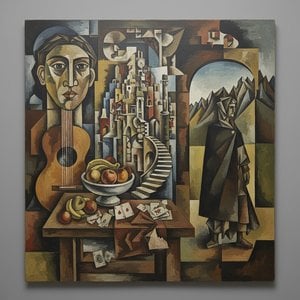
StatsThe guitar
 Acrylic On Canvas
- WallArt
- Cubism
 1913
1913- Modern
 66.0 x 49.0 cm
 Read More
The artwork displayed on this page is protected by copyright law, which means we cannot legally create or sell an identical reproduction. This protection is enforced under international agreements such as the Berne Convention and by national laws, including those outlined by the U.S. Copyright Law - Title 17.
As a respectful and legal alternative, we offer custom, hand-painted artworks inspired by the original. Our skilled and professional artists carefully study the original's style, mood, and artistic essence to create a new, unique piece that evokes the same feeling - while remaining an original creation in its own right.
This method fully complies with copyright regulations because it does not involve copying or duplicating the protected artwork. Instead, it is a creative reinterpretation - a new painting that is influenced by the original but not identical to it.
Hand Made Oil Reproduction
Hand-painted oil on canvas in your size and frame, made to order by our artists. ( Switch to Print Switch to Digital Image)




P118B $10

P118H $10

P118W $10

P438Z $10

P508JH $12

P508YH $12

P805H $10

P805Z $10

P919BZ $10

P919G $10

P919XJ $10

P959ZH $10

P968JZ $12

W106C $8

W218G $10

W218JH $8

W218Y $10

W307PJ $10

W316G $10

W316PJ $8

W316Y $10

W398PJ $8

W4111J $10

W500HY $15

W500JH $15

W692G $12

W849H $8

W940BG $15

W953PJ $8




Pick from our preset sizes that match the artwork's original proportions.

Type the width and the height you need, to fit your frame or your wall. This is hand-painted, so for a size with a different shape the artist can paint a bit more around the picture, or cut a bit — you choose. We send you a digital mockup to approve before the painting starts. The picture shown on this page does not show the real result — only the mockup does.
After order, ArtsDot.com team will email client for instructions and provide a mockup preview
Worldwide Delivery () in 3/4 weeks instead of standard 5 weeks. (24 October). No compromise on quality.

Free Worldwide Express Shipping

High-Quality Linen Canvas

Full Shipping Insurance

Customs Tax Refund Guarantee

True Color Matching Guarantee

100-Day Return Policy (Defects Only)

100% Money-Back Guarantee

Bulk Discount Offer
 Glass option is only available in size under 110 CM

The guitar
Reproduction Medium
Reproduction Size
-


Total Price
$ 263
Deconstructing Reality: A Deep Dive into Picasso’s *The Guitar* (1913)
Pablo Picasso's *The Guitar*, created in 1913, is far more than a depiction of a musical instrument; it’s a pivotal statement within the evolution of modern art and a prime example of Synthetic Cubism. Measuring 66 x 49 cm, this work isn’t about representing a guitar as we *see* it, but rather how we *know* it – its essential form distilled into fragmented planes and suggestive shapes. The painting resides today in the Museo Thyssen-Bornemisza in Madrid, a testament to its enduring significance.A Symphony of Shapes: Composition & Technique
The composition immediately strikes the viewer as unconventional. Picasso doesn’t present a traditionally rendered guitar; instead, he presents *aspects* of one – curves suggesting sound holes, lines hinting at the neck and strings – scattered across a predominantly blue background. These elements aren't merely broken apart; they are reassembled in a flattened space, overlapping and interacting with other forms like those suggestive of a chair, sheet music, or even a wine bottle. This technique is central to Synthetic Cubism: building up an image from abstracted components rather than analyzing it down into its constituent parts (as was done in Analytic Cubism). Collage elements are subtly integrated – fragments resembling newspaper print and decorative patterns appear within the composition, blurring the lines between painting and assemblage. This incorporation of real-world materials further emphasizes Picasso’s desire to challenge traditional artistic boundaries. The blue background isn't merely a backdrop; it provides depth and contrast, allowing the fragmented forms to ‘float’ and interact dynamically.The Birth of Synthetic Cubism: Historical Context
*The Guitar* emerges from a period of intense experimentation in Picasso’s career. Following his earlier Blue and Rose Periods, he, alongside Georges Braque, pioneered Cubism – a revolutionary approach to representing reality. Synthetic Cubism (1912-1919), the phase exemplified by this work, marked a shift *from* breaking down objects *to* constructing them anew. This period was also influenced by Picasso’s artistic rivalry with Henri Matisse and the vibrant energy of the Fauvist movement. However, Picasso pushed beyond pure color exploration, focusing instead on formal innovation and intellectual deconstruction. The “Crystal Period,” as it's sometimes called, reflects this focus on fractured forms and crystalline structures.Beyond Representation: Symbolism & Interpretation
While seemingly abstract, *The Guitar* isn’t devoid of meaning. The guitar itself held symbolic weight for Picasso – representing his Spanish heritage, a source of comfort, and perhaps even a metaphor for the artist himself, shaping and manipulating form to create something new. The fragmented nature of the image can be interpreted as reflecting the complexities and uncertainties of modern life. Some scholars suggest that the painting also alludes to the burgeoning industrial age and the mechanization of society, where objects are often reduced to their functional components. The inclusion of newspaper fragments hints at the overwhelming influx of information characteristic of the early 20th century.Emotional Resonance & Lasting Legacy
Despite its intellectual rigor, *The Guitar* evokes a surprisingly emotional response. The interplay of cool blues and muted tones creates a sense of melancholy and introspection. The fragmented forms, while challenging, are also strangely harmonious, suggesting a hidden order beneath the surface chaos. Picasso’s contributions to modern art are immeasurable. His work in Cubism fundamentally altered the course of artistic expression, paving the way for movements like Surrealism and Abstract Expressionism. Artists such as Kazimir Malevich were profoundly influenced by his formal innovations. *The Guitar* remains a powerful testament to Picasso's genius – a captivating exploration of form, space, and the very nature of representation.Inspiring Interiors: Bringing Modern Art Home
A high-quality reproduction of *The Guitar* can serve as a striking focal point in any modern or contemporary interior. Its cool color palette complements minimalist spaces, while its dynamic composition adds visual interest to more eclectic settings. Consider pairing it with furniture featuring clean lines and geometric shapes to echo the painting’s aesthetic. Its intellectual depth also makes it an excellent conversation starter – a piece that invites contemplation and sparks dialogue.- Explore related works by Picasso: The Guitar, Guitar and Bottle ,Geometrical Composition: The Guitar
- Discover the work of fellow Cubist, Juan Gris.
- Plan your visit to the Museu Picasso in Barcelona or the Musée National Picasso in Paris.
Questions & Answers
Is "The guitar" free of copyright?
"The guitar" by Pablo Picasso is still protected by copyright. This status governs how the image of the work may be reproduced.
Which reproduction size is suggested for "The guitar" by Pablo Picasso?
The recommended print size for "The guitar" by Pablo Picasso is large.
How can I view "The guitar" by Pablo Picasso as a slideshow?
A slideshow is available: the Diaporama page of "The guitar" by Pablo Picasso.
Related Artworks


Artist Biography
The boy from Málaga
A child's first words in Málaga were “piz, piz,” a small attempt at saying pencil. This early pull toward the lead and paper was nurtured by his father, José Ruiz y Blasco, who taught him the basics of figure drawing and oil painting. The boy learned to copy the masters and draw from plaster casts under a disciplined eye. As he grew, the family moved through A Coruña and Barcelona. These years were marked by the quiet weight of loss, particularly the death of his sister, Conchita, from diphtheria when she was only seven. Such shadows would later find their way into the heavy, blue-green tones of his early work.
By thirteen, he was already taking entrance exams for advanced classes in Barcelona, finishing in a week what took others a month. His hands moved with a precision that even his father noticed, once seeing him paint over an unfinished sketch of a pigeon with such accuracy that the instructor realized the student had surpassed him. He eventually moved to Paris, a city where he would spend much of his adult life, constantly shifting his focus from one way of seeing to another.
Shifting palettes and fractured forms
The early twentieth century saw his work move through distinct phases of color and mood. There was the Blue Period, where the canvases were filled with beggars, the blind, and the lonely, rendered in somber shades of blue. This gave way to the Rose Period, a time when pinks, oranges, and reds appeared, often featuring the figures of circus performers like harlequins and acrobats. These years showed a man reacting to his own life and the world around him through the temperature of his palette.
In 1907, the way he handled space changed fundamentally with Les Demoiselles d'Avignon. Influenced by African masks and Iberian sculpture, he began to break objects into geometric shapes. Alongside Georges Braque, he developed Cubism. This involved two main stages:
- Analytic Cubism: A method of fragmenting objects into muted, geometric pieces as if dissecting the form itself.
- Synthetic Cubism: An approach that brought in collage elements like newspaper clippings and fabric scraps to add texture and new layers.
A life of constant change
His work never settled into a single way of being. He explored Neoclassicism with large, monumental figures and later engaged with the imagery of Surrealism, using distorted perspectives to tap into the subconscious. The violence of the Spanish Civil War left its mark on his canvas in 1937 through Guernica. This large oil painting used a stark palette of black, white, and grey to show the suffering of a bombed town, featuring a gored horse, a bull, and screaming women. It remains a heavy, monochromatic response to the chaos of war.
In his later years, he continued to experiment with ceramics, sculpture, and printmaking. He even created large-scale public works, such as the 1967 steel sculpture in Chicago, which was inspired by the head of his Afghan Hound, Kabul. He died in Mougins, France, leaving behind a massive collection of work that spans over seventy-six years of experimentation.

Pablo Picasso
1881 - 1973 , Spain
Quick Facts
- Full Name: Pablo Diego José Ruiz Picasso
- Nationality: Spanish
- Date Of Birth: 1881
- Date Of Death: 1973
- Place Of Birth: Malaga, Spain
- Notable Artworks:
- Les Demoiselles d'Avignon
- Guernica
- The Old Guitarist
- La Vie
- Family of Saltimbanques
- Artistic Movement Or Style: Cubism, Surrealism
- Artists Who Influenced This Artist:
- Velázquez
- Goya
- Matisse
- Artists Or Movements Influenced By This Artist:
- Cubism
- Modern art
Related Articles
Cubist Expression: 10 Masterpieces That Revolutionized Modern Art | ArtsDot
Explore 10 Cubist masterpieces by Picasso, Braque & more! Discover the stories behind these revolutionary paintings and their impact on modern art. Find museum-quality reproductions for your home at ArtsDot.com – where art comes to life.

Cubist Portraits: 10 Masterpieces That Revolutionized Art | ArtsDot
Explore 10 revolutionary Cubist portraits by Picasso, Braque & more! Discover the stories behind these iconic paintings and how they shaped modern art. Find museum-quality reproductions to elevate your home decor on ArtsDot.com.

Slate Blue Masterpieces: 10 Iconic Paintings & Timeless Home Decor Ideas
Immerse yourself in the captivating world of slate blue! Explore 10 iconic paintings by Monet, Van Gogh & Renoir. Discover their stories, techniques & find museum-quality art reproductions for your home at .

Pablo Picasso: A Revolutionary Vision – Cubism, Symbolism & Enduring Legacy
Explore the revolutionary art of Pablo Picasso with ArtsDot.com. Discover Cubism's origins, symbolism in his masterpieces & investment insights for collectors. Expert appraisal & custom reproductions available.

Cubism's Revolution: 10 Masterpieces That Redefined Modern Art | ArtsDot
Explore 10 Cubist masterpieces by Picasso, Braque & more! Delve into the history of this revolutionary art movement. Find museum-quality reproductions and elevate your home decor with ArtsDot. Discover all masterpieces on ArtsDot.com


