

 Preview
 Send
Send Share
Share
 Details
 Guide
Guide

 Download
 Similars
 X-Ray
X-Ray Diaporama
 Q&A
Q&A Stats
StatsUntitled (876)

 Read More
The artwork displayed on this page is protected by copyright law, which means we cannot legally create or sell an identical reproduction. This protection is enforced under international agreements such as the Berne Convention and by national laws, including those outlined by the U.S. Copyright Law - Title 17.
This method fully complies with copyright regulations because it does not involve copying or duplicating the protected artwork. Instead, it is a creative reinterpretation - a new painting that is influenced by the original but not identical to it.
Giclée / Art Print
Museum-quality giclée or canvas print with fast production and flexible finish options. ( Buy Hand Made Painting Switch to Digital Image)




P118B $10

P118H $10

P118W $10

P438Z $10

P508JH $12

P508YH $12

P805H $10

P805Z $10

P919BZ $10

P919G $10

P919XJ $10

P959ZH $10

P968JZ $12

W106C $8

W218G $10

W218JH $8

W218Y $10

W307PJ $10

W316G $10

W316PJ $8

W316Y $10

W398PJ $8

W4111J $10

W500HY $15

W500JH $15

W692G $12

W849H $8

W940BG $15

W953PJ $8




Pick from our preset sizes that match the artwork's original proportions.

Type the width and the height you need, to fit your frame or your wall. A print can only be cut, never made bigger than the picture, so a size with a different shape loses a part of the image. We send you a digital mockup to approve before we print anything. The picture shown on this page does not show the real cut — only the mockup does.
Worldwide Delivery () in 2 weeks instead of standard 4/5 weeks. (7 November)

Free Worldwide Express Shipping

High-Quality Linen Canvas

Full Shipping Insurance

Customs Tax Refund Guarantee

True Color Matching Guarantee

100-Day Return Policy (Defects Only)

100% Money-Back Guarantee

Bulk Discount Offer
 Glass option is only available in size under 110 CM

Untitled (876)
Giclée / Art Print
Reproduction Size
-


Total Price
$ 63
Related Artworks


Artist Biography
A World Between Worlds: The Enigmatic Vision of Neo Rauch
Neo Rauch emerged as a pivotal figure in contemporary art, a painter whose work feels simultaneously rooted in the past and startlingly present. Born in Leipzig, Germany, in 1960, his life began under the shadow of profound loss. His parents, both promising art students at the Hochschule für Grafik und Buchkunst Leipzig, tragically perished in a train accident when he was just weeks old. Raised by his grandparents in Aschersleben, this early experience of absence and disruption arguably instilled within him a sensibility attuned to fragmentation and the weight of history—themes that would become central to his artistic practice. Rauch’s formative years unfolded against the backdrop of East Germany, a world steeped in socialist realism and ideological control. He attended the Thomas-Müntzer-Oberschule (now Gymnasium Stephaneum) before following in his parents' footsteps, studying painting at the very institution where their artistic journeys were cut short. There, he benefited from the mentorship of Professors Arno Rink and Bernhard Heisig, figures who guided him through a rigorous academic training while fostering his unique artistic voice.The New Leipzig School and a Synthesis of Styles
Rauch is inextricably linked to the “New Leipzig School,” a group of artists who revitalized figurative painting in Germany during the 1990s. However, to categorize him solely within this movement feels limiting. His paintings are not simply a revival of socialist realism; they represent something far more complex—a deliberate and unsettling synthesis of styles and influences. The echoes of his East German upbringing are undeniable, manifesting in the architectural motifs, the stoic figures, and the muted color palettes reminiscent of official state art. Yet, Rauch transcends mere imitation, layering these elements with a distinctly surreal sensibility. He openly acknowledges inspiration from masters like Giorgio de Chirico and René Magritte, artists who explored the realm of dreams, symbolism, and psychological unease. But he resists easy categorization as a Surrealist, preferring to forge his own path—one that blends the concrete and the ethereal, the historical and the imagined. His canvases often depict fragmented narratives, populated by figures drawn from different eras, creating a sense of temporal dislocation and underlying tension. It’s as if Rauch is excavating the collective unconscious, unearthing forgotten memories and anxieties. He masterfully merges modern myths originating from both the Warsaw Pact nations and the Western world, seamlessly blending American comic aesthetics with the rigid formalism of communist social realism.Career Trajectory and Growing Recognition
Following his studies, Rauch initially worked as an assistant to Arno Rink and Sighard Gille at the Leipziger Akademie from 1993 to 1998, a period that allowed him to refine his technique and solidify his artistic vision. His breakthrough came in the early 2000s, with exhibitions that garnered critical acclaim and propelled him onto the international stage. He served as a selector for Eastinternational in 2004, further establishing his position within the contemporary art world. In 2005, he accepted a professorship at the Hochschule für Grafik und Buchkunst Leipzig, returning to the institution that had shaped his own artistic development. Beyond his painting practice, Rauch has also demonstrated a curatorial sensibility, co-curating the exhibit "Man muss sich beeilen, wenn man noch etwas sehen will..." ("One has to hurry, if one still wants to see something...") at Gut Selikum in Neuss with Timm Rautert. A significant aspect of his career is his close collaboration with his spouse and fellow artist Rosa Loy, both working within the vibrant creative hub of the Leipziger Baumwollspinnerei—a former cotton mill transformed into an artists’ complex. This collaborative spirit extends beyond their shared studio space, influencing their individual artistic explorations. Recognition followed swiftly: the Vincent Award in 2002, a joint museum retrospective at the Museum der Bildenden Künste in Leipzig and the Pinakothek der Moderne, Munich, in 2010 (which subsequently traveled to Warsaw), and numerous solo exhibitions worldwide cemented his reputation as one of Germany’s most important contemporary artists.Legacy and Artistic Philosophy
Today, Neo Rauch stands as a financially successful artist—ranked among the wealthiest individuals in Germany—and a subject of scholarly attention, evidenced by the 2016 documentary film "Neo Rauch – Gefährten und Begleiter" directed by Nicola Graef. Represented by prestigious galleries such as Galerie Eigen + Art Leipzig/Berlin and David Zwirner, New York, his work continues to captivate audiences with its enigmatic power. But beyond the accolades and commercial success, what truly defines Rauch’s legacy is his unique artistic philosophy. He views painting not as a means of representation but as a process of discovery—a “natural form of discovering the world…almost natural as breathing.” He describes himself as a "peristaltic filtration system in the river of time," suggesting that his paintings are not deliberate constructions but rather the result of an intuitive and unconscious engagement with history, memory, and the complexities of human experience. Rauch’s art doesn't offer easy answers; it invites us to contemplate the ambiguities of existence, the weight of the past, and the elusive nature of truth. He remains a central figure in contemporary painting, continuing to challenge conventions and inspire a new generation of artists with his singular vision.Recurring Themes & Influences
- Socialist Realism: A direct reflection of his upbringing in East Germany, influencing the architectural structures and figure types within his work.
- Surrealism (De Chirico & Magritte): The dreamlike quality, illogical juxtapositions, and symbolic imagery owe a debt to these masters of the surrealist movement, though Rauch maintains a distinct stylistic independence.
- German Neo-Conservatism: Identified as an exemplar of this artistic trend, characterized by a return to figurative painting and a rejection of postmodern abstraction.
- Personal History & Industrial Alienation: The intersection of Rauch’s own biography with the socio-political landscape of post-war Germany forms the core thematic concern of his work. He explores feelings of displacement, loss, and the dehumanizing effects of industrialization.
- Fragmented Narratives & Temporal Dislocation: His paintings rarely tell a straightforward story; instead, they present fragmented scenes and figures from different historical periods, creating a sense of ambiguity and unease.

Neo Rauch
1960 - , Germany
Quick Facts
- Artistic Movement Or Style: New Leipzig School
- Artists Or Movements Influenced By This Artist: New Leipzig School
- Artists Who Influenced This Artist:
- Giorgio de Chirico
- René Magritte
- Date Of Birth: 1960
- Full Name: Neo Rauch
- Nationality: German
- Notable Artworks:
- Untitled (683)
- Untitled (876)
- Untitled (283)
- Place Of Birth: Leipzig, Germany
Related Articles

Timeless & Chic: Elevating Your New Home with the Sophistication of Black and White Photography
Transform your new home with the timeless allure of black and white photography. ArtsDot.com specializes in elegant monochrome decor and custom hand-painted wedding portraits that turn cherished milestones into lasting, soulful masterpieces. Elevate your space with ease.

Dark Masterpieces: 10 Iconic Paintings Dominated by Black Tones |
Explore 10 iconic paintings dominated by black tones, from Rembrandt’s chiaroscuro to Goya's dark expressions. Discover the stories behind these masterpieces & find museum-quality art reproductions for your home at .
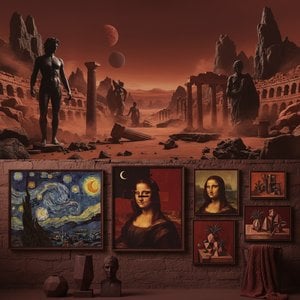
Mars Black Masterpieces: 10 Iconic Paintings & Timeless Art Decor Ideas
Delve into the power of 'Mars Black' with 10 iconic paintings by masters like Rembrandt & Caravaggio. Explore dramatic chiaroscuro, gothic art, and timeless beauty. Find museum-quality reproductions & elevate your home decor on .

Monochrome Visions: Exploring the Aesthetic & Historical Significance of Black & White Photography
Explore the rich history & artistic power of black and white photography. From early techniques to iconic masters like Ansel Adams, discover why monochrome continues to captivate art lovers today. Expert insights for collectors.

White on Canvas: 10 Masterpieces & Timeless Elegance for Your Home Decor
Explore 10 iconic white paintings by Monet, Whistler & Rothko! Discover the stories behind these serene masterpieces and their impact on art history. Find museum-quality reproductions for your home decor at .


