

 Preview
 Send
Send Share
Share
 Details
 Guide
Guide

 Download
 Similars
 X-Ray
X-Ray Diaporama
 Q&A
Q&A Stats
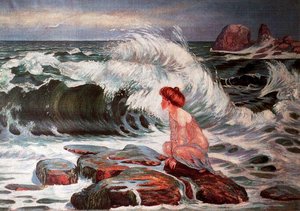
StatsThe Mermaid


 Read More
Get a print-ready file that goes far beyond the web preview. Every digital image we sell comes from a high-resolution master in our stock database — usually 5,000 to 15,000 pixels wide — so you can print large, crop tightly, or reproduce fine detail with confidence.
No file leaves our studio untouched. A digital expert checks the colors against the original painting and corrects them if needed, then improves clarity and detail with professional retouching tools — always staying faithful to the artist's brushwork and style. The result is an image that looks like the painting, not like a filtered scan.
You approve before you're done: our expert sends the image by e-mail within 72 hours for your review. Not satisfied? Ask for improvements or corrections, or request a refund if the quality falls short.
This is the quality relied on by publishers, design studios, galleries and print shops.
Digital Image
Download a high-resolution file for personal display, printing, and creative projects. ( Switch to Print Buy Hand Made Painting)
Included in Every Digital Image Order
Expert Digital Delivery, Guaranteed
When you choose ArtsDot.com, you're not just getting an image - you're receiving a professionally enhanced digital artwork, crafted with precision and backed by a satisfaction guarantee. Here's everything that comes with your order, automatically:

Fast Email Delivery
Your high-resolution digital image file will be emailed to you within 72 hours of ordering - ready for immediate use.

AI-Enhanced Digital File
Your artwork is professionally optimized using advanced AI tools and manual editing, ensuring maximum detail, clarity, and color accuracy.

Free Lifetime Re-Delivery
Accidentally deleted or lost your file? No worries - we'll resend it to you anytime, free of charge.

No Import Fees - Ever
Enjoy your artwork instantly with zero customs, duties, or delivery fees - digital downloads are always tax-free.

Color Accuracy Guarantee
We ensure your digital image reflects the original colors as closely as possible using professional tools and color management.

100-Day Satisfaction Guarantee
If you're not satisfied with your digital image, we'll revise it or refund 100% within 100 days - no questions asked.

100% Money-Back Guarantee
Not satisfied? Get a full refund within 100 days of receiving your digital file - no questions asked.

Bulk Order Discounts
Buy 3 images, save 10% - Buy 5, save 15% - Buy 10+, save 20%. Great for creative projects, galleries, and agencies.
Related Artworks




Artist Biography
A Pioneer of American Illustration: The Life and Legacy of Howard Pyle
Howard Pyle, born in Wilmington, Delaware, in 1853, stands as a monumental figure in the history of American illustration. More than simply an artist, he was a storyteller, educator, and innovator who fundamentally shaped the visual landscape of late 19th and early 20th-century America. His influence extends far beyond the pages of books and magazines; Pyle essentially *created* the romanticized image of pirates that continues to dominate our collective imagination today. From a young age, Pyle displayed an innate talent for both drawing and writing, nurtured by supportive parents who recognized his potential despite his somewhat indifferent attitude toward formal schooling. His artistic training was relatively brief—three years at the studio of F.A. van der Wielen in Philadelphia, supplemented by lessons at the Art Students League of New York—but it proved sufficient to launch a career that would redefine illustration as a serious art form. Early struggles in New York were overcome with encouragement from established artists like Edwin Austin Abbey and A.B. Frost, culminating in his first published spread in Harper’s Weekly in 1878, a moment that signaled the beginning of his ascent.The Brandywine School and a Generational Impact
Pyle's commitment to fostering artistic talent led him to teaching roles at the Drexel Institute of Art, Science, and Industry in 1894, and subsequently, to founding his own school, the Howard Pyle School of Illustration Art around 1900. This wasn’t merely a classroom; it was an immersive environment where students were instilled with Pyle's rigorous standards and unique approach to narrative illustration. The impact of this school—later dubbed the “Brandywine School” by scholar Henry C. Pitz, due to its concentration in the Brandywine region—is immeasurable. A remarkable roster of artists passed through his tutelage, including N.C. Wyeth, Frank Schoonover, Violet Oakley, and Jessie Willcox Smith, each going on to achieve significant recognition in their own right. Pyle’s teaching philosophy emphasized not just technical skill but also a deep understanding of history, literature, and the power of visual storytelling. He encouraged his students to research their subjects thoroughly, to immerse themselves in the atmosphere of the scenes they depicted, and to strive for authenticity even when portraying fantastical worlds. His home and studio in Wilmington, still standing today as a National Historic Landmark, served as the heart of this artistic community.Medieval Visions and Modern Mythmaking
Pyle’s artistic output was remarkably diverse, encompassing historical scenes, adventure stories, fairy tales, and—most famously—pirate imagery. He found particular inspiration in medieval European history and Arthurian legends, producing lavishly illustrated editions of *The Merry Adventures of Robin Hood* (1883) and a four-volume set on King Arthur that captivated readers with their romanticism and attention to detail. These works weren’t simply illustrations; they were immersive visual experiences that transported audiences to another time and place. However, it was his depictions of pirates that truly cemented his legacy. Prior to Pyle, the popular image of a pirate was largely undefined. He single-handedly crafted the now-iconic stereotype—the flamboyant attire, the eye patches, the swaggering poses—drawing inspiration from diverse sources like gypsy dress and historical costume books, but ultimately creating something entirely new and enduring. While historically inaccurate for practical seafaring life, Pyle’s pirates were undeniably *romantic*, embodying a spirit of adventure and rebellion that resonated with audiences then and continues to do so today. His influence can be seen in countless depictions of pirates in film, literature, and popular culture, from Errol Flynn's swashbuckling heroes to Johnny Depp's enigmatic Jack Sparrow.A Late Flourishing and Enduring Influence
In 1910, Pyle traveled to Florence, Italy, seeking to study mural painting and further refine his artistic skills. Sadly, this journey was cut short by a sudden kidney infection (Bright’s disease), leading to his death in 1911 at the age of 58. Despite his relatively early passing, Pyle left behind an extraordinary body of work that continues to inspire artists and captivate audiences today. His illustrations are celebrated for their dynamic compositions, rich colors, and masterful storytelling. He wasn’t merely illustrating stories; he was *creating* worlds, breathing life into characters, and shaping the visual language of adventure and fantasy. The Smithsonian American Art Museum recognizes Pyle as a pivotal figure whose work bridged the gap between fine art and popular illustration, elevating the latter to new heights of artistic expression. His legacy extends beyond his individual artworks; it lives on in the generations of artists he mentored and in the enduring power of the images he created—images that continue to shape our understanding of history, myth, and the boundless possibilities of imagination.Major Works & Recognition
- The Merry Adventures of Robin Hood (1883): A cornerstone of children’s literature, renowned for its vibrant illustrations and captivating retelling of the classic tale.
- Otto of the Silver Hand (1888): Pyle's first novel, showcasing his talent as both author and illustrator, set in a medieval European setting.
- The Pirate was a Picturesque Fellow (circa 1890): A defining image of the romanticized pirate archetype that continues to influence popular culture.
- The Story of King Arthur and His Knights (1903-1905): A comprehensive and beautifully illustrated retelling of the Arthurian legends.
- Mural Paintings: Including *The Battle of Nashville* at the Minnesota State Capitol, demonstrating his versatility in large-scale works.

Howard Pyle
1853 - 1911 , United States of America
Quick Facts
- Full Name: Howard Pyle
- Nationality: American
- Date Of Birth: 1853
- Date Of Death: 1911
- Place Of Birth: Wilmington, United States of America
- Notable Artworks:
- Robin Hood
- The Mermaid
- Pirate Fellow
- Otto Silver Hand
- Artistic Movement Or Style: Illustration, Art Nouveau
- Artists Who Influenced This Artist:
- Edwin Abbey
- A.B. Frost
- Frederick Church
- Artists Or Movements Influenced By This Artist:
- N.C. Wyeth
- Brandywine School