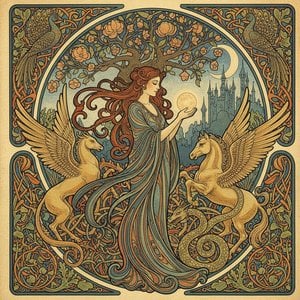
A Brushstroke of Dreams: The Life and Art of Edmund Dulac
Edmund Dulac, a name that resonates with the shimmering allure of the Golden Age of Illustration, conjures visions of fantastical realms brought to life through breathtaking watercolor artistry. Born Edmond Dulac in Toulouse, France, in 1882, his journey from aspiring lawyer to celebrated artist is a compelling testament to the power of following one’s artistic calling. Initially enrolled in law at the University of Toulouse, Dulac found himself irresistibly drawn to the world of visual storytelling. He quickly distinguished himself at the École des Beaux-Arts, garnering accolades that propelled him toward a life dedicated to art. A brief sojourn in Paris solidified his ambition before he ultimately settled in London in 1904, a city poised to embrace his unique talent and become the central stage for his blossoming career. It was in England that Dulac truly discovered his artistic voice—a voice that would captivate generations of readers and art enthusiasts alike. He became a naturalized British citizen in 1912, forever intertwining his identity with the cultural landscape of his adopted home.The Alchemy of Influence: Shaping a Distinctive Style
Dulac’s artistry wasn't born in isolation; it was carefully cultivated through exposure to diverse influences. The sinuous lines and decorative flourishes of Art Nouveau are readily apparent in his work, lending an elegant grace to figures and settings alike. However, his aesthetic vision extended far beyond European trends. He harbored a deep admiration for Japanese woodblock prints—Ukiyo-e—captivated by their flattened perspective, bold compositions, and refined linework; elements he subtly incorporated into his own style. Perhaps most significantly, Dulac was profoundly inspired by Orientalism. A fascination with Eastern cultures, particularly Persian and Arabian aesthetics, permeated much of his imagery, reaching its zenith in his iconic illustrations for *The Rubaiyat of Omar Khayyam*. This masterful blend of influences—European elegance, Japanese precision, and Eastern mystique—coalesced into a style that was uniquely Dulac’s: meticulous detail combined with rich color palettes and an ethereal, dreamlike quality. He deliberately moved away from the prevailing austere styles of the time, embracing instead a more decorative and imaginative approach to illustration, one that prioritized beauty and emotional resonance.Illustrating Dreams: Major Works and Artistic Flourishing
The early 20th century witnessed Dulac’s meteoric rise to prominence. His breakthrough came with commissions to illustrate classic fairy tales—*The Arabian Nights*, *Grimm's Fairy Tales*, and the enchanting stories of Hans Christian Andersen. These weren't mere depictions; they were immersive experiences, brought to life through his masterful watercolor technique. Each illustration was a miniature masterpiece, brimming with intricate detail and vibrant hues. However, it was his 1909 illustrations for *The Rubaiyat of Omar Khayyam* that cemented his reputation as an artist of exceptional vision. He captured the mystical and sensual atmosphere of the Persian poetry with unparalleled sensitivity, creating images that were both evocative and deeply symbolic. Beyond fairy tales and poetry, Dulac extended his artistic reach to literary classics like *Don Quixote*, demonstrating a versatility that further solidified his standing in the art world. His contributions weren’t limited to books; he also graced the pages of prominent magazines such as The Strand Magazine and The London Illustrated News, expanding his audience and influence considerably. During World War I, Dulac contributed to relief efforts, creating *Edmund Dulac’s Picture-Book for the French Red Cross*, demonstrating a commitment to using his art for humanitarian purposes.A Legacy Etched in Color: Historical Significance and Enduring Appeal
Edmund Dulac played a pivotal role in elevating illustration from a craft to an art form during the Golden Age of Illustration. He wasn’t simply illustrating stories; he was creating worlds, inviting viewers to step into realms of fantasy and wonder. His revitalization of fairy tale illustration with his distinctive style breathed new life into these timeless narratives, captivating audiences young and old. Furthermore, his popularization of Orientalist themes in Western art broadened artistic horizons and introduced a new aesthetic sensibility to a wider audience. Though his popularity waned somewhat after the 1920s as tastes shifted, Dulac’s legacy endures. His work continues to inspire generations of illustrators and artists with its technical brilliance, imaginative vision, and enduring beauty. Even his later ventures into stamp design—including designs for the coronation of King George VI and the 1948 Summer Olympics—and banknote illustration demonstrate a continued commitment to artistic excellence and a lasting impact on visual culture. He died in London in 1953, leaving behind not just illustrations, but portals to other worlds—a testament to the power of art to transport, enchant, and ignite the imagination. His contribution remains a vibrant thread in the rich tapestry of 20th-century art, ensuring that his enchanting visions will continue to captivate for years to come.Notable Works
- The Arabian Nights (1907): A landmark collection showcasing Dulac’s ability to capture the exotic and fantastical elements of Middle Eastern folklore.
- The Rubaiyat of Omar Khayyam (1909): Perhaps his most iconic work, these illustrations perfectly embody the mystical and sensual spirit of Persian poetry.
- Sleeping Beauty and Other Fairy Tales (1910): A stunning collection that revitalized classic fairy tales with Dulac’s signature style.
- Stories from Hans Christian Andersen (1911): Evocative illustrations bringing to life the poignant and imaginative stories of Andersen.
- Edmund Dulac's Picture-Book for the French Red Cross (1915): A testament to his commitment to using art for humanitarian purposes during World War I.
Questions & Answers
Where is Edmund Dulac from?
Edmund Dulac was born in France.
Is there an overview of all the subjects Edmund Dulac painted?
Edmund Dulac's works can be explored by subject on the artist's Subject Atlas page.
In which historical period did Edmund Dulac work?
Edmund Dulac worked in the Modern period. The period situates the artist's activity in history.
What are the birth city and country of Edmund Dulac?
Edmund Dulac was born in Toulouse, in France.
Where can I see Edmund Dulac's artworks in chronological order?
A timeline of Edmund Dulac's works exists: the artist's Artwork Timeline page orders the artworks by creation date.
What other names is Edmund Dulac known by?
Edmund Dulac is also known as Edmond Dulac.
Where can I see Edmund Dulac's artworks in a 3D gallery?
The 3D Museum of Edmund Dulac is a page that displays the artist's artworks in a virtual three-dimensional gallery.
Can I browse Edmund Dulac's works by mood?
Edmund Dulac's works can be browsed by mood on the artist's Mood Room page, which arranges the artworks by their recorded moods.