Preview
 Send
Send Share
Share
 Details
 Guide
Guide

 Download
 Similars
 X-Ray
X-Ray Diaporama
 Stats
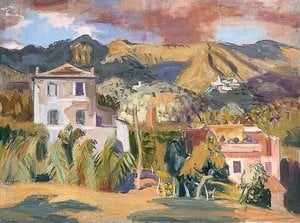
StatsCloud Shadows
 Impressionism
 61.0 x 82.0 cm
 Pallant House Gallery
 Read More
The artwork displayed on this page is protected by copyright law, which means we cannot legally create or sell an identical reproduction. This protection is enforced under international agreements such as the Berne Convention and by national laws, including those outlined by the U.S. Copyright Law - Title 17.
This method fully complies with copyright regulations because it does not involve copying or duplicating the protected artwork. Instead, it is a creative reinterpretation - a new painting that is influenced by the original but not identical to it.
Giclée / Art Print
Museum-quality giclée or canvas print with fast production and flexible finish options. ( Buy Hand Made Painting Switch to Digital Image)




































Pick from our preset sizes that match the artwork's original proportions.

Type the width and the height you need, to fit your frame or your wall. A print can only be cut, never made bigger than the picture, so a size with a different shape loses a part of the image. We send you a digital mockup to approve before we print anything. The picture shown on this page does not show the real cut — only the mockup does.
Worldwide Delivery () in 2 weeks instead of standard 4/5 weeks. (24 October)

Free Worldwide Express Shipping

High-Quality Linen Canvas

Full Shipping Insurance

Customs Tax Refund Guarantee

True Color Matching Guarantee

100-Day Return Policy (Defects Only)

100% Money-Back Guarantee

Bulk Discount Offer
 Glass option is only available in size under 110 CM

Cloud Shadows
Giclée / Art Print
Reproduction Size
-


Total Price
$ 63
Related Artworks


Artist Biography
A Life Forged in the Fires of Change
Born in Frankfurt am Main, Hans Feibusch’s early years were a tapestry of artistic awakening and historical upheaval. The son of a dental surgeon and an amateur painter, his creative spirit was nurtured by the delicate brushstrokes of his mother and the rigorous academic training he received under Karl Hofer at the Berlin University of the Arts. His youth, however, was not merely one of quiet study; the shadows of World War I loomed large as he served on the Russian front, an experience that would forever color his understanding of human resilience and the fragility of existence. In the vibrant, pre-war atmosphere of Germany and later Paris, Feibusch absorbed the rhythmic energy of Expressionism and the daring palettes of Fauvism, honing a style that balanced meticulous realism with a profound, emotive intensity.
From Exile to the Sacred Walls of England
The ascent of Nazism in 1933 forced a dramatic and painful redirection of Feibusch’s destiny. Driven by the necessity to protect his family, he fled Germany for England, carrying with him the weight of displacement and the richness of his Jewish heritage. It was within this new, often uncertain landscape that Feibusch found his most enduring calling: the transformation of Anglican sacred spaces. He did not merely decorate; he breathed life into stone and mortar. Through a series of monumental murals spanning nearly thirty churches across England, he wove together themes of faith, suffering, and transcendence. His work in places like Ely Cathedral stands as a testament to an artist who could bridge the gap between his ancestral traditions and the liturgical heart of the Church of England, creating a visual language that was both deeply personal and universally spiritual.
The Eternal Dance of Color and Spirit
Feibusch’s oeuvre is characterized by a breathtaking vitality, where color serves as a primary vessel for emotion. Whether capturing the sun-drenched landscapes of Sicily in Taormina, Sicily or the rhythmic ecstasy of human connection in his 1950 masterpiece The Dance, his brushwork remains unapologetically expressive. His mastery lies in the ability to evoke the sublime through several key elements:
- Bold Chromaticism: The use of vibrant, often clashing hues that command attention and stir the soul.
- Dynamic Motion: A sense of rhythmic vitality that makes even a static mural feel alive with movement.
- Symbolic Depth: An intricate layering of Jewish cultural motifs and Christian iconography.
As we look back upon his century-long journey, Feibusch remains a singular figure—a painter who turned the trauma of exile into a legacy of light, leaving behind a trail of sacred beauty that continues to inspire awe in all who enter his painted sanctuaries.

Hans Feibusch
1898 - 1998
Quick Facts
- Artistic Movement Or Style: Expressionist Color
- Artists Or Movements Influenced By This Artist:
- Jankel Adler
- Marc Chagall
- Artists Who Influenced This Artist:
- Rudolf Hofer
- Andre Lhote
- Date Of Birth: 1898
- Date Of Death: 1998
- Full Name: Hans Nathan Feibusch
- Nationality: German
- Notable Artworks:
- Taormina, Sicily
- Narcissus
- Wooded Landscape
- Place Of Birth: Frankfurt am Main, Germany
Related Articles

Evocations of Place: A Historical Journey Through Landscape Art
Explore the rich history of landscape art with ArtsDot. Discover renowned artists, movements like Impressionism & tonalism, and expert guidance for collecting timeless pieces. Find your perfect serene escape today!

Evocations of Place: A Historical Journey Through Landscape Art
Explore the rich history of landscape art with ArtsDot. Discover renowned artists, movements like Impressionism & Romanticism, and expert guidance for collecting timeless pieces. Find your perfect serene escape today!

Romantic Landscapes: 10 Masterpieces for Your Home | ArtsDot
Journey through 10 Romantic landscape masterpieces by Friedrich, Turner & Cole. Explore emotional art, sublime nature scenes & iconic 19th-century paintings. Find museum-quality reproductions for your home at ArtsDot.com – discover the full collection online!

Impressionist Landscapes: 10 Masterpieces for Your Home | ArtsDot
Journey through 10 iconic Impressionist landscapes by Monet, Renoir & Degas. Explore the history, techniques & emotions behind these masterpieces. Find museum-quality reproductions for your home at ArtsDot.com – where art comes to life! Discover all masterpieces on ArtsDot.com

Impressionistic Landscapes: 10 Masterpieces That Changed Art & Decor
Journey into the heart of Impressionism! Explore 10 masterpieces by Monet, Renoir & Degas that revolutionized landscape art. Discover their stories, techniques & find museum-quality reproductions to elevate your home decor on ArtsDot.com.