


The Lyrical Vision of Josep Mompou Dencausse
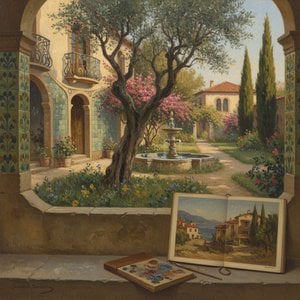
Born in the vibrant cultural cradle of Barcelona in 1888, Josep Mompou Dencausse emerged as a profound voice within the Catalan art scene, weaving together the delicate light of Impressionism with the raw, emotive power of Fauvism. His journey into the heart of visual expression was deeply personal, rooted in a lineage of creativity; as the son of a painter, his eyes were trained from childhood to perceive the subtle shifts in atmosphere and the rhythmic dance of color across the Spanish landscape. This early immersion allowed him to develop a technique that did not merely replicate reality but sought to capture its very soul, transforming the rural vistas of Catalonia into poetic meditations on light and existence.
As his artistic identity matured, Mompoc Dencausse navigated the shifting tides of early 20th-century modernism with remarkable fluidity. While he drew significant inspiration from the French Impressionist masters—learning to master the art of capturing fleeting moments through a soft, luminous touch—he was not content to remain within the bounds of naturalism. He found a kindred spirit in the Fauvist movement, embracing the radical liberation of color championed by Henri Matisse. This evolution brought a newfound intensity to his canvases, where bold, unapologetic hues of crimson, azure, and sun-drenched yellow began to pulse with an almost visceral energy, breaking away from traditional constraints to evoke deeper emotional resonances.
A Mastery of Subject and Medium
The breadth of Mompou Dencausse’s oeuvre reflects a restless curiosity and a deep reverence for the textures of life. While he is most celebrated for his sweeping landscapes—those tranquil, sun-soaked depictions of olive groves, vineyards, and rugged coastal vistas—his talent extended into the intimate realms of still life and illustration. In works such as Lemons, Bananas and Eucalyptus, one can witness his ability to blend impressionistic light with a tactile, textural beauty that celebrates the simple elegance of nature. His approach to still life often transcended mere arrangement, turning everyday objects into vibrant studies of form and color.
Beyond the landscape, Mompou Dencausse explored more complex and sometimes unsettling territories through his diverse use of media:
- Oil Paintings: His primary medium for large-scale explorations of light, atmosphere, and the bold, expressive brushwork characteristic of his Fauvist period.
- Watercolors and Etchings: Used to capture more delicate, ephemeral qualities of the Catalan countryside with a sense of lightness and transparency.
- Illustrations: A fascinating facet of his later work, where he utilized lines to explore themes of exoticism and power, as seen in the captivatingly eerie Monologue From Bass.
- Abstract Expressionist Tendencies: In his later years, particularly during the 1960s, his work embraced a more dynamic, textured approach, exemplified by pieces like Rabbit And Partridge, which showcase a masterful command of color and movement.
Legacy and Historical Significance
The historical significance of Josep Mompou Dencausse lies in his role as a bridge between the traditional landscape traditions of Spain and the avant-garde movements of Europe. He successfully synthesized the observational rigor of the 19th century with the emotional liberation of the 20th, creating a body of work that feels both timeless and modern. His ability to move from the serene, light-filled landscapes of his youth to the more textured, abstract compositions of his later years mirrors the broader evolution of modern art itself.
Today, his legacy is preserved through his presence in prestigious institutions, most notably the Reina Sofía, ensuring that his unique vision of Catalonia continues to inspire. Mompou Dencausse remains a vital figure for students and connoisseurs alike, offering a window into a period of intense artistic transformation where the boundaries of color, light, and emotion were being perpetually redefined.
Questions & Answers
Can I sort Josep Mompou i Dencausse's artworks by color?
The Spectral Index of Josep Mompou i Dencausse is a page that organizes the artist's artworks by their colors.
In which movements did Josep Mompou i Dencausse work?
Josep Mompou i Dencausse's works can be browsed by movement on the artist's All Movements page.
How many artworks by Josep Mompou i Dencausse are available to browse?
You can browse 143 artworks by Josep Mompou i Dencausse on the All Artworks page.




![Palau De La Música. [barcelona] — Josep Mompou I Dencausse](/media/artworks/images-thumb/85/9f/859f6d074b89701aa981c033799e1f3f.jpg)


