


 Preview
 Send
Send Share
Share
 Details
 Guide
Guide

 Download
 Similars
 X-Ray
X-Ray Diaporama
 Stats
Statsuntitled (7352)


 Read More
Hand Made Oil Reproduction
Hand-painted oil on canvas in your size and frame, made to order by our artists. ( Switch to Print Switch to Digital Image)




P118B $10

P118H $10

P118W $10

P438Z $10

P508JH $12

P508YH $12

P805H $10

P805Z $10

P919BZ $10

P919G $10

P919XJ $10

P959ZH $10

P968JZ $12

W106C $8

W218G $10

W218JH $8

W218Y $10

W307PJ $10

W316G $10

W316PJ $8

W316Y $10

W398PJ $8

W4111J $10

W500HY $15

W500JH $15

W692G $12

W849H $8

W940BG $15

W953PJ $8




Pick from our preset sizes that match the artwork's original proportions.

Type the width and the height you need, to fit your frame or your wall. This is hand-painted, so for a size with a different shape the artist can paint a bit more around the picture, or cut a bit — you choose. We send you a digital mockup to approve before the painting starts. The picture shown on this page does not show the real result — only the mockup does.
After order, ArtsDot.com team will email client for instructions and provide a mockup preview
Worldwide Delivery () in 3/4 weeks instead of standard 5 weeks. (18 October). No compromise on quality.

Free Worldwide Express Shipping

High-Quality Linen Canvas

Full Shipping Insurance

Customs Tax Refund Guarantee

True Color Matching Guarantee

100-Day Return Policy (Defects Only)

100% Money-Back Guarantee

Bulk Discount Offer
 Glass option is only available in size under 110 CM

untitled (7352)
Reproduction Medium
Reproduction Size
-


Total Price
$ 263
A Descent into Melancholy: Exploring Edvard Munch’s “Untitled (7352)”
Edvard Munch's "Untitled (7352)," a cornerstone of the Expressionist movement, isn’t merely a depiction of a solitary figure; it’s an immersion into raw emotion—a visceral portrayal of isolation, anxiety, and the unsettling beauty of twilight. Painted around 1893, this work transcends simple representation, becoming a potent symbol of the human condition grappling with mortality and inner turmoil. Munch, deeply influenced by personal tragedy – the early deaths of his mother and sister from tuberculosis, coupled with a lifelong struggle against mental illness within his family – channeled these profound experiences into his art, forging a style uniquely attuned to capturing the darkest recesses of the psyche. The painting’s power resides not in its precise details but in its evocative atmosphere, achieved through bold brushstrokes, jarring color choices, and a deliberate distortion of form. It's a landscape of the soul, rendered with an unflinching honesty that continues to resonate powerfully over a century later.The Expressionist Palette: Color as Emotion
At the heart of “Untitled (7352)” lies Munch’s masterful manipulation of color – a technique central to the Expressionist movement's core philosophy. The dominant hues are not those of naturalistic representation, but rather shades of deep blues and purples that bleed into an unsettling orange-red horizon. This chromatic dissonance immediately establishes a mood of unease and foreboding. The sky isn’t simply illuminated by sunset; it pulsates with an almost violent energy, mirroring the internal chaos experienced by the figure. Notice how the colors intensify towards the center of the composition, drawing the viewer's eye into the painting’s emotional vortex. Munch deliberately avoided blending his brushstrokes, opting instead for a visible, textured application that further amplifies the sense of urgency and instability. This technique wasn’t intended to mimic reality but to convey the subjective experience—the feeling of being overwhelmed by emotion.A Figure in Isolation: Symbolism and Psychological Depth
The solitary figure standing on the beach is not presented as a heroic adventurer or a contemplative observer; rather, he appears lost, vulnerable, and utterly alone. His posture – slumped shoulders, averted gaze – speaks volumes about his internal state. The figure’s elongated form and distorted features contribute to the overall sense of unease, suggesting a being struggling against an unseen force. Some art historians interpret this figure as Munch himself, grappling with his own demons and anxieties. The beach itself holds symbolic weight; often associated with transition, liminal spaces, and the passage between life and death. It’s a place where boundaries blur, and the familiar world dissolves into uncertainty. The absence of any other figures reinforces the theme of isolation, emphasizing the individual's struggle within a vast and indifferent universe.Contextualizing Munch: The Birth of Modern Anxiety
“Untitled (7352)” was created during a period of profound social and intellectual upheaval in Europe – the late 19th century, marked by rapid industrialization, urbanization, and growing anxieties about modernity. The rise of psychology, particularly Freud’s exploration of the unconscious mind, profoundly influenced artists like Munch, who sought to depict the hidden realities of human experience. Munch's work reflects this shift towards introspection and a rejection of traditional artistic conventions that prioritized objective representation. He wasn’t interested in portraying what *was* but rather what *felt*. The painting anticipates many of the themes explored by later Expressionist artists – alienation, despair, and the fragmentation of identity—making it a pivotal work in the development of modern art.Bringing Munch Home: A High-Quality Reproduction
At ArtsDot.com, we are proud to offer meticulously crafted hand-painted reproductions of “Untitled (7352),” capturing the essence and emotional depth of Munch’s original masterpiece. Our skilled artisans utilize traditional oil painting techniques, carefully replicating the artist's bold brushstrokes, vibrant colors, and distinctive style. Unlike digital prints, our reproductions possess a tactile quality and nuanced color palette that faithfully recreate the artwork’s atmospheric intensity. Owning a ArtsDot reproduction of “Untitled (7352)” is not simply acquiring an image; it’s bringing home a powerful symbol of human emotion—a testament to Munch's enduring legacy and his profound exploration of the darkest corners of the human soul. Explore our collection today and discover how this iconic work can enrich your space and ignite your imagination.Questions & Answers
What type of artwork is "untitled (7352)" by Edvard Munch?
"untitled (7352)" by Edvard Munch is classified as wall art. The category describes the kind of artwork the original is.
Is there a slideshow for "untitled (7352)" by Edvard Munch?
The diaporama of "untitled (7352)" can be watched on the artwork's Diaporama page.
Why is the copyright status of "untitled (7352)" what it is?
"untitled (7352)" by Edvard Munch is in the public domain - its copyright has expired. Copyright terms are measured from the artist's death, and Edvard Munch died in 1944.
Related Artworks


Artist Biography
A Life Shaped by Loss
Edvard Munch arrived in the world in 1863, born into the stark landscapes of Norway. His early years were defined by a heavy presence of grief that would later find its way onto his canvases. The deaths of his mother and his sister, Sophie, both taken by tuberculosis, left a deep mark on his young mind. These losses created a preoccupation with mortality and the fragility of life that stayed with him forever. He grew up in a household where the shadows of sickness were never far away.
His father, Christian, was a physician who struggled with intense religious devotion and mental instability. This atmosphere of dread and the vivid ghost stories told in his childhood helped shape his later visions. Munch did not merely paint what he saw; he sought to externalize his internal state. He called this approach soul painting. It was a way to translate psychological distress into visual form, using the colors and shapes of his own experience.
The Path to Expressionism
Munch began his formal studies at the Royal School of Art and Design in Kristiania, which is now known as Oslo. During this time, he moved within bohemian circles that challenged the strict rules of academic art. A significant influence was Hans Jæger, a nihilist who encouraged Munch to abandon conventional styles and instead focus on his own subjective emotions. This shift led him toward the development of Expressionism.
Travels through Europe brought new perspectives to his work. In Paris, he encountered the techniques of artists like Paul Gauguin and Vincent van Gogh, particularly their use of color. In Berlin, his connections with figures such as August Strindberg further pushed his investigations into psychological themes. He began to move away from naturalistic representation, opting instead for distorted forms and rhythmic lines that could communicate the tremors of human existence.
Themes and Lasting Impact
Much of his work belongs to a series he called The Frieze of Life, where he explored the recurring cycles of love, fear, death, and anxiety. Some of his most recognized paintings include:
- The Scream: A work from 1893 that uses swirling, fiery landscapes to represent existential dread.
- Madonna: A piece that explores themes of sexuality and mortality.
- The Sick Child: A poignant reminder of the loss of his sister.
- Puberty: An exploration of the physical and psychological changes of youth.
Munch was a highly active printmaker, using techniques like etching, lithography, and woodcut to expand his reach. He possessed over one thousand paintings at the time of his death in 1944. His ability to confront the darker aspects of the human condition helped pave the way for later movements like German Expressionism. Today, much of his legacy is preserved in the Munch Museum in Oslo, where his work continues to speak to the complexities of the human psyche.

Edvard Munch
1863 - 1944 , Sweden
Quick Facts
- Artistic Movement Or Style:
- Expressionism
- Symbolism
- Post-Impressionism
- Artists Or Movements Influenced By This Artist: ['German Expressionism']
- Artists Who Influenced This Artist:
- Paul Gauguin
- Vincent van Gogh
- Toulouse-Lautrec
- Full Name: Edvard Munch
- Nationality: Norwegian
- Notable Artworks:
- The Scream
- Madonna
- The Sick Child
- Puberty
- Place Of Birth: Adelsbruk, Sweden
- Date Of Birth: 1863
- Date Of Death: 1944
Related Articles

The Enduring Legacy of Hand-Painted Oil Paintings: Aesthetic Value, Longevity & Emotional Resonance
Explore the enduring legacy of hand-painted oil paintings. Discover the aesthetic value, material longevity & emotional resonance that sets original art—and expertly crafted reproductions—apart. Invest in timeless beauty.

Edvard Munch: Anxiety, Modernity & the Dawn of Expressionism
Explore the profound world of Edvard Munch, pioneer of Expressionism. Discover the origins of 'The Scream' & his haunting depictions of anxiety, mortality, and love. Expert analysis & high-quality reproductions at ArtsDot.
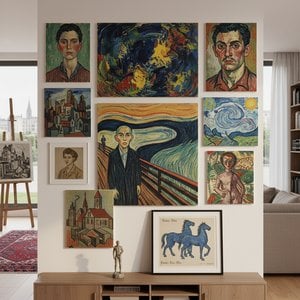
Expressionism's Soul: 10 Masterpieces for Your Home |
Journey into the soul of Expressionism! Explore 10 iconic paintings by Munch, Kirchner, Kandinsky & more. Discover their stories, bold colors & lasting impact. Find museum-quality art reproductions at .

Oil on Board Masters: 10 Paintings That Redefined Art | ArtsDot
Explore 10 legendary 'Oil on Board' masterpieces by Van Gogh, Monet & more! Discover art history, iconic styles like Impressionism, and find museum-quality reproductions to elevate your home decor. Explore the full collection online at ArtsDot.com.

Edvard Munch's Masterpieces: 25 Iconic Paintings for Art Lovers | ArtsDot
Explore 25 iconic Edvard Munch paintings, from 'The Scream' to lesser-known masterpieces. Discover the stories behind Expressionism’s most emotional works & find museum-quality art reproductions for your home at ArtsDot.com.


