

Edvard Munch's Masterpieces: 25 Iconic Paintings for Art Lovers | ArtsDot
Table of Contents
Introduction
To embark on a journey through the top 25 artworks of Edvard Munch is to step into a world where the veil between inner experience and outward reality dissolves. These paintings are not merely images; they are visceral echoes of the human condition, rendered with an intensity that continues to resonate across generations.
Born in Norway in 1863, Munch lived during a period of profound societal upheaval – the dawn of modernity, marked by rapid industrialization, shifting religious beliefs, and a growing sense of existential angst. The late 19th and early 20th centuries witnessed a questioning of traditional values, a rise in psychological exploration (think Freud’s groundbreaking work), and an increasing awareness of the darker undercurrents of human existence. Munch became a pivotal figure in this cultural landscape, channeling these anxieties into his art.
His life was deeply scarred by loss – the early deaths of his mother and sister to tuberculosis cast a long shadow over his emotional world. These experiences weren’t simply biographical details; they were formative forces that fueled his relentless exploration of themes like mortality, sickness, grief, and longing. He sought not to depict what he saw , but what he felt – a radical departure from the prevailing artistic norms of his time.
Munch’s influence extends far beyond the realm of painting. His work laid the groundwork for Expressionism, a movement that prioritized subjective emotion over objective representation. He dared to externalize inner turmoil, using distorted forms, jarring colors, and symbolic imagery to convey the raw intensity of human experience.
Today, these artworks remain profoundly meaningful because they speak to something universal within us all – the inescapable realities of suffering, loss, and the search for meaning in a chaotic world. They are a testament to the power of art to confront difficult truths, to offer solace in shared vulnerability, and to remind us that we are not alone in our emotional struggles.
Prepare to be moved, challenged, and perhaps even unsettled as we delve into the 25 most iconic works of this extraordinary artist. Each painting is a window into Munch’s soul – and, ultimately, into our own."
"The Scream - Edvard Munch
 The Scream - Edvard Munch
Before us hangs a painting that has become synonymous with the very feeling of being human – a primal scream echoing through the corridors of modern consciousness. This is The Scream by Edvard Munch, completed in 1893.
Born from a deeply personal experience—a walk at sunset where Munch felt overwhelmed by a sense of existential dread—the artwork transcends autobiography to become a universal symbol of anxiety and alienation. It emerged during a period of rapid societal change and philosophical questioning, perfectly capturing the zeitgeist of late 19th-century Europe.
Munch’s breakthrough lay in his rejection of representational accuracy in favor of conveying inner emotional experience. The distorted forms, swirling lines, and jarring color palette—fiery oranges against cool blues—aren't meant to depict a realistic scene but rather to externalize a psychological state. Notice the gaunt figure clutching its head, mouth agape in a silent cry; it’s not screaming at something, but from within.
The visible brushstrokes and textured surface amplify this raw intensity, drawing us into the vortex of Munch's despair. The two figures receding into the background underscore the protagonist’s isolation, a poignant reminder of our own vulnerability. Its inclusion among the top 25 artworks of Edvard Munch is not merely due to its iconic status but because it embodies his core artistic mission: to paint the soul.
Today, The Scream continues to resonate with audiences worldwide, serving as a powerful testament to the enduring power of art to confront difficult truths and transform spaces—and our emotions within them."
"Melancholy - Edvard Munch
 Melancholy - Edvard Munch
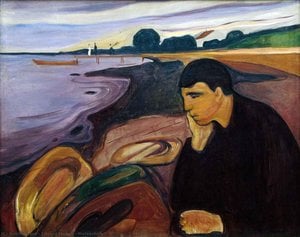
A profound stillness emanates from Melancholy by Edvard Munch, painted in 1894. It’s not a painting of joy or triumph, but one that dares to confront the weight of human sorrow – a quiet contemplation of isolation and loss.
This artwork is a cornerstone of Expressionism, embodying Munch’s radical departure from traditional representation. He wasn't interested in depicting what he saw, but rather in externalizing an internal state. The solitary figure seated on the shoreline isn’t merely a portrait; it’s a vessel for universal feelings of despair and longing.
Notice the compressed composition, the high horizon line that seems to press down upon the subject, amplifying their sense of confinement. The muted palette – blues, purples, and browns—evokes a pervasive gloom, while the visible brushstrokes add a raw intensity, mirroring the turbulence within. The figure’s dark clothing further isolates them from the vastness of the landscape.
Its inclusion among the top 25 artworks of Edvard Munch speaks to its enduring power to resonate with our deepest emotions. It's a reminder that even in moments of profound sadness, there is beauty and meaning to be found—a testament to the human spirit’s capacity for introspection.
At ArtsDot, we believe art should transform spaces, inviting contemplation and connection. Melancholy offers precisely this – a poignant reminder of our shared vulnerability, beautifully rendered for refined homes and sanctuaries."
"Madonna - Edvard Munch
 Madonna - Edvard Munch
There is a haunting vulnerability at the heart of Madonna by Edvard Munch, painted in 1894. It’s not an image of serene motherhood, but rather a raw and unsettling exploration of suffering, loss, and the weight of existence.
This artwork stands as a pivotal example of early Expressionism, embodying Munch’s radical departure from traditional artistic conventions. He eschews idealized representation in favor of conveying inner turmoil through swirling lines, distorted forms, and a deliberately jarring color palette. The skeletal features of the woman and the ghostly infant figure speak to inherited pain and the burdens of life.
Notice the double framing—a dark rectangle within an irregular orange shape—which heightens the sense of confinement and isolation. The visible brushstrokes and bold application of paint amplify this emotional intensity, drawing us into Munch’s deeply personal world. This work reflects not only universal themes of grief but also his own internal demons.
Its inclusion among the top 25 artworks of Edvard Munch speaks to its enduring power to confront difficult truths and resonate with our deepest emotions. It's a testament to the human spirit’s capacity for both suffering and resilience.
At ArtsDot, we believe in bringing such profound artistry into your home—faithful reproductions that preserve the emotion and texture of the original, allowing you to connect with Munch’s vision on a deeply personal level."
"Near the bed of death (fever) - Edvard Munch
 Near the bed of death (fever) - Edvard Munch
A quiet ache permeates Near the Bed of Death (Fever) by Edvard Munch, painted in 1915 – a haunting meditation on loss and the psychological weight of grief.
This artwork is a cornerstone of Expressionist art, embodying Munch’s radical commitment to conveying subjective emotional experience. It transcends mere depiction, offering an unflinching portrayal of mortality and the raw intensity of human suffering. The distorted figures, swirling compositions, and non-naturalistic color palette aren't meant to replicate reality but rather to externalize inner turmoil.
Notice the visible brushstrokes, applied with an impasto technique in places, adding physicality and rawness to the scene. Mask-like faces suggest suppressed emotions, perhaps reflecting societal expectations surrounding mourning. Flashes of red amidst the dominant blues and greens symbolize passion, pain, or the fading life force.
Its inclusion among the top 25 artworks of Edvard Munch speaks to its enduring power to confront difficult truths and resonate with our deepest anxieties. It’s a testament to the human spirit’s capacity for both sorrow and resilience.
At ArtsDot, we believe in bringing such profound artistry into your home—faithful reproductions that preserve the emotion and texture of the original, allowing you to connect with Munch’s vision on a deeply personal level and create spaces imbued with quiet prestige."
"Christmas in the Brothel - Edvard Munch
 Christmas in the Brothel - Edvard Munch
Unveiling Christmas in the Brothel by Edvard Munch is to encounter a rare intimacy – a glimpse into a world both vibrant and unsettling, painted with an emotional honesty that few artists achieve.
Created in 1905, this artwork secures its place among the top 25 for its masterful blend of bold color, dynamic brushstrokes, and profound psychological insight. It’s not merely a depiction of a scene but rather a visceral exploration of human connection—or perhaps disconnection—within the confines of modern life.
Notice the central figure engrossed in reading, her focused expression suggesting deep contemplation amidst the bustling energy of the brothel. The warm tones and visible brushstrokes create a sense of immediacy, drawing us into this intimate space. The painting’s power lies in its ability to evoke complex emotions—a quiet melancholy, perhaps, or a subtle yearning for connection.
Its enduring resonance speaks to our shared human experience, making it a compelling focal point for any refined interior. At ArtsDot, we believe in bringing such emotional intelligence into your home—faithful reproductions that preserve the texture and nuance of Munch’s vision, allowing you to connect with his artistry on a deeply personal level."
"Jealousy - Edvard Munch
 Jealousy - Edvard Munch
There’s a haunting stillness within Jealousy by Edvard Munch, painted in 1895 – a dreamlike tableau that explores the complexities of human emotion with an unsettling intimacy.
This artwork secures its place among the top 25 for its masterful use of color and form to convey psychological states. The vibrant red dress of the central figure—a beacon amidst the shadowy landscape—draws us into a world of passion, betrayal, and unspoken anxieties. It’s not merely a depiction of jealousy but rather an exploration of the raw emotions that consume us.
Notice the fluid lines, loosely defined shapes, and expressive brushstrokes – hallmarks of Munch’s signature Expressionistic style. The painting's power lies in its ambiguity, inviting viewers to interpret the scene through their own emotional lens. The dark-cloaked figures add a sense of mystery and foreboding.
Its enduring resonance speaks to our shared human experience, making it a compelling focal point for any refined interior. At ArtsDot, we believe in bringing such profound artistry into your home—faithful reproductions that preserve the texture and nuance of Munch’s vision, allowing you to connect with his work on a deeply personal level."
"Kiss - Edvard Munch
 Kiss - Edvard Munch
There is a quietude within Kiss by Edvard Munch that belies its profound emotional depth – a solitary figure enveloped in shadow, lost in contemplation.
This artwork secures its place among the top 25 for its masterful exploration of solitude and introspection. It’s not merely a depiction of grief but rather an evocation of the raw emotions that consume us—a testament to Munch’s ability to capture the essence of human experience.
Notice the loose, gestural brushstrokes and muted color palette, creating a sense of turbulence and emotional unrest. The single light source illuminates part of the figure, suggesting hope amidst darkness. The absence of distinct facial features invites viewers to project their own emotions onto the subject, forging a deeply personal connection.
Its enduring resonance speaks to our shared human experience, making it a compelling focal point for any refined interior. At ArtsDot, we believe in bringing such profound artistry into your home—faithful reproductions that preserve the texture and nuance of Munch’s vision, allowing you to connect with his work on a deeply personal level."
"Ashes - Edvard Munch
 Ashes - Edvard Munch
Imagine a forest steeped in shadow, where grief hangs heavy in the air and the scent of decay mingles with the last embers of hope—this is the world of Ashes by Edvard Munch, painted in 1894.
This artwork stands out among the top 25 for its haunting beauty and profound emotional depth. It’s not merely a depiction of loss but rather an evocation of the raw emotions that consume us—a testament to Munch’s ability to capture the essence of human experience.
Notice the muted color palette, dominated by earthy tones contrasted with the vibrant red of the woman's hair. The loose brushstrokes and visible texture add a sense of turbulence and emotional unrest. The enigmatic poses of the figures invite viewers to interpret the scene through their own lens, forging a deeply personal connection.
Its enduring resonance speaks to our shared human experience, making it a compelling focal point for any refined interior. At ArtsDot, we believe in bringing such profound artistry into your home—faithful reproductions that preserve the texture and nuance of Munch’s vision, allowing you to connect with his work on a deeply personal level."
"Girls on the Pier - Edvard Munch
 Girls on the Pier - Edvard Munch
A hush falls over the scene in Edvard Munch’s Girls on the Pier (1904), a nocturne of longing and unspoken anxieties. This isn't simply a depiction of figures by the sea; it’s an exploration of isolation, rendered with a palette of dusky pinks, bruised greens, and a swollen moon that casts long shadows over the water.
The painting’s power lies in its unconventional composition—a dramatic diagonal relentlessly drawing the eye towards a distant hotel, creating a sense of unease. The four young women positioned along this trajectory seem lost within their own thoughts, adrift in a space that feels both expansive and claustrophobic. Their postures are subtly melancholic, suggesting a shared burden of unspoken emotions.
Munch’s masterful use of color and visible brushstrokes—a hallmark of his Expressionistic style—underscores the painting’s intensely personal nature. Girls on the Pier is a testament to Munch's ability to translate psychological distress into visual form, resonating with viewers over a century later. It reminds us that even in moments of shared experience, profound solitude can exist.
The Military Band on Karl Johan Street - Edvard Munch
 The Military Band on Karl Johan Street - Edvard Munch
A wave of sound washes over you in Edvard Munch’s The Military Band on Karl Johan Street (1889), a captivating street scene that captures not just a moment in time, but the very pulse of urban anxiety.
This artwork secures its place among the top 25 for its innovative exploration of modern life and psychological tension. Munch doesn’t simply depict a band playing; he dissects the emotional impact of the crowd—their diverse reactions, their sense of detachment, their fleeting moments of connection.
Notice the bold brushstrokes and unsettling palette of yellows, blues, and reds, creating a sense of unease and disorientation. The painting’s energy is palpable, mirroring the vibrancy of city life while hinting at a deeper psychological turmoil. The Military Band on Karl Johan Street reminds us that even in moments of shared experience, profound solitude can exist.
Man and Woman I - Edvard Munch
 Man and Woman I - Edvard Munch
A shared breath, a silent understanding—a moment suspended between intimacy and unease defines Edvard Munch’s Man and Woman I (1905). This isn't merely a depiction of two figures; it’s a raw, visceral plunge into the heart of human connection.
This artwork secures its place among the top 25 for its profound exploration of love, anxiety, and the complexities of shared experience. Munch distills these emotions into a carefully orchestrated symphony of color, line, and form—a somber palette punctuated by an arresting red background that intensifies the sense of unease.
Notice the bold brushstrokes and simplified forms, prioritizing emotional impact over precise detail. Man and Woman I reminds us that even in moments of closeness, a shared solitude can exist. Its enduring power lies in its ability to evoke not just what we see, but how it *feels*—a testament to Munch’s genius.
Mother and Daughter - Edvard Munch
 Mother and Daughter - Edvard Munch
A quiet contemplation, a shared silence—Edvard Munch’s Mother and Daughter (1897) captures an intimacy laced with unease. This isn't merely a portrait; it’s a haunting exploration of connection, vulnerability, and the anxieties inherent in human relationships.
This artwork secures its place among the top 25 for its masterful use of color and brushwork—a muted palette and agitated strokes that convey a sense of restlessness. The composition, with its diagonal lines and symbolic clock, mirrors the emotional tension simmering beneath the surface.
Mother and Daughter embodies the core tenets of Expressionism, prioritizing subjective experience over objective observation. Its enduring power lies in its ability to evoke not just what we see, but how it *feels*—a testament to Munch’s genius. Today, this painting's palette and mood resonate with a desire for serene yet emotionally resonant spaces.
Virginia creeper red 2 - Edvard Munch
 Virginia creeper red 2 - Edvard Munch
A crimson pulse against a shadowed sky—Edvard Munch’s Virginia Creeper Red 2 (1898) isn't simply a landscape; it’s a visceral echo of modern anxiety. This artwork secures its place among the top 25 for its haunting exploration of isolation and decay.
Notice the intense red dominating the scene—not as realistic color, but as a symbolic expression of inner turmoil. The composition feels unbalanced, with a solitary figure dwarfed by the looming architecture, their gaze directly engaging you in an unnerving intimacy.
Munch’s Expressionist technique—distorted forms and bold brushstrokes—prioritizes subjective experience over objective reality. Virginia Creeper Red 2 reminds us that even within a seemingly tranquil setting, profound unease can simmer beneath the surface. Its enduring power lies in its ability to evoke not just what we see, but how it *feels*—a testament to Munch’s genius.
Starry Night - Edvard Munch
 Starry Night - Edvard Munch
Before a name is spoken, imagine a night sky alive with swirling energy—a cosmos rendered not as observed reality, but as felt emotion. This is Starry Night (1893) by Edvard Munch, a work that transcends its historical moment to become an enduring symbol of the human condition.
Securing its place among the top 25 artworks, Starry Night showcases Munch’s mastery of Expressionism—a bold use of color and distorted forms conveying deep psychological intensity. The vivid blues and greens pulse with life, while the swirling clouds seem to echo the artist's inner turmoil.
The painting isn’t merely a depiction of a landscape; it’s an exploration of isolation, longing, and the sublime power of nature. Its enduring power lies in its ability to evoke not just what we see, but how it *feels*—a testament to Munch’s genius. Today, Starry Night reminds us that art can transform spaces, inviting serenity and reflection into our daily lives.
Moonlight - Edvard Munch
 Moonlight - Edvard Munch
Imagine a stillness so profound it hums—a Norwegian coastline bathed in the ethereal glow of moonlight, where shadows dance and secrets linger. This is Moonlight (1895) by Edvard Munch, a work that transcends mere landscape to become an exploration of solitude and the sublime.
Securing its place among the top 25 artworks, Moonlight exemplifies Munch’s mastery of Expressionism—a simplified composition dominated by strong vertical elements and a muted palette of blues and whites. The painting isn't about what is *seen*, but how it *feels*—a quiet tension that underscores the beauty of the scene.
The absence of human figures invites introspection, allowing viewers to project their own emotions onto the tranquil yet mysterious landscape. Moonlight reminds us that art can transform spaces, inviting serenity and a sense of connection with nature into our daily lives.
Self-Portrait with Wounded Eye - Edvard Munch
 Self-Portrait with Wounded Eye - Edvard Munch
Before a face is recognized, imagine a quiet desperation—a gaze turned inward, shadowed by fear and the encroaching darkness of mortality. This is Self-Portrait with Wounded Eye (1930) by Edvard Munch, a work that transcends self-representation to become a visceral embodiment of vulnerability.
Securing its place among the top 25 artworks, this painting reveals Munch’s raw honesty and deliberate sparseness. Created during a period of failing eyesight, it isn't about polished technique but about capturing an internal struggle—a fleeting moment of introspection rendered in earthy tones and sketchy lines.
The limited palette and visible canvas ground amplify the feeling of fragility, inviting viewers to connect with Munch’s pain on a deeply personal level. Self-Portrait with Wounded Eye reminds us that art can transform spaces, offering a poignant reflection on the human condition.
untitled (7446) - Edvard Munch
 untitled (7446) - Edvard Munch
Before a narrative is sought, imagine a haunting echo—two figures adrift within an ambiguous space, their silence speaking volumes about isolation and longing. This is untitled (7446) by Edvard Munch, a work that distills anxieties into a visually arresting scene.
Securing its place among the top 25 artworks, this painting exemplifies Munch’s mastery of Expressionism—a chaotic composition dominated by blurred shapes and a cool palette punctuated by striking crimson accents. The heavily textured *impasto* style and loose brushstrokes amplify the emotional intensity, inviting viewers to project their own interpretations onto the scene.
More than a depiction of figures in a landscape, untitled (7446) is an exploration of the inner world—a poignant reminder that art can transform spaces, offering a powerful reflection on the universal human condition.
Vampire - Edvard Munch
 Vampire - Edvard Munch
Unveiled to a discerning eye, Vampire (1893-94) by Edvard Munch is not merely a painting—it’s an exploration of the darker currents within human connection. Securing its place among the top 25 artworks, this Symbolist masterpiece distills anxieties and desires into a hauntingly beautiful scene.
The intertwined figures, bathed in muted earth tones and dominated by the woman's fiery red hair, evoke both intimacy and entrapment. Munch’s masterful use of color and composition creates a claustrophobic atmosphere, amplifying the psychological tension within the work. The ambiguous narrative—is it love or something more sinister?—invites viewers to project their own emotions onto the scene.
More than a depiction of figures, Vampire is a reflection on vulnerability and the complexities of relationships—a timeless piece that continues to resonate with those seeking art that speaks to the depths of the human experience.
Vampyren nasjonalgalleri oslo - Edvard Munch
 Vampyren nasjonalgalleri oslo - Edvard Munch
Before a gaze is met, imagine an embrace steeped in both passion and unease—a closeness that hints at vulnerability and perhaps even danger. This is Vampyren (The Vampire) by Edvard Munch, a work that transcends simple representation to explore the darker currents of human connection.
Securing its place among the top 25 artworks, this Symbolist masterpiece distills anxieties into an intimate scene dominated by intertwined figures and a dramatic palette. Munch’s signature expressive style—loose brushwork, organic shapes, and intense red light—creates a claustrophobic atmosphere that amplifies the emotional weight of their interaction.
More than just a depiction of love or loss, Vampyren is a reflection on the complexities of intimacy—a timeless piece that continues to resonate with those seeking art that speaks to the depths of the human experience.
Model in Front of the Verandah - Edvard Munch
 Model in Front of the Verandah - Edvard Munch
A stillness hangs heavy—a moment suspended between anticipation and apprehension. This is Model in Front of the Verandah (1942) by Edvard Munch, a work that embodies the core tenets of Expressionism and secures its place among the top 25 artworks.
Created during a period of intense personal struggle, this oil-on-canvas painting isn’t merely a depiction of a scene; it's an immersion into a profound state of psychological unease. The muted palette dominated by earthy browns and ochres is punctuated by the startlingly vibrant red of the doorway—a focal point that acts as both invitation and warning.
Munch’s genius lies in his ability to translate personal torment into universally resonant imagery, inspiring a sense of contemplative solitude that continues to captivate. The artwork's aesthetic—its quiet intensity and evocative use of color—resonates with modern interiors seeking to evoke serenity and introspection.
Cree (casein on cardboard) 2 - Edvard Munch
 Cree (casein on cardboard) 2 - Edvard Munch
A silence echoes—a raw emotion captured on cardboard, frozen in time. Cree (casein on cardboard) 2 (1893) by Edvard Munch is not simply a painting; it’s an intimate glimpse into the artist's soul, securing its place among the top 25 artworks.
This casein-on-cardboard work embodies the core tenets of Expressionism—a movement that sought to convey inner emotional experiences rather than objective reality. The muted palette and textured surface amplify a sense of isolation and despair, while the solitary figure evokes feelings of vulnerability and anguish.
Munch’s genius lies in his ability to translate personal torment into universally resonant imagery, inspiring a quiet contemplation that continues to captivate. Its harmony—a balance of somber tones and raw emotion—resonates with modern interiors seeking to evoke serenity and introspection.
Eye in Eye - Edvard Munch
 Eye in Eye - Edvard Munch
A silent exchange—a gaze that penetrates, a connection both intimate and unsettling. Eye in Eye (1894) by Edvard Munch is not merely a painting; it’s a visceral exploration of the human condition, rightfully securing its place among the top 25 artworks.
This arresting canvas commands attention with its bold colors and raw emotional intensity—a cornerstone of Expressionism. The muted palette and deliberately rough-hewn technique amplify a sense of melancholy and unease, mirroring the psychological landscape Munch so masterfully explored.
At ArtsDot, we believe in making great art accessible, allowing you to bring this timeless piece into your home—a subtle reminder of the power of connection and the beauty found within vulnerability.
Death of Marat I - Edvard Munch
 Death of Marat I - Edvard Munch
A haunting stillness—a moment suspended between tragedy and torment. Death of Marat I (1907) by Edvard Munch is not merely a depiction of a historical event; it’s a visceral exploration of mortality, political violence, and the enduring scars of personal suffering, securing its place among the top 25 artworks.
This iconic image transcends its subject matter with dramatic composition—a stark contrast between the pale figure of Marat and the determined woman tending to him. The painting’s palette—bruised purples, sickly greens, and stark whites—evokes a sense of decay and unease, mirroring Munch's own emotional turmoil.
At ArtsDot, we believe in bringing this profound piece into your home—a subtle reminder of the power of art to evoke contemplation and inspire introspection.
Meeting - Collection of Nadia and Jacob Stolt-Niel - - Edvard Munch
 Meeting - Collection of Nadia and Jacob Stolt-Niel - - Edvard Munch
A silent gathering—three figures poised against a dramatic landscape, their emotions echoing through time. Meeting - Collection of Nadia and Jacob Stolt-Niel (1921) by Edvard Munch is not merely a painting; it’s an intimate exploration of human connection and existential contemplation, securing its place among the top 25 artworks.
This captivating piece embodies Expressionist principles—a deliberate rejection of realistic representation in favor of conveying inner feelings. The cliff face symbolizes instability, while the cascading waterfall represents the relentless force of nature, mirroring Munch’s preoccupation with mortality and anxiety.
At ArtsDot, we believe in bringing this profound piece into your home—a subtle reminder of the power of art to evoke contemplation and inspire introspection.
Girl Combing Her Hair - Edvard Munch
 Girl Combing Her Hair - Edvard Munch
A portrait of quietude—a moment suspended between introspection and melancholy. Girl Combing Her Hair (1892) by Edvard Munch is not merely a depiction of domesticity; it’s a profound exploration of the human psyche, securing its place among the top 25 artworks.
This oil-on-canvas work exemplifies the core tenets of Expressionism—a movement that sought to convey subjective emotions. The muted blues and greens create a sense of stillness, punctuated by warmer highlights suggesting vulnerability beneath composure.
At ArtsDot, we believe in bringing this timeless piece into your home—a subtle reminder of the power of art to evoke contemplation and inspire introspection.
Conclusion
As the light fades, we leave these canvases—not as relics of a distant past, but as living echoes of human experience. Edvard Munch’s masterpieces are not simply paintings; they are portals into the depths of emotion, testaments to our shared vulnerabilities and enduring longings.
To encounter his work is to recognize oneself in the shadows, to find solace in the beauty of melancholy, and to be reminded that even in the face of existential dread, there exists a profound capacity for feeling. These images—born from personal turmoil yet resonating with universal truth—continue to move hearts, shape interiors, and inspire creativity across generations.
We invite you to continue your journey through Munch’s world—to explore the full breadth of his artistic vision and discover the pieces that speak most deeply to your own soul. You can find our full collection here, where these timeless works await, ready to bring their quiet power into your home.
Related Articles

Echoes of a Turning Century: Art & Symbolism at the Dawn of Modernity
Explore the artistic responses to the turning of the 19th century – Symbolism & Post-Impressionism. Discover Munch, Toulouse-Lautrec, and more with ArtsDot's expert insights.


Egon Schiele: Expressionism, Anxiety & the Modern Condition – A Comprehensive Exploration
Explore the emotionally charged world of Egon Schiele (1890-1918). Discover his Expressionist masterpieces, psychological themes, and lasting impact on modern art. A comprehensive guide for collectors & enthusiasts.

