


 Preview
 Send
Send Share
Share
 Details
 Guide
Guide

 Download
 Similars
 X-Ray
X-Ray Diaporama
 Stats
StatsLandscape
 Oil On Canvas
- WallArt
- Dutch Golden Age Landscape
 1670
1670 24.0 x 30.0 cm
 Hermitage Museum
 Read More
Giclée / Art Print
Museum-quality giclée or canvas print with fast production and flexible finish options. ( Buy Hand Made Painting Switch to Digital Image)




P118B $10

P118H $10

P118W $10

P438Z $10

P508JH $12

P508YH $12

P805H $10

P805Z $10

P919BZ $10

P919G $10

P919XJ $10

P959ZH $10

P968JZ $12

W106C $8

W218G $10

W218JH $8

W218Y $10

W307PJ $10

W316G $10

W316PJ $8

W316Y $10

W398PJ $8

W4111J $10

W500HY $15

W500JH $15

W692G $12

W849H $8

W940BG $15

W953PJ $8




Pick from our preset sizes that match the artwork's original proportions.

Type the width and the height you need, to fit your frame or your wall. A print can only be cut, never made bigger than the picture, so a size with a different shape loses a part of the image. We send you a digital mockup to approve before we print anything. The picture shown on this page does not show the real cut — only the mockup does.
Worldwide Delivery () in 2 weeks instead of standard 4/5 weeks. (23 October)

Free Worldwide Express Shipping

High-Quality Linen Canvas

Full Shipping Insurance

Customs Tax Refund Guarantee

True Color Matching Guarantee

100-Day Return Policy (Defects Only)

100% Money-Back Guarantee

Bulk Discount Offer
 Glass option is only available in size under 110 CM

Landscape
Giclée / Art Print
Reproduction Size
-


Total Price
$ 63
Dirk van Bergen: A Master of Tranquil Dutch Landscapes
Dirk van Bergen (c. 1645 – Haarlem, ca. 1700) stands as a cornerstone of the Dutch Golden Age landscape tradition, celebrated for his masterful depictions of rural Dutch scenes imbued with subtle mythological elements and an unwavering commitment to serene beauty. Unlike many contemporaries who embraced dramatic chiaroscuro and turbulent compositions, Van Bergen cultivated a distinctive aesthetic characterized by meticulous detail and a profound reverence for natural harmony.
Early Life & Training
Born in Haarlem around 1645, Van Bergen’s artistic journey began under the tutelage of Adriaen van de Velde in Amsterdam. This formative influence instilled in him a foundational understanding of atmospheric perspective and compositional balance – techniques that would become hallmarks of his entire oeuvre. Van de Velde's emphasis on realism combined with careful observation of light and shadow provided Van Bergen with invaluable tools for capturing the essence of Dutch countryside.
Style & Technique
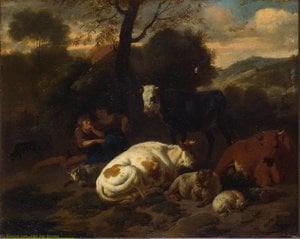
Van Bergen’s signature style is marked by an extraordinary level of precision, particularly in rendering the textures of foliage and animal fur. He favored muted palettes dominated by greens, browns, and blues – colors that evoke a palpable sense of peace and contemplation. His brushstrokes are delicate yet confident, conveying a remarkable sensitivity to nuance and subtlety. Rather than striving for grand spectacle, Van Bergen sought to distill the grandeur of nature into understated elegance.
Historical Context & Mythological Influence
Van Bergen’s landscapes emerged during a period of considerable artistic innovation in Holland, coinciding with the burgeoning interest in classical mythology and humanist ideals. While he eschewed overtly dramatic narratives, his paintings subtly incorporated mythological references – often symbolized by shepherds or cattle – reflecting the broader cultural preoccupation with themes of pastoral virtue and divine providence. These elements contribute to a deeper understanding of the artist’s worldview and enrich the visual experience.
Emotional Impact & Legacy
The enduring appeal of Dirk van Bergen's landscapes lies in their ability to transport viewers to tranquil Dutch vistas, fostering feelings of serenity and connection with the natural world. His meticulous attention to detail and masterful use of color create images that resonate with timeless beauty—a testament to his artistic genius and a lasting contribution to the legacy of Dutch landscape painting.
Additional Research: Explore Jan van Goyen’s groundbreaking approach to atmospheric perspective, mirroring Van Bergen's dedication to realism. Consider Wilhelm von Kobell’s influence on Van Bergen’s later work, highlighting the transmission of artistic principles across generations.
Questions & Answers
What medium is "Landscape" by Dirk Van Bergen executed in?
Dirk Van Bergen used the oil on canvas technique for "Landscape". The technique defines the material nature of the original work.
What color leads the composition of "Landscape" by Dirk Van Bergen?
The color that stands out most in "Landscape" is phthalo green (#221914). The dominant color is useful when matching an artwork to an interior.
Where can I see the original "Landscape" by Dirk Van Bergen?
The original "Landscape" by Dirk Van Bergen is held at the Hermitage Museum, Saint Petersburg, Russia. A reproduction allows the work to be displayed at home.
Related Artworks


Artist Biography
The Serene Vision of Dirk van Bergen
In the golden twilight of the Dutch Golden Age, few artists captured the quiet pulse of the countryside with as much tenderness as Dirk van Bergen. Born in the vibrant artistic hub of Haarlem around 1645, Van Bergen emerged during an era when the Netherlands was redefining the boundaries of landscape painting. His work does not shout with the dramatic turbulence found in some of his contemporaries; instead, it whispers of pastoral peace, inviting the viewer into a world where time seems to slow beneath a soft, atmospheric sky. Through his eyes, the Dutch landscape became more than mere topography—it became a sanctuary of light and tranquility.
Van Bergen’s artistic foundation was laid in Amsterdam under the watchful eye of Adria rien van de Velde, one of the most esteemed masters of the era. This apprenticeship was transformative, gifting him a profound understanding of atmospheric perspective and the delicate balance required to compose a scene that feels both expansive and intimate. From Van de Velde, he inherited a mastery of light that allowed him to render the subtle shifts in a midday sun or the hazy glow of an approaching dusk. As his style matured, he began to weave subtle threads of classical mythology into his rural settings, creating a unique dialogue between the humble reality of Dutch farming life and the lofty ideals of humanist tradition.
Technique and the Art of Detail
To observe a Van Bergen landscape is to embark on a journey of discovery through texture and tone. He possessed an extraordinary ability to render the tactile world, from the coarse hair of a resting bull to the delicate, translucent leaves of a summer canopy. His palette was intentionally restrained, favoring a harmonious blend of earthy browns, deep forest greens, and soft, ethereal blues. This muted color scheme served a higher purpose: it prevented any single element from overwhelming the composition, ensuring that the viewer’s eye could wander freely across the canvas, discovering small wonders in every corner.
While his brushwork was deliberate and precise, there remained an underlying fluidity that breathed life into his subjects. He avoided the harsh, jagged edges of dramatic chiaroscuro, opting instead for soft tonal gradations that mimicked the natural diffusion of light through moisture-laden air. This technique allowed him to create a sense of depth that felt almost palpable, as if one could step directly into the meadow. His ability to capture the weight of livestock and the gentle posture of a shepherdess contributed to a sense of profound realism, grounded in an unwavering commitment to natural harmony.
Legacy of the Pastoral Ideal
The significance of Dirk van Bergen lies in his role as a custodian of the pastoral idyll. While the art world often gravitates toward the revolutionary and the chaotic, Van Bergen’s oeuvre stands as a testament to the enduring power of the serene. His works, such as “Landscape with Mercury and Battus”, demonstrate how he could elevate a simple scene of cattle and shepherds into something timeless by infusing it with classical narrative. He bridged the gap between the everyday and the eternal, making the local Dutch landscape feel part of a much larger, universal story.
Though many of his paintings remain in small, intimate formats, their impact is monumental. His influence can be traced through the way he balanced the realism of the Dutch tradition with a poetic sensibility that would inspire later generations of landscape painters. Today, his legacy survives in the quiet majesty of his compositions, reminding us that there is profound beauty to be found in the stillness of a sun-drenched field and the rhythmic, peaceful existence of the natural world.
Dirk Van Bergen
1645 - 1700 , Netherlands
Quick Facts
- Full Name: Dirk van Bergen
- Nationality: Dutch
- Date Of Birth: 1645
- Date Of Death: 1700
- Place Of Birth: Haarlem, Netherlands
- Notable Artworks: ['Landscape with Mercury and Battus']
- Artistic Movement Or Style: Landscape Painting
- Artists Who Influenced This Artist: [Adriaen van de Velde]
Related Articles

Dutch Masters: 10 Golden Age Paintings That Still Inspire |
Journey into the Dutch Golden Age! Explore 10 iconic paintings by Rembrandt, Vermeer & Hals. Discover the stories behind these Baroque masterpieces and find museum-quality art reproductions to elevate your home decor on .

Charles Leickert: Capturing the Dutch Golden Age Light – A Comprehensive Study of Technique, Context, and Legacy
Explore the captivating winter landscapes of Charles Leickert, a master of Dutch Golden Age light & atmosphere. Discover his techniques, symbolism, and lasting legacy – a comprehensive study for art enthusiasts and collectors.

Golden Light & Dutch Skies: Bringing the Magic of Dutch Golden Age Landscapes into Your Home
Transform your home with the breathtaking light of Dutch Golden Age landscapes. Discover how hand-painted oil reproductions of masterworks like Ruisdael and Vermeer bring timeless elegance, atmosphere, and soulful texture to modern interiors. Elevate your space with museum-quality art.

Rembrandt's Masterpieces: Explore 25 Iconic Paintings & Prints | ArtsDot
Journey through Rembrandt van Rijn's 25 most iconic paintings & etchings. Explore Dutch Golden Age masterpieces, dramatic chiaroscuro, and timeless portraits. Find museum-quality art reproductions to elevate your home decor on ArtsDot.com.

Jan van Goyen: Master of Dutch Landscape & Atmospheric Perspective
Discover Jan van Goyen, the master of Dutch landscape painting. Explore his subtle technique, atmospheric realism & lasting influence on art history. Learn about this 17th-century pioneer at ArtsDot.

