


 Preview
 Send
Send Share
Share
 Details
 Guide
Guide

 Download
 Similars
 X-Ray
X-Ray Diaporama
 Stats
StatsAltarpiece
 Acrylic On Canvas
- WallArt
- Renaissance Revival
 1485
1485 236.0 x 198.0 cm
 Museum of Fine Arts
 Read More
Giclée / Art Print
Museum-quality giclée or canvas print with fast production and flexible finish options. ( Buy Hand Made Painting Switch to Digital Image)




P118B $10

P118H $10

P118W $10

P438Z $10

P508JH $12

P508YH $12

P805H $10

P805Z $10

P919BZ $10

P919G $10

P919XJ $10

P959ZH $10

P968JZ $12

W106C $8

W218G $10

W218JH $8

W218Y $10

W307PJ $10

W316G $10

W316PJ $8

W316Y $10

W398PJ $8

W4111J $10

W500HY $15

W500JH $15

W692G $12

W849H $8

W940BG $15

W953PJ $8




Pick from our preset sizes that match the artwork's original proportions.

Type the width and the height you need, to fit your frame or your wall. A print can only be cut, never made bigger than the picture, so a size with a different shape loses a part of the image. We send you a digital mockup to approve before we print anything. The picture shown on this page does not show the real cut — only the mockup does.
Worldwide Delivery () in 2 weeks instead of standard 4/5 weeks. (24 October)

Free Worldwide Express Shipping

High-Quality Linen Canvas

Full Shipping Insurance

Customs Tax Refund Guarantee

True Color Matching Guarantee

100-Day Return Policy (Defects Only)

100% Money-Back Guarantee

Bulk Discount Offer
 Glass option is only available in size under 110 CM

Altarpiece
Giclée / Art Print
Reproduction Size
-


Total Price
$ 63
A Vision of Faith Embodied: Exploring Bartolomeo Vivarini’s Altarpiece
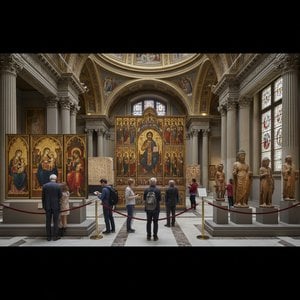
Fra Angelico, a name synonymous with serenity and spiritual illumination, stands apart from his contemporaries as an artist profoundly rooted in monastic devotion. Born around 1395 in Murano, Italy – the heartland of Venetian glassmaking – Guido di Pietro's life intersected seamlessly with his artistic endeavors, resulting in a corpus of work that continues to captivate audiences centuries later with its ethereal beauty and palpable sincerity. Unlike many artists of his era who catered to aristocratic patrons or wealthy mercantile families, Angelico’s unwavering allegiance resided within the sanctuary of San Domenico in Fiesole, where he served as a monk for nearly four decades. This singular environment profoundly influenced his artistic sensibilities, imbuing every brushstroke with an unmistakable aura of piety and a fervent aspiration toward divine grace. His formative years were spent honing his craft under Lorenzo Monaco, a Florentine maestro who championed humanist ideals alongside artistic excellence. Monaco’s influence instilled in Angelico a meticulous attention to detail and a masterful command of perspective—skills that would prove invaluable as he embarked on his monumental undertaking: the decoration of San Domenico's chapel. This ambitious project demanded not merely technical prowess but also an unwavering commitment to conveying theological concepts with breathtaking visual splendor. The resulting frescoes are considered among the finest achievements of Early Renaissance art, embodying Angelico’s profound understanding of Christian iconography and his ability to translate spiritual truths into unforgettable images.- Style: Florentine Gothic Revival – Vivarini's style reflects the stylistic trends prevalent in Florence during the mid-15th century, blending elements of Gothic tradition with emerging Renaissance ideals.
- Technique: Tempera and Gold Leaf – The altarpiece utilizes tempera paint—known for its luminosity and durability—combined with lavish gold leaf application. This technique was favored by artists of the period to enhance visual impact and convey a sense of majesty.
- Historical Context: Commissioned during Angelico’s tenure at San Domenico, the altarpiece served as a centerpiece of liturgical worship and aimed to inspire devotion among pilgrims visiting the basilica. It exemplifies the artistic fervor of the Renaissance, driven by papal patronage and fueled by renewed interest in classical art and philosophy.
- Recommended Reproduction Size: For optimal visual experience, consider commissioning a reproduction in 236 x 198 cm – capturing the grandeur and detail of the original artwork.
- Interior Design Inspiration: Integrate Vivarini's Altarpiece’s serene palette and symbolic motifs into contemporary interior spaces to create environments that foster contemplation and spiritual harmony.
Questions & Answers
Is "Altarpiece" a famous Renaissance Revival artwork?
"Altarpiece" is recorded as recognized among the Renaissance Revival works in the catalog.
What is the dominant color of "Altarpiece" by Bartolomeo Vivarini?
walnut (#685037) is the leading color of "Altarpiece" by Bartolomeo Vivarini.
How is the palette of "Altarpiece" by Bartolomeo Vivarini described?
The palette of "Altarpiece" by Bartolomeo Vivarini is described as earthy. It is a compact description of the work's colors.
Related Artworks


Artist Biography
A Legacy of Venetian Light and Devotion
In the vibrant, shimmering atmosphere of the Quattrocento, Bartolomeo Vivarini emerged as a pivotal figure in the evolution of Venetian painting. Born in the storied glassmaking hub of Murano, Italy, he was part of an influential dynasty of artists that helped shape the visual identity of the Republic of Venice. As a member of the Vivarini family, his life and work were deeply intertwined with the artistic pulse of his homeland, bridging the transition from the ornate, gilded traditions of the late Gothic period to the burgeoning humanism of the early Renaissance.
The artistry of Vivarini is characterized by a profound sense of spiritual depth and technical precision. While he was a master of tempera, often utilizing gold leaf to imbue his compositions with a celestial luxury, he was also an innovator in the use of new mediums. It is noted that he learned the art of oil painting from Antonello da Messina, and he is credited with producing what is believed to be the first oil painting in Venice around 1473. This mastery allowed him to manipulate light and texture in ways that brought a new level of intimacy and serenity to his religious subjects.
Mastery of Form and Symbolism
Vivarini’s work often presents a striking balance between hard, defined outlines and a rich, emotive color palette. His figures frequently possess a dignified and devout expression, capturing the solemnity required for the altarpieces that adorned Venetian basilicas. This ability to convey human emotion through structured forms made him a sought-after painter for significant religious commissions. A notable example of his skill is found in his Madonna and Child, where he uses light entering through windows and deep red drapery to create a sense of sacred space.
Beyond the figures themselves, Vivarini’s paintings are often layered with symbolic meaning:
- The use of gold: His frequent application of gold leaf serves not only as decoration but as a medium to represent divine light.
- Natural motifs: In a charming nod to his name—as vivarino translates to goldfinch in Italian—he occasionally included the small bird as a subtle signature within his works.
- Architectural depth: His compositions, such as the Conversano Polyptych, demonstrate a sophisticated understanding of perspective and the integration of sacred figures into complex, multi-paneled structures.
Historical Significance and Artistic Influence
The historical importance of Bartolomeo Vivarini lies in his role as a bridge between eras. He stood at the crossroads of the Byzantine-influenced traditions of his predecessors and the revolutionary Renaissance styles brought by artists like Fra Angelico and Giovanni Bellini. By blending these diverse influences, he helped establish a unique Venetian visual language—one that prioritized luminous color and emotional resonance.
His influence extended through his family lineage, notably impacting the work of his nephew, Alvise Vivarini, who would become a leading artist in Venice before the rise of Bellini. Through his meticulous detail and his pioneering adoption of oil techniques, Bartolomeo Vivarini left an indelible mark on the history of Italian art, ensuring that the spiritual and aesthetic grandeur of Murano and Venice would be preserved for generations to come.

Bartolomeo Vivarini
1440 - 1499 , Italy
Quick Facts
- Artistic Movement Or Style: Venetian Renaissance
- Artists Or Movements Influenced By This Artist: ['Alvise Vivarini']
- Artists Who Influenced This Artist:
- Antonello da Messina
- Fra Angelico
- Full Name: Bartolomeo Vivarini
- Nationality: Italian
- Notable Artworks:
- Madonna and Child
- Conversano Polyptych
- Triptych (detail)
- Place Of Birth: Murano, Italy
- Date Of Birth: 1440
- Date Of Death: 1499
Related Articles

Sacred Narratives on Canvas: Exploring Religious Scenes & Their Enduring Influence
Explore the rich history of religious art from Giotto to the Renaissance masters with ArtsDot. Discover symbolism, techniques & enduring legacies. Museum-quality reproductions available.
Sacred Narratives Embodied: A Comprehensive Exploration of Religious Iconography in Art History
Explore the rich history of religious iconography in art! Discover symbolism, movements & masterpieces from Byzantine to Renaissance periods. Expert insights for collectors and enthusiasts at ArtsDot.

Sacred Narratives on Canvas: Exploring Religious Painting Through History
Explore the rich history of religious painting with ArtsDot.com! Discover iconic artworks, symbolism & techniques from antiquity to the Renaissance. Enhance your art appreciation today.

Bartolomeo Pinelli: Neoclassical Linearity & Roman Topography of Memory
Explore the captivating world of Bartolomeo Pinelli, a master Italian engraver renowned for his evocative Roman scenes & historical narratives. Discover his art and legacy with ArtsDot.

Sacred Narratives on Canvas: Exploring Devotional Imagery Across Art History
Explore the rich history of devotional art! Discover iconic masterpieces, symbolism & techniques from antiquity to the Renaissance. Expert insights for collectors & enthusiasts at ArtsDot.


