


 Preview
 Send
Send Share
Share
 Details
 Guide
Guide

 Download
 Similars
 X-Ray
X-Ray Diaporama
 Stats
StatsYoung Man, the Young Waltonian
 Oil On Canvas
- WallArt
- Georgian Portraiture
 1750
1750 142.0 x 153.0 cm
 Government Art Collection
 Read More
Hand Made Oil Reproduction
Hand-painted oil on canvas in your size and frame, made to order by our artists. ( Switch to Print Switch to Digital Image)




P118B $10

P118H $10

P118W $10

P438Z $10

P508JH $12

P508YH $12

P805H $10

P805Z $10

P919BZ $10

P919G $10

P919XJ $10

P959ZH $10

P968JZ $12

W106C $8

W218G $10

W218JH $8

W218Y $10

W307PJ $10

W316G $10

W316PJ $8

W316Y $10

W398PJ $8

W4111J $10

W500HY $15

W500JH $15

W692G $12

W849H $8

W940BG $15

W953PJ $8




Pick from our preset sizes that match the artwork's original proportions.

You may enter your own dimensions to fit a specific frame or space. If your selected size does not match the original image's proportions, we will either crop the artwork or extend the painting with additional hand-painted elements. A digital mockup will be sent for your approval before production begins.
Please note that the on-screen preview does not reflect the actual cropping or extension. Only the mockup will accurately show the final composition.
While custom sizes are available, we recommend selecting a dimension from the predefined list to preserve the original proportions.
After order, ArtsDot.com team will email client for instructions and provide a mockup preview
Worldwide Delivery () in 3/4 weeks instead of standard 5 weeks. (25 September). No compromise on quality.

Free Worldwide Express Shipping

High-Quality Linen Canvas

Full Shipping Insurance

Customs Tax Refund Guarantee

True Color Matching Guarantee

100-Day Return Policy (Defects Only)

100% Money-Back Guarantee

Bulk Discount Offer
 Glass option is only available in size under 110 CM

Young Man, the Young Waltonian
Reproduction Medium
Reproduction Size
-


Total Price
$ 263
Young Man, the Young Waltonian: An Intimate Portrait of Georgian Elegance
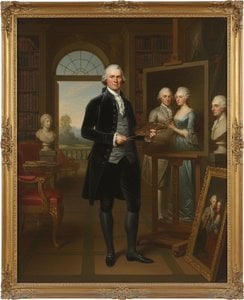
Arthur William Devis’s “Young Man, the Young Waltonian,” painted circa 1750, stands as a quintessential example of the conversation piece – a genre that flourished during the Georgian era and captured not just likeness but also social milieu. This captivating portrait resides within the Government Art Collection at Old Admiralty Building in London, offering visitors a glimpse into a period defined by refined sensibilities and burgeoning naval ambition. Measuring 142 x 153 cm, Devis’s masterful brushstrokes convey a remarkable level of detail, reflecting the meticulous observation characteristic of his artistic practice.A Window Into Georgian Society
The painting depicts a young gentleman posed confidently beside a dog, dressed in attire indicative of colonial influence – a subtle nod to Britain's expanding empire at the time. The pose itself is deliberately relaxed yet dignified, mirroring the social conventions of the period where portraiture served as both documentation and assertion of status. Devis skillfully captures not merely physical appearance but also an aura of intellectual curiosity and composure, qualities valued in Georgian gentlemen. The inclusion of two dogs adds to the scene’s narrative richness, symbolizing loyalty and companionship – themes prevalent within aristocratic circles.Technique and Artistic Style
Devis employed oil paint on canvas with remarkable precision, utilizing layering techniques to achieve luminous tonal gradations that illuminate the subject's face and clothing. His brushwork is characterized by delicate blending and subtle modeling, creating a palpable sense of texture and depth. This meticulous approach aligns perfectly with Devis’s reputation as a painter known for his “gentle hand,” emphasizing accuracy and subtlety rather than dramatic flair. The artist’s focus on capturing the nuances of human expression distinguishes him from more flamboyant contemporaries like Joshua Reynolds, establishing Devis as a champion of psychological realism within portraiture.Symbolism and Emotional Resonance
Beyond its depiction of an individual, “Young Man, the Young Waltonian” speaks to broader cultural values. The fishing rod symbolizes aspiration – reaching for achievement and mastering one's environment—a sentiment resonating with the ambitions of Georgian Britain. Furthermore, the serene setting contributes to a mood of contemplative contemplation, inviting viewers to consider themes of virtue and refinement. Devis’s ability to convey emotion through visual means elevates this portrait beyond mere likeness, transforming it into an enduring emblem of Georgian elegance and intellectual grace.Legacy and Rediscovery
Forgotten for much of the 20th century, “Young Man, the Young Waltonian” experienced a significant revival in scholarly interest during the latter half of the century. Art historians recognized Devis’s contribution to the conversation piece genre and celebrated his dedication to capturing the subtleties of human psychology. Today, reproductions of this artwork continue to inspire collectors and interior designers alike, offering a tangible connection to a bygone era—a testament to Devis's enduring artistic legacy.Related Artworks


Artist Biography
Arthur William Devis (1762–1822): The Gentle Hand of Portraiture and History
Arthur William Devis (19 February 1712 – 25 July 1787) was an English painter whose father, Anthony, was progenitor of what became a family dynasty of painters and writers. The place of Arthur Devis in art history is generally as painter of the type of portrait now called a conversation piece. After moving to London and apprenticeship to a Flemish topographical artist there, he switched to portraiture and acquired a considerable reputation, although this success did not last. Unable to adapt to later fashionable artistic currents, his commissions declined and his work was largely forgotten after his death until the 20th century revival of interest in the conversation piece.- Early Life & Training: Devis’s artistic talent emerged early on, fueled by a familial legacy steeped in artistic tradition. Following in the footsteps of his elder brother Thomas Anthony Devis, who was also a painter, he enrolled at the Royal Academy Schools in 1774, immersing himself in the rigorous training demanded by the era's leading artistic institution. His formative years were marked by exposure to influential figures like Sir Joshua Reynolds, whose teachings profoundly shaped Devis’s stylistic sensibilities.
- Notable Commissions & Travels: Devis gained recognition through his membership in the Free Society of Artists and continued to exhibit his work at the Royal Academy, attracting considerable acclaim. A pivotal moment arrived in 1783 when he was appointed as draughtsman on the British East India Company’s packet antelope under Captain Henry Wilson. Tragically, Devis suffered a serious injury during an encounter with Papuans near the Schouten Islands and subsequently endured a shipwreck on the Pelw islands—challenges that nevertheless spurred him to persevere in his artistic endeavors.
Style & Technique: The Delicate Stroke of Elegance
Devis’s artistic style is characterized by an exquisite sensitivity to detail and a masterful command of technique, particularly evident in his portraits. He favored graceful poses—often depicting subjects in moments of quiet contemplation—creating images imbued with understated beauty and psychological depth. His palette tended towards muted tones, reflecting the prevailing aesthetic preferences of the late 18th century, yet he achieved remarkable luminosity through careful layering of glazes and subtle gradations of color. Devis’s meticulous observation of anatomy combined seamlessly with an intuitive understanding of human expression, resulting in portraits that captured not only physical likeness but also inner character.- Conversation Pieces: Devis excelled at capturing the essence of domestic life through “conversation pieces”—genre paintings depicting scenes of familial gatherings or intimate interiors—a style highly valued during his time.
- Historical Subjects: Beyond portraiture, Devis undertook ambitious historical commissions, notably the depiction of Nelson’s death and a posthumous portrait honoring Admiral Horatio Nelson.
Significant Works & Legacy
Devis produced an impressive oeuvre encompassing approximately sixty-five paintings that graced the Royal Academy galleries between 1779 and 1821, cementing his reputation as one of London’s foremost artists. Among his most celebrated achievements include:- Portrait of Sir William Jones: This masterpiece resides at the British Library, showcasing Devis's exceptional skill in capturing dignified composure and intellectual curiosity.
- Nelson Portraits: His depictions of Nelson—both as Vice Admiral and posthumously—remain iconic representations of naval heroism and national pride.
- Other Notable Commissions: He undertook commissions for prominent figures such as King George III on horseback, Lord Howe, and Sir Roger Newdigate, demonstrating his versatility and artistic ambition.

arthur william devis
1712 - 1787 , United Kingdom
Quick Facts
- Artistic Movement Or Style: Portraiture; History Painting
- Artists Or Movements Influenced By This Artist: ['Conversation Piece']
- Artists Who Influenced This Artist: ['Joshua Reynolds']
- Date Of Birth: August 10, 1762
- Date Of Death: July 25, 1822
- Full Name: Arthur William Devis
- Nationality: English
- Notable Artworks:
- Death of Nelson
- Nelson Portraits
- Master Simpson
- King George III on Horseback
- Babington Plot
- Magna Carta
- Place Of Birth: London, United Kingdom
Related Articles

Arthur William Devis: A Provincial Eye on Georgian Life & Naval History
Explore the life & work of Arthur William Devis (1762-1822), a key figure in Georgian portraiture and naval history painting. Discover his intimate 'conversation pieces' and captivating depictions of colonial India. Learn more at ArtsDot.

John Hoppner: Portraiture, Patronage & British Identity in the Late Georgian Era
Explore the life & work of John Hoppner, a leading Georgian portraitist. Discover his vibrant style, influential patrons, and lasting impact on British art history. Expert insights for collectors.

Johann Zoffany: Capturing Georgian Society with Brushstrokes of Cosmopolitan Flair
Explore the captivating world of Johann Zoffany, master portraitist of Georgian society. Discover his unique 'conversation pieces,' imperial commissions & lasting legacy. A guide for discerning collectors.

Thomas Hudson: A Study in 18th-Century Portraiture & British Artistic Identity
Explore the life & work of Thomas Hudson, a leading 18th-century British portraitist. Discover his mastery of the 'Grand Manner,' influential style, and lasting impact on British art. Learn about his notable portraits like Judge William Noel & Alexander Van Aken.
Sir Nathaniel Dance-Holland: Portraiture, Patronage & Georgian Identity
Explore the life & art of Sir Nathaniel Dance-Holland, a leading Georgian portraitist. Discover his masterful technique, influential patrons, and lasting impact on 18th-century British society. A guide for discerning collectors.


