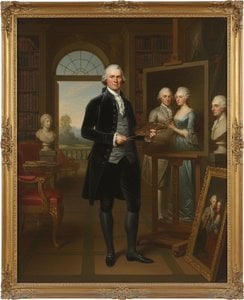
Early Life, Family and Training
Born on 26 December 1734 in Beckside, Dalton-in-Furness, Lancashire, George Romney entered a world of practical craftsmanship. He was the third of eleven children born to John Romney, a cabinet maker, and Anne Simpson. His early years were shaped by the domestic rhythms of a large family in the Northwest of England. While he attended school at nearby Dendron, his formal education was brief. He was withdrawn from his studies at the age of eleven to begin an apprenticeship in his father's cabinet making business.
The precision required by his father's trade likely informed his later attention to detail, yet his inclinations leaned toward something more illustrative. A local watchmaker sparked an early interest in drawing, providing a subtle redirection from the woodworking tools of his household. This nascent talent eventually led him away from the furniture workshop and toward the study of portraiture. He sought out Christopher Steele, a Kendal-based itinerant portraitist, to refine his skills. Under Steele, Romney began to transition from a craftsman's apprentice to a student of the human form.
Establishing a Reputation in London
By 1762, Romney had left the northern landscapes of Lancashire for the competitive atmosphere of London. He arrived in the capital seeking both fortune and recognition, driven by an ambition that extended beyond his early training. The city was a difficult crucible for a newcomer, yet he navigated its social complexities with a natural ease. He quickly established himself as a skilled portrait painter, finding a place within the high-society circles that dictated the era's aesthetic tastes.
His rise was marked by a direct competition with the most prominent figures of the age, including Thomas Gainsborough and Joshua Reynolds. While these contemporaries held significant influence, Romney carved out a distinct space for himself. He became one of the most popular British portrait painters of the late eighteenth century, catering to a burgeoning merchant class and the established nobility alike. His ability to navigate the shifting social hierarchies of the Georgian era ensured his presence in the most fashionable salons of the time.
- 1763: Jacob Morland of Capplethwaite
- 1765: Portrait of a Lady
- 1767: Portrait of a Girl
Technique and Artistic Style
Romney’s approach to the canvas was defined by a delicate balance between meticulous detail and expressive brushwork. He favored a refined technique that avoided the heavy-handedness of some of his contemporaries, opting instead for soft brushstrokes that produced a sense of gentle realism. This method allowed him to render the subtle textures of fabric and skin with a quiet sophistication. His palette often relied on muted colors, which contributed to an atmosphere of calm and composure in his compositions. Rather than relying on dramatic artifice, he sought to capture the essence of his subjects through a keen understanding of human psychology, a quality reflected in the nuanced expressions he achieved.
His technical repertoire was broad, extending far beyond the finished oil on canvas. He was a prolific draughtsman who utilized sketches, cartoons, and even small thumbnail studies to work out his ideas. This disciplined practice allowed him to experiment with form and light before committing to a larger scale. His ability to translate these preliminary studies into polished portraits helped him navigate the competitive social landscape of London, where he was often called upon to portray the era's leading figures with both accuracy and grace.
- Portrait of Sir Chaloner Ogle, 1st Baronet (1782)
- Portrait of Thomas Greene
The Influence of Emma Hamilton
The trajectory of Romney’s creative output shifted profoundly upon his encounter with Emma Hart, the woman who would later be known as Lady Hamilton. She became far more than a frequent subject; she was his most celebrated model and a muse who exerted a powerful influence over his imagination. Their relationship was intense and all-consuming, a connection that deeply affected the artist's personal life and his professional focus. Through her, Romney found a way to move beyond the constraints of standard portraiture into more imaginative, poetic territory.
Under the spell of Emma, Romney produced a sequence of Shakespearean and other fancy subjects. These works allowed him to explore themes of fantasy and literary narrative, utilizing her expressive range to bring dramatic characters to life. He painted over 80 portraits of her, each attempt capturing a different facet of her personality. This period of intense collaboration saw him experimenting with composition and symbolism, moving toward the more imaginative and poetic canvases that defined his later years.
Later Years and Death
The final decade of Romney’s life was marked by a gradual retreat from the social circles that had once fueled his career. In 1794, illness began to seriously curtail his portrait practice, slowing the prolific output that had defined his peak years. This decline in productivity was not merely a matter of waning interest, but a physical struggle that shadowed his later years. The man who had once competed with the most prominent figures of the Georgian era found himself increasingly sidelined by his own health.
By 1799, the necessity of seeking respite became undeniable. Romney returned, in failing health, to Kendal to be with his wife, Molly. This period of convalescence in the Northwest was a quiet coda to a life spent in the bustling artistic hubs of London and Paris. He remained a powerful draughtsman even as his ability to undertake large-scale commissions diminished. He died in Kendal, Westmorland, England, on 15 November 1802. His remains were laid to rest in Dalton, returning him to the landscape of his birth.
Where to See the Works Today
The distribution of Romney’s surviving canvases reflects the geographic arc of his life, from his northern roots to his eventual prominence in the capital. In London, his presence is felt most strongly within the collections of the Tate Gallery, which preserves seventeen of his works, and the National Portrait Gallery, which holds ten. These institutions offer a view of the artist at the height of his social influence, capturing the faces of the Georgian era with the psychological depth that defined his career.
Beyond the capital, his connection to the Northwest remains visible through the holdings of the Abbot Hall Art Gallery in Kendal, which maintains nine of his paintings. This collection provides a link to the region where his life began and where it eventually reached its quiet conclusion. His reach extends across the Atlantic as well, with several works held by the Metropolitan Museum of Art in New York. Among these is the 1782 Portrait of Sir Chaloner Ogle, 1st Baronet.
- Portrait of Sir Chaloner Ogle, 1st Baronet (1782)
- The Leigh Family
- Portrait of Mrs. Verelst
Questions & Answers
Where are George Romney's artworks grouped by keywords?
To find works by George Romney on a specific theme, use the artist's By Keywords page, which groups the artworks by keyword.
Can I explore George Romney's works by color spectrum?
The Spectral Index page organizes George Romney's artworks by color.
What aliases or alternate names does George Romney have?
George Romney appears under the alternate names Georg Romney, Romney George, Romny, Geo Romney, Romney.