

 Preview
 Send
Send Share
Share
 Details
 Guide
Guide

 Download
 Similars
 X-Ray
X-Ray Diaporama
 Q&A
Q&A Stats
StatsPanic


 Read More
The artwork displayed on this page is protected by copyright law, which means we cannot legally create or sell an identical reproduction. This protection is enforced under international agreements such as the Berne Convention and by national laws, including those outlined by the U.S. Copyright Law - Title 17.
This method fully complies with copyright regulations because it does not involve copying or duplicating the protected artwork. Instead, it is a creative reinterpretation - a new painting that is influenced by the original but not identical to it.
Giclée / Art Print
Museum-quality giclée or canvas print with fast production and flexible finish options. ( Buy Hand Made Painting Switch to Digital Image)




P118B $10

P118H $10

P118W $10

P438Z $10

P508JH $12

P508YH $12

P805H $10

P805Z $10

P919BZ $10

P919G $10

P919XJ $10

P959ZH $10

P968JZ $12

W106C $8

W218G $10

W218JH $8

W218Y $10

W307PJ $10

W316G $10

W316PJ $8

W316Y $10

W398PJ $8

W4111J $10

W500HY $15

W500JH $15

W692G $12

W849H $8

W940BG $15

W953PJ $8




Pick from our preset sizes that match the artwork's original proportions.

Type the width and the height you need, to fit your frame or your wall. A print can only be cut, never made bigger than the picture, so a size with a different shape loses a part of the image. We send you a digital mockup to approve before we print anything. The picture shown on this page does not show the real cut — only the mockup does.
Worldwide Delivery () in 2 weeks instead of standard 4/5 weeks. (18 November)

Free Worldwide Express Shipping

High-Quality Linen Canvas

Full Shipping Insurance

Customs Tax Refund Guarantee

True Color Matching Guarantee

100-Day Return Policy (Defects Only)

100% Money-Back Guarantee

Bulk Discount Offer
 Glass option is only available in size under 110 CM

Panic
Giclée / Art Print
Reproduction Size
-


Total Price
$ 63
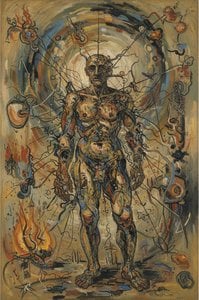
The Raw Nerve of Anxiety: Unpacking André Masson’s “Panic”
André Masson's "Panic," created in 1955, isn’t merely a painting; it’s an excavation. A visceral plunge into the turbulent depths of the human psyche, rendered with a frenetic energy that both unsettles and compels. This etching, executed on paper, captures a moment suspended between chaos and control, reflecting the anxieties simmering beneath the surface of post-war Europe – a period Masson himself deeply inhabited through his pioneering work in Surrealism and Automatism.
The composition immediately assaults the senses. A dominant teal background—a shade suggestive of both twilight and unease—is fractured by swirling, violently intertwined lines in shades of purple and magenta. These aren’t neat, controlled strokes; they are a deliberate act of disruption, mirroring the feeling of being overwhelmed by internal turmoil. The lack of a clear focal point forces the viewer's eye to dart across the surface, mimicking the restless, fragmented experience of panic itself. The overall effect is less about depicting a specific scene and more about conveying an intense emotional state – a raw, unfiltered expression of anxiety.
Automatism: A Journey Beyond Conscious Control
Masson’s technique—Automatism—was central to his artistic practice. Rejecting the constraints of rational thought and deliberate planning, he sought to tap into the unconscious mind through spontaneous action. In “Panic,” this manifests as a seemingly chaotic outpouring of lines, yet beneath the surface lies a carefully orchestrated process. Masson would often begin with sand drawings, allowing the subconscious to dictate the initial forms, then translate these images onto paper using various tools – in this case, etching techniques—to create the final image. This method aimed to bypass conscious control and reveal hidden emotions and associations.
The influence of Surrealism is undeniable, but Masson’s approach extends beyond simple dream imagery. He was deeply interested in primal emotions, exploring themes of violence, eroticism, and metamorphosis – all powerfully represented within the swirling forms of “Panic.” The piece echoes the work of artists like André Breton and Joan Miró, yet possesses a uniquely personal intensity, reflecting Masson's own struggles with psychological turmoil.
Symbolic Echoes: Violence, Repression, and the Unconscious
The imagery within "Panic" is rich in symbolic potential. The tangled lines can be interpreted as representing repressed emotions struggling to surface, a visual manifestation of internal conflict. The use of dark teal and vibrant purples and magentas creates a dramatic contrast, suggesting a battle between opposing forces – perhaps order versus chaos, reason versus instinct. Some viewers have noted the resemblance to organic forms—twisted limbs or distorted figures—suggesting a sense of fragmentation and loss of control.
Interestingly, Masson’s work frequently engaged with themes of violence, reflecting anxieties prevalent in post-war Europe. The piece can be seen as an exploration of the destructive potential within the human psyche – a warning against succumbing to overwhelming fear and losing oneself in the chaos of internal struggle. The title itself—"Panic"—underscores this central theme, encapsulating the feeling of being trapped within one’s own anxieties.
A Legacy of Raw Emotion: Masson's Enduring Impact
“Panic” stands as a powerful testament to André Masson’s innovative approach to art. It’s not a comfortable piece; it demands engagement and invites introspection. His exploration of Automatism, combined with his unflinching portrayal of psychological turmoil, cemented his place as a key figure in the Surrealist movement and beyond. Reproductions of this work continue to resonate today, offering a glimpse into the complexities of the human experience – a reminder that beneath the surface of everyday life, there often lies a turbulent landscape of anxieties and unresolved emotions.
Questions & Answers
Is "Panic" by André Masson a bright or a dark artwork?
In terms of perceived brightness, "Panic" by André Masson is brilliant.
Where do the visitors of "Panic" by André Masson come from?
The Stats page of "Panic" by André Masson presents public visit statistics: monthly visits of this artwork, a comparison with the artist's most viewed works, and where its visitors come from.
From which country does the Surrealist Automatic Drawing work "Panic" come?
"Panic" connects the Surrealist Automatic Drawing movement with France through its creator's birthplace.
Related Artworks


Artist Biography
André Masson: A Life in Art
- Born: Balagny-sur-Thérain, France (January 4, 1896)
- Died: 1987
Early Life and Artistic Training
- Masson began his artistic journey at the age of eleven, studying at the Académie Royale des Beaux-Arts in Brussels under Constant Montald. This early training provided a foundation for his later experimentation with various styles.
- His initial work showed an interest in Cubism, demonstrating an early engagement with modern art movements.
The Surrealist Period and Automatic Drawing
- Masson became a key figure within the Surrealist movement, enthusiastically embracing automatic drawing as a technique. This involved creating artwork without conscious control, allowing the subconscious to guide the hand.
- He collaborated with other prominent figures of the era like Antonin Artaud, Michel Leiris, Joan Miró, Georges Bataille, Jean Dubuffet, and Georges Malkine, fostering a vibrant artistic community.
- Notable Techniques:
- Automatic Drawings: Numerous pen-and-ink works showcasing his innovative approach to art.
- Sand and Glue on Canvas: Experimentation with throwing sand and glue onto canvas, creating unique oil paintings based on the resulting shapes.
- His work during this period often explored violent or erotic themes, reflecting a departure from traditional artistic conventions.
Evolution and Later Works
- By the late 1920s, Masson moved away from Surrealism, developing a more structured style influenced by artists like André Derain. This is evident in his landscape paintings.
- During World War II, his work was condemned as "degenerate" by the Nazis. He escaped to the United States with assistance from Varian Fry, significantly impacting American Abstract Expressionists like Jackson Pollock.
- After returning to France, Masson settled in Aix-en-Provence and focused on landscape painting, demonstrating a shift towards more naturalistic subjects.
Legacy and Influence
- André Masson's pioneering work in Surrealism and automatic drawing left an enduring legacy on the art world.
- His influence can be seen across various artistic movements, from Cubism to Abstract Expressionism, solidifying his position as a pivotal figure in modern art history.
- Masson’s exploration of subconscious imagery and innovative techniques continue to inspire artists today.

André Masson
1896 - 1987 , France
Quick Facts
- Full Name: André Aimé René Masson
- Nationality: French
- Date Of Birth: 1896
- Date Of Death: 1987
- Place Of Birth: Balagny-sur-Thérain, France
- Notable Artworks:
- Beyond
- Landscape with Rocks
- The metamorphosis of the lovers
- Pygmalion
- Artistic Movement Or Style:
- Surrealism
- Cubism
- Artists Who Influenced This Artist: ['André Derain']
- Artists Or Movements Influenced By This Artist:
- Jackson Pollock
- Abstract Expressionism
Related Articles

Unveiling Inner Worlds: Exploring Psychological Depth in 20th & 21st Century Art
Explore the profound psychological themes within 20th & 21st-century art. Discover Expressionism, Surrealism & more – and learn how to collect impactful pieces with confidence. Expert insights for discerning collectors.

Emotional Transmutation in Visual Art: A Study of Affective Representation Through Color, Form, and Texture
Explore the fascinating intersection of art & emotion! Discover how color, form, and texture convey feelings in masterpieces. Expert analysis for collectors & enthusiasts.

Beyond Representation: Decoding Emotion and Meaning in Modern Abstract Art
Explore the profound world of Abstract Expressionism with ArtsDot. Discover its history, emotional power & key artists like Pollock & Rothko. Expert insights for collectors & art lovers.

The Architecture of Anxiety: Examining the Raw Emotional Intensity of Expressionism
Explore the raw psychological depth of Expressionism through Munch and Klee. Dive into the anatomy of anxiety today.
André Masson: Automatism, Surrealism & Primal Expression in 20th-Century Art
Explore the revolutionary art of André Masson – pioneer of automatism & Surrealist expression. Discover his powerful imagery, innovative techniques, and lasting influence on modern art. Learn more at ArtsDot.


