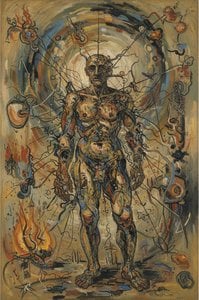
André Masson: A Life in Art
- Born: Balagny-sur-Thérain, France (January 4, 1896)
- Died: 1987
Early Life and Artistic Training
- Masson began his artistic journey at the age of eleven, studying at the Académie Royale des Beaux-Arts in Brussels under Constant Montald. This early training provided a foundation for his later experimentation with various styles.
- His initial work showed an interest in Cubism, demonstrating an early engagement with modern art movements.
The Surrealist Period and Automatic Drawing
- Masson became a key figure within the Surrealist movement, enthusiastically embracing automatic drawing as a technique. This involved creating artwork without conscious control, allowing the subconscious to guide the hand.
- He collaborated with other prominent figures of the era like Antonin Artaud, Michel Leiris, Joan Miró, Georges Bataille, Jean Dubuffet, and Georges Malkine, fostering a vibrant artistic community.
- Notable Techniques:
- Automatic Drawings: Numerous pen-and-ink works showcasing his innovative approach to art.
- Sand and Glue on Canvas: Experimentation with throwing sand and glue onto canvas, creating unique oil paintings based on the resulting shapes.
- His work during this period often explored violent or erotic themes, reflecting a departure from traditional artistic conventions.
Evolution and Later Works
- By the late 1920s, Masson moved away from Surrealism, developing a more structured style influenced by artists like André Derain. This is evident in his landscape paintings.
- During World War II, his work was condemned as "degenerate" by the Nazis. He escaped to the United States with assistance from Varian Fry, significantly impacting American Abstract Expressionists like Jackson Pollock.
- After returning to France, Masson settled in Aix-en-Provence and focused on landscape painting, demonstrating a shift towards more naturalistic subjects.
Legacy and Influence
- André Masson's pioneering work in Surrealism and automatic drawing left an enduring legacy on the art world.
- His influence can be seen across various artistic movements, from Cubism to Abstract Expressionism, solidifying his position as a pivotal figure in modern art history.
- Masson’s exploration of subconscious imagery and innovative techniques continue to inspire artists today.
Questions & Answers
Where can I see André Masson's artworks in chronological order?
A timeline of André Masson's works exists: the artist's Artwork Timeline page orders the artworks by creation date.
What other names is André Masson known by?
André Masson is also known as Masson, أندريه ماسون, Андре Масон, Αντρέ Μασόν, アンドレ・マッソン.
Can I explore André Masson's works by keyword?
André Masson's works can be explored by keyword on the artist's By Keywords page. Each keyword groups the related artworks.