


The picture follows your choices: , .
Collectible Description
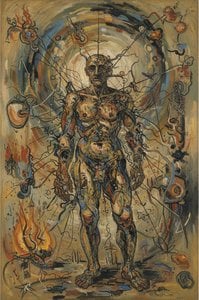
Explore Masson's 'Leda,' a powerful 1947 Surrealist Expressionism masterpiece. Abstract lines & forms evoke desire, transformation & the myth of Leda and Zeus.
 Read More
Artist Biography
Explore André Masson's art: Surrealist pioneer known for automatic drawing & sand paintings. Discover his influence on abstract expressionism & evocative themes of violence, eroticism & metamorphosis.
This Artwork Is Under Copyright Protection
The artwork displayed on this page is protected by copyright law, which means we cannot legally create or sell an identical reproduction. This protection is enforced under international agreements such as the Berne Convention and by national laws, including those outlined by the U.S. Copyright Law - Title 17.
As a respectful and legal alternative, we offer custom, hand-painted artworks inspired by the original. Our skilled and professional artists carefully study the original's style, mood, and artistic essence to create a new, unique piece that evokes the same feeling - while remaining an original creation in its own right.
This method fully complies with copyright regulations because it does not involve copying or duplicating the protected artwork. Instead, it is a creative reinterpretation - a new painting that is influenced by the original but not identical to it.
Order your in four simple steps
Take your time. You can change any answer; the price in your order card follows each choice.
1 Step one of four
Which size would you like?
These sizes keep the proportions of the original painting. The drawing shows your choice on a wall, above a two-metre sofa.
Or give your own measurements
Pick from our preset sizes that match the artwork's original proportions.

Type the width and the height you need, to fit your frame or your wall. This is hand-painted, so for a size with a different shape the artist can paint a bit more around the picture, or cut a bit — you choose. We send you a digital mockup to approve before the painting starts. The picture shown on this page does not show the real result — only the mockup does.
2 Step two of four
How should it be prepared: rolled, stretched or framed?
The prices below are for the size you chose in step one.
Choose the edges of the stretched canvas
Choose your frame

White $1

Blurside $1

Extended $1

P118B $10

P118H $10

P118W $10

P438Z $10

P508JH $12

P508YH $12

P805H $10

P805Z $10

P919BZ $10

P919G $10

P919XJ $10

P959ZH $10

P968JZ $12

W106C $8

W218G $10

W218JH $8

W218Y $10

W307PJ $10

W316G $10

W316PJ $8

W316Y $10

W398PJ $8

W4111J $10

W500HY $15

W500JH $15

W692G $12

W849H $8

W940BG $15

W953PJ $8

H24-GOLD $30

H24-SILVER $30

H36-GOLD $45

H36-SILVER $45
Framed
Moulding: . Overall size with the frame: .
3 Step three of four
Would you like anything changed in the painting?
Most people answer no. Because each painting is made by hand, our artist can also adapt it for you.
After order, ArtsDot.com team will email client for instructions and provide a mockup preview
4 Step four of four
A few finishing options
All of them are optional. The answers already selected cost nothing extra.
Who paints it?
Worldwide Delivery () in 3/4 weeks instead of standard 5 weeks. (20 November). No compromise on quality.
A nameplate, as in a museum?
Engraved Bronze Plaque Details
This elegant plaque features the artist's name and the title of the artwork, finely engraved for a timeless presentation.
It is made from bronze with a refined, elegant finish. The text is precisely laser-engraved for a sharp and permanent result. Measuring 9x2 cm, the plaque is compact yet easy to read. It's built to be durable and scratch-resistant, offering a professional, museum-quality look. Mounting is simple thanks to the included adhesive backing.
Transparent Acrylic Plaque Details
The plaque includes essential engraved details such as the artist's name, the title of the artwork, the date it was created, the type of media used-like oil on canvas or watercolor-a brief description of the piece, and a QR code that links to the complete artwork information.
It is crafted from clear acrylic, offering a sleek, modern appearance. The text is UV-engraved in black to ensure strong visual contrast. With a size of 10x15 cm, it ensures optimal readability. It comes equipped with two metal hooks for secure wall mounting. The plaque is designed to be weather-resistant, making it suitable for various environments, and it includes interactive features that work seamlessly with smartphone scanning.
Black Acrylic Plaque Details
This elegant plaque includes engraved information such as the artist's name, the title of the artwork, the date it was created, the type of media used (like oil on canvas or watercolor), a short description of the artwork, and a QR code for quick access to more information.
The plaque itself is made from refined black acrylic with a premium finish. The text is laser-engraved in white for high contrast and readability. Its size is 10x15 cm, designed to be easy to read. It comes with two metal hooks for professional mounting. The design is sleek and fits any interior style. It is also weather-resistant and durable, with built-in digital integration for mobile compatibility.
A protective varnish?
When do you need it?
✓ Check and order
Your painting, as you ordered it

Leda
Reproduction Medium
Reproduction Size
-

Elite Senior Artist
More detail, finesse, and extra production time
-

Reproduction Frame
-
-
For artworks or reproductions larger than 105 cm (approximately 41 inches) on any side, the frame will be shipped as a kit, disassembled. This method ensures safe delivery and prevents damage during transport.
Professional assembly required - this is not a DIY product.
The kit must be assembled and the canvas stretched by an experienced professional framer, using wood glue (not supplied), a canvas stretching plier and clamps to hold the bars square while the glue dries. Incorrect assembly or uneven canvas tension can permanently damage the artwork and is not covered by our warranty.
 For artworks or reproductions larger than 105 cm (approximately 41 inches) on any side, the frame will be shipped as a kit, disassembled. This method ensures safe delivery and prevents damage during transport.
All solid wood bars are included, precisely cut to size.
Assembled with the screws provided, plus wood glue for the corner joints, which is not supplied and must be sourced by your framer.
Professional tools are required and not included: a canvas stretching plier (tensioner) and clamps to hold the bars square while the glue dries.
Important:
The corner joints require wood glue, the bars must be held with clamps until the glue is fully dry, and tightening the canvas on the assembled frame requires a canvas stretching plier. None of these are included in the kit. Please arrange an experienced professional framer before ordering this size.

Nameplate
-
-

Protective Varnish
Glossy Varnish (enhances colors, protects against light/moisture)
-

Customize My Artwork
Examples of what can be changed: Replace face with customer photo; Add pet (e.g., replace cat with dog); Include hidden message in background; Change background landscape or elements.
-

Urgent
Worldwide Delivery () in 3/4 weeks instead of standard 5 weeks. (20 November). No compromise on quality.
-
Express Shipping
Worldwide Delivery () in 5 weeks. (27 November).
Included
Total Price
$ 263
Glass option is only available in size under 110 CM
Included with every order
- Free Worldwide Express Shipping
- High-Quality Linen Canvas
- Full Shipping Insurance
- Customs Tax Refund Guarantee
- True Color Matching Guarantee
- 100-Day Return Policy (Defects Only)
- 100% Money-Back Guarantee
- Bulk Discount Offer


A Descent into Myth: Exploring Masson's "Leda"
André Masson’s 1947 work, “Leda,” is far more than a depiction of a classical myth; it's an intensely personal and psychologically charged exploration of desire, transformation, and the unsettling power dynamics inherent in the story of Leda and Zeus. The Greek myth recounts how Zeus, disguised as a swan, seduced or raped Leda, resulting in the birth of Helen of Troy and other children. Masson doesn’t offer a literal representation of this narrative. Instead, he channels the myth's emotional core through a powerful visual language rooted in Surrealism and Abstract Expressionism. This piece invites viewers to confront not just the story itself, but also the complex feelings it evokes – vulnerability, powerlessness, and the unsettling beauty that can emerge from chaos.Style & Technique: Automatic Drawing and Surrealist Expression
Masson was a pivotal figure in the Surrealist movement, deeply involved with its exploration of the unconscious mind. “Leda” exemplifies his embrace of *automatic drawing*, a technique championed by André Breton and other Surrealists aimed at bypassing conscious control to access raw, unfiltered creativity. The artwork is rendered entirely in shades of gray and black ink on paper, creating a striking monochromatic effect that amplifies the intensity of the swirling lines. The dense, scribbled application of these lines isn’t merely decorative; it's integral to the work's expressive power. It creates a palpable texture, almost as if one could feel the artist's hand moving across the surface. The style blends Surrealism’s dreamlike imagery with Abstract Expressionism’s emphasis on spontaneous gesture and emotional expression, resulting in a unique visual language that is both unsettling and captivating.Symbolism & Emotional Impact
The distorted forms of Leda and the swan are key to understanding the artwork's symbolic weight. The intertwining figures lack clear boundaries, suggesting a blurring of identities and a loss of control – central themes within the myth itself. The chaotic lines evoke feelings of anxiety, desire, and transformation. The absence of a defined background further intensifies this sense of disorientation, drawing the viewer into the swirling emotional vortex at the heart of the piece. While the swan traditionally represents beauty and grace, in Masson’s hands, it becomes an instrument of unsettling power, its form distorted and integrated with Leda's own, creating a complex visual metaphor for vulnerability and violation. The monochromatic palette reinforces this sense of unease, stripping away any potential for comforting color or light.Historical Context & Masson's Artistic Journey
Created in 1947, “Leda” reflects the post-war climate of existential questioning and psychological exploration that characterized much of Abstract Expressionism. Having witnessed the horrors of World War II, many artists sought to express profound emotional truths beyond traditional representational forms. Masson’s work, deeply rooted in Surrealist principles, aligns with this impulse. His early training encompassed Cubism, but his association with Surrealism led him to experiment extensively with automatic techniques and altered states of consciousness – all evident in the raw energy and psychological depth of “Leda.” His exploration of mythology wasn't merely academic; it was a means of delving into universal human experiences like desire, power, and transformation.Questions & Answers
How strong are the colors of "Leda"?
The colors of "Leda" by André Masson show a muted saturation with a monochromatic intensity.
How do I discover artworks close to "Leda" by André Masson?
Artworks similar to "Leda" by André Masson are gathered on the artwork's Similars page.
What stage of André Masson's development does "Leda" represent?
"Leda" belongs to the Mature Period of André Masson's career. This classification relates the work to the artist's development.
More about this painting
 Preview
 Switch to Print
 Send
Send Share
Share
 Details
 Guide
Guide

 Download
 Similars
 X-Ray
X-Ray Diaporama
 Q&A
Q&A Stats
StatsRelated Artworks


André Masson
1896 - 1987, France
Artist Biography
André Masson: A Life in Art
- Born: Balagny-sur-Thérain, France (January 4, 1896)
- Died: 1987
Early Life and Artistic Training
- Masson began his artistic journey at the age of eleven, studying at the Académie Royale des Beaux-Arts in Brussels under Constant Montald. This early training provided a foundation for his later experimentation with various styles.
- His initial work showed an interest in Cubism, demonstrating an early engagement with modern art movements.
The Surrealist Period and Automatic Drawing
- Masson became a key figure within the Surrealist movement, enthusiastically embracing automatic drawing as a technique. This involved creating artwork without conscious control, allowing the subconscious to guide the hand.
- He collaborated with other prominent figures of the era like Antonin Artaud, Michel Leiris, Joan Miró, Georges Bataille, Jean Dubuffet, and Georges Malkine, fostering a vibrant artistic community.
- Notable Techniques:
- Automatic Drawings: Numerous pen-and-ink works showcasing his innovative approach to art.
- Sand and Glue on Canvas: Experimentation with throwing sand and glue onto canvas, creating unique oil paintings based on the resulting shapes.
- His work during this period often explored violent or erotic themes, reflecting a departure from traditional artistic conventions.
Evolution and Later Works
- By the late 1920s, Masson moved away from Surrealism, developing a more structured style influenced by artists like André Derain. This is evident in his landscape paintings.
- During World War II, his work was condemned as "degenerate" by the Nazis. He escaped to the United States with assistance from Varian Fry, significantly impacting American Abstract Expressionists like Jackson Pollock.
- After returning to France, Masson settled in Aix-en-Provence and focused on landscape painting, demonstrating a shift towards more naturalistic subjects.
Legacy and Influence
- André Masson's pioneering work in Surrealism and automatic drawing left an enduring legacy on the art world.
- His influence can be seen across various artistic movements, from Cubism to Abstract Expressionism, solidifying his position as a pivotal figure in modern art history.
- Masson’s exploration of subconscious imagery and innovative techniques continue to inspire artists today.


Related Articles

Georges Braque: Pioneering Cubism & the Evolution of Modern Form
Explore the revolutionary art of Georges Braque, a pioneer of Cubism alongside Picasso. Discover his artistic evolution, key works, and lasting impact on modern art. A guide for discerning collectors.

Beyond Reality's Grasp: Exploring the Philosophical Foundations of Surrealism
Explore the philosophical roots & artistic innovations of Surrealism with ArtsDot. Discover Dalí, Ernst, Delvaux & Freud's influence on this revolutionary movement. High-quality art reproductions available.
André Masson: Automatism, Surrealism & Primal Expression in 20th-Century Art
Explore the revolutionary art of André Masson – pioneer of automatism & Surrealist expression. Discover his powerful imagery, innovative techniques, and lasting influence on modern art. Learn more at ArtsDot.