


The picture follows your choices: , .
Collectible Description
Albert Edelfelt Explore Albert Edelfelt's iconic portrait of Louis Pasteur—a masterpiece capturing scientific brilliance and humanist compassion. Discover the artist’s meticulous observation and impressionistic realism.
 Read More
Artist Biography
A realist master known for Portrait of Louis Pasteur. Discover his stunning collection of fine art today.
Hand Made Oil Reproduction
Hand-painted oil on canvas in your size and frame, made to order by our artists. ( Switch to Print Switch to Digital Image)
More about this painting
 Preview
 Send
Send Share
Share
 Details
 Guide
Guide

 Download
 Similars
 X-Ray
X-Ray Diaporama
 Q&A
Q&A Stats
StatsOrder your painting in four simple steps
Take your time. You can change any answer; the price in your order card follows each choice.
1 Step one of four
Which size would you like?
These sizes keep the proportions of the original painting. The drawing shows your choice on a wall, above a two-metre sofa.
Or give your own measurements
Pick from our preset sizes that match the artwork's original proportions.

Type the width and the height you need, to fit your frame or your wall. This is hand-painted, so for a size with a different shape the artist can paint a bit more around the picture, or cut a bit — you choose. We send you a digital mockup to approve before the painting starts. The picture shown on this page does not show the real result — only the mockup does.
2 Step two of four
How should it be prepared: rolled, stretched or framed?
The prices below are for the size you chose in step one.
Choose the edges of the stretched canvas
Choose your frame

White $1

Blurside $1

Extended $1

P118B $10

P118H $10

P118W $10

P438Z $10

P508JH $12

P508YH $12

P805H $10

P805Z $10

P919BZ $10

P919G $10

P919XJ $10

P959ZH $10

P968JZ $12

W106C $8

W218G $10

W218JH $8

W218Y $10

W307PJ $10

W316G $10

W316PJ $8

W316Y $10

W398PJ $8

W4111J $10

W500HY $15

W500JH $15

W692G $12

W849H $8

W940BG $15

W953PJ $8

H24-GOLD $30

H24-SILVER $30

H36-GOLD $45

H36-SILVER $45
Framed
Moulding: . Overall size with the frame: .
3 Step three of four
Would you like anything changed in the painting?
Most people answer no. Because each painting is made by hand, our artist can also adapt it for you.
After order, ArtsDot.com team will email client for instructions and provide a mockup preview
4 Step four of four
A few finishing options
All of them are optional. The answers already selected cost nothing extra.
Who paints it?
Worldwide Delivery () in 3/4 weeks instead of standard 5 weeks. (10 November). No compromise on quality.
A nameplate, as in a museum?
Engraved Bronze Plaque Details
This elegant plaque features the artist's name and the title of the artwork, finely engraved for a timeless presentation.
It is made from bronze with a refined, elegant finish. The text is precisely laser-engraved for a sharp and permanent result. Measuring 9x2 cm, the plaque is compact yet easy to read. It's built to be durable and scratch-resistant, offering a professional, museum-quality look. Mounting is simple thanks to the included adhesive backing.
Transparent Acrylic Plaque Details
The plaque includes essential engraved details such as the artist's name, the title of the artwork, the date it was created, the type of media used-like oil on canvas or watercolor-a brief description of the piece, and a QR code that links to the complete artwork information.
It is crafted from clear acrylic, offering a sleek, modern appearance. The text is UV-engraved in black to ensure strong visual contrast. With a size of 10x15 cm, it ensures optimal readability. It comes equipped with two metal hooks for secure wall mounting. The plaque is designed to be weather-resistant, making it suitable for various environments, and it includes interactive features that work seamlessly with smartphone scanning.
Black Acrylic Plaque Details
This elegant plaque includes engraved information such as the artist's name, the title of the artwork, the date it was created, the type of media used (like oil on canvas or watercolor), a short description of the artwork, and a QR code for quick access to more information.
The plaque itself is made from refined black acrylic with a premium finish. The text is laser-engraved in white for high contrast and readability. Its size is 10x15 cm, designed to be easy to read. It comes with two metal hooks for professional mounting. The design is sleek and fits any interior style. It is also weather-resistant and durable, with built-in digital integration for mobile compatibility.
A protective varnish?
When do you need it?
✓ Check and order
Your painting, as you ordered it

Jean-Baptiste Pasteur
Reproduction Medium
Reproduction Size
-

Elite Senior Artist
More detail, finesse, and extra production time
-

Reproduction Frame
-
-
For artworks or reproductions larger than 105 cm (approximately 41 inches) on any side, the frame will be shipped as a kit, disassembled. This method ensures safe delivery and prevents damage during transport.
Professional assembly required - this is not a DIY product.
The kit must be assembled and the canvas stretched by an experienced professional framer, using wood glue (not supplied), a canvas stretching plier and clamps to hold the bars square while the glue dries. Incorrect assembly or uneven canvas tension can permanently damage the artwork and is not covered by our warranty.
 For artworks or reproductions larger than 105 cm (approximately 41 inches) on any side, the frame will be shipped as a kit, disassembled. This method ensures safe delivery and prevents damage during transport.
All solid wood bars are included, precisely cut to size.
Assembled with the screws provided, plus wood glue for the corner joints, which is not supplied and must be sourced by your framer.
Professional tools are required and not included: a canvas stretching plier (tensioner) and clamps to hold the bars square while the glue dries.
Important:
The corner joints require wood glue, the bars must be held with clamps until the glue is fully dry, and tightening the canvas on the assembled frame requires a canvas stretching plier. None of these are included in the kit. Please arrange an experienced professional framer before ordering this size.

Nameplate
-
-

Protective Varnish
Glossy Varnish (enhances colors, protects against light/moisture)
-

Customize My Artwork
Examples of what can be changed: Replace face with customer photo; Add pet (e.g., replace cat with dog); Include hidden message in background; Change background landscape or elements.
-

Urgent
Worldwide Delivery () in 3/4 weeks instead of standard 5 weeks. (10 November). No compromise on quality.
-
Express Shipping
Worldwide Delivery () in 5 weeks. (17 November).
Included
Total Price
$ 263
Glass option is only available in size under 110 CM
Included with every order
- Free Worldwide Express Shipping
- High-Quality Linen Canvas
- Full Shipping Insurance
- Customs Tax Refund Guarantee
- True Color Matching Guarantee
- 100-Day Return Policy (Defects Only)
- 100% Money-Back Guarantee
- Bulk Discount Offer


A Portrait of Genius: Albert Edelfelt’s Vision of Louis Pasteur
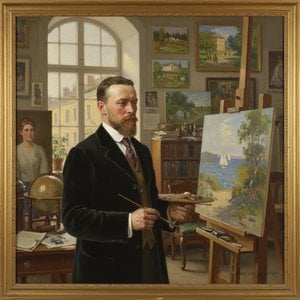
The painting of Louis Pasteur by Albert Edelfelt stands as an emblem of scientific achievement and humanist compassion—a testament to the transformative power of art when allied with intellectual curiosity. Completed in 1881, it transcends mere representation; instead, Edelfelt captured not just Pasteur’s physical likeness but also his profound dedication to unraveling the mysteries of life and combating disease. This remarkable artwork resides within the Musée d’Orsay in Paris, offering visitors a chance to contemplate its enduring legacy.The Artist's Approach: Collaboration and Observation
Albert Edelfelt wasn’t merely commissioned to depict Pasteur; he actively participated in shaping the portrait’s narrative. Driven by an unwavering belief in the importance of scientific inquiry, Edelfelt meticulously documented Pasteur’s laboratory environment—a deliberate decision that underscored his commitment to portraying Pasteur as a man deeply engaged with his craft. As evidenced by Edelfelt's correspondence with his mother, he undertook extensive preparatory sketches and studies, capturing Pasteur’s posture and facial expressions with painstaking accuracy. These detailed observations informed the artist’s vision, resulting in an image imbued with palpable sincerity and intellectual depth.Style and Technique: Impressionistic Realism
Edelfelt’s style exemplifies a harmonious blend of impressionistic realism—a hallmark of his era—characterized by luminous brushstrokes and subtle tonal gradations. He skillfully employed oil paints on canvas to achieve a velvety texture that conveys both the solidity of Pasteur's physique and the ethereal quality of scientific contemplation. The artist’s masterful use of light creates an atmosphere of quiet intensity, drawing viewers into Pasteur’s world and emphasizing his serene gaze—a symbol of unwavering resolve and intellectual perseverance. Edelfelt’s technique reflects a broader artistic movement that sought to capture fleeting moments of experience while maintaining fidelity to observed reality.Historical Context: Science and Art in Belle Époque Paris
The painting emerged during the Belle Époque, a period marked by unprecedented optimism and cultural flourishing in Paris—a time when science and art intertwined to celebrate human progress. Pasteur’s groundbreaking discoveries in microbiology revolutionized medicine and challenged prevailing scientific dogma, establishing him as a beacon of intellectual brilliance. Edelfelt recognized this significance, elevating Pasteur's portrait to the status of an icon—a visual embodiment of the virtues prized by the Parisian intelligentsia. The artwork served as a powerful affirmation of the humanist spirit that permeated Belle Époque society.Symbolism: Calm Reflection and Intellectual Integrity
Beyond its technical prowess, Edelfelt’s portrait resonates with symbolic meaning. Pasteur's seated posture exudes composure and thoughtfulness—a deliberate gesture conveying his unwavering dedication to scientific pursuits. His clasped hands symbolize both physical strength and mental focus—representing the artist’s conviction that intellectual integrity is paramount to achieving profound understanding. The inclusion of a simple chair underscores the importance of solitude and contemplation—essential conditions for fostering creativity and pursuing knowledge with earnestness.Emotional Impact: A Legacy of Inspiration
The painting continues to inspire admiration for its ability to convey both scientific rigor and human compassion. It serves as a poignant reminder that intellectual curiosity can coexist harmoniously with empathy—a message particularly relevant in our contemporary world. Edelfelt’s portrait transcends mere depiction; it embodies the spirit of inquiry and perseverance—qualities celebrated throughout history as catalysts for transformative change. Its enduring presence within the Musée d’Orsay ensures that Louis Pasteur's image—and Albert Edelfelt’s masterful artistic vision—will continue to captivate audiences for generations to come.Questions & Answers
Can the image of "Jean-Baptiste Pasteur" by Albert Edelfelt be freely reproduced?
Regarding copyright, "Jean-Baptiste Pasteur" is in the public domain - its copyright has expired.
At what size is "Jean-Baptiste Pasteur" recommended to be printed?
A large reproduction is suggested for "Jean-Baptiste Pasteur" by Albert Edelfelt. Size can be adjusted while keeping the proportions.
What emotional tone accompanies the Contemporary Realism style of "Jean-Baptiste Pasteur"?
The reflective emotion of "Jean-Baptiste Pasteur" accompanies its Contemporary Realism style.
Related Artworks


Albert Edelfelt
1854 - 1905, Finland
Artist Biography
Early Life, Family and Training
Albert Edelfelt was born on July 21, 1854, in Porvoo, Finland. His father, Carl Albert Edelfelt, was a Swedish-speaking Finn and an architect, while his mother, Alexandra Edelfelt, was born Alexandra Brandt. The early years of his life were shaped by the quiet surroundings of Porvoo. By 1869, his interest in drawing led him to the drawing school of the Finnish Art Society to begin formal studies.
His training moved beyond Finland as he sought broader technical instruction. Between 1873 and 1874, he spent time at the Antwerp Academy of Art, where he focused on the mechanics of history painting. This period of study provided the foundation for his move to France. In 1874, he enrolled at the Ecole Nationale des Beaux-Arts in Paris. There, he studied under Jean-Léon Gérôme, refining his ability to handle complex compositions and the specific demands of academic training.
Artistic Journey and Parisian Years
In 1874, at nineteen, Edelfelt moved to Paris. He shared a small studio at 24 Rue Bonaparte with a friend from Finland. The space was modest, a place for a young man to find his footing away from home. By 1876, he had moved to a studio at 81 boulevard du Montparnasse. It was during these years that he began to move away from the formal constraints of his early training, finding a new way to see the light and the world around him.
His life in Paris was shaped by the people he met in the city's studios and social circles. He became close with the painter Jules Bastien-Lepage, who influenced his approach to the canvas. He also developed a friendship with Jean-Baptiste Pasteur, the son of the chemist Louis Pasteur. These connections placed him in the center of a changing artistic landscape, where the focus shifted toward observing life as it actually appeared. In 1881, he took up residence in a new studio at 147, avenue des Villiers, continuing to refine his practice through the decade.
Technique and Artistic Style
His approach to the canvas was rooted in a naturalistic style, favoring a realist perspective that sought to document life as it appeared. This commitment to observation often led him to the practice of painting in the open air, capturing the way light settles on a landscape or a subject. In these moments, he moved away from the rigid, formal academic traditions of his early training to embrace more fluid, impressionistic techniques. This shift is visible in the way he handled light and atmosphere in works such as The Eklöf Boys on the Veranda of Villa Sjökulla.
He often focused on the weight of history, using his brush to render the heavy details of past conflicts. His paintings frequently depicted scenes from the long series of wars involving the Russians, Swedes, and Finns, where he paid close attention to the textures of the era. He was a prominent contributor to the Golden Age of Finnish Art, using his technical skill to bridge the gap between formal history painting and a more modern, observational way of seeing the world.
Notable Works and Achievements
His brush captured the quiet intensity of scientific discovery and the simple movements of life. In 1886, he painted Louis Pasteur dans son laboratoire de l, a work that looked closely at the chemist's environment. This connection to the Pasteur family continued through his Portrait of Louis Pasteur. These studies of light and subject brought him recognition in France, leading to his appointment to the Legion of Honour in 1886. Later, at the Paris Universal Exposition of 1889, he was awarded a gold medal.
There is a particular stillness in Boys Playing on the Shore (1884). It remains one of his most significant paintings, capturing a moment of youth against the landscape. His ability to observe the world led to his selection as the Commissioner of Finnish participation in the Paris Exposition Universelle in 1900. He moved between the formal requirements of history painting and the directness of observing people in their natural settings.
- Louis Pasteur dans son laboratoire de l (1886)
- Boys Playing on the Shore (1884)
- Portrait of Louis Pasteur
Legacy and Influence
Edelfelt was among the first Finnish painters to find a place in the international art scene. He brought a sense of Finnish identity to a broader European stage, making the culture of his home visible far beyond its borders. His commitment to the realist art movement in Finland helped shape how the country saw itself through paint, moving away from idealized subjects toward a more honest representation of life. This approach helped ground the visual language of a nation during a period of significant change.
His presence in the studios of Paris and Antwerp left a mark on the generations that followed him. Younger Finnish painters, including Akseli Gallen-Kallela and Gunnar Berndtson, looked to his methods and his ability to navigate the European art world. He helped pave the way for these artists, offering a bridge between local traditions and the evolving styles of the continent. His influence was felt in the way they approached light, landscape, and the human figure.
In the history of Finnish art, he is often regarded as the most significant figure from the second half of the 19th century through the first half of the 20th century. His work remains a point of reference for the development of a national aesthetic. His ability to blend formal academic training with the observation of everyday life helped define the Golden Age of Finnish Art.
Where to See the Works Today
To see his brushwork in person, one might travel to Helsinki. The Ateneum Art Museum holds a significant portion of his output, including the 1877 painting Queen Bianca. These works sit within the largest collection of Finnish art in the country. You can find his depictions of rural life and historical scenes there, where the light often mimics the quiet atmosphere of the landscapes he once studied.
In Paris, his presence is felt in several locations. The Musée d'Orsay houses his 1885 portrait of Louis Pasteur. It is a quiet, focused study of the man in his workspace. Nearby, the Musée Pasteur also maintains several of his works, many of which focus on the family and the scientific environment that surrounded him during his time in France.
- Queen Bianca (1877)
- Louis Pasteur (1885)


Related Articles
Albert Edelfelt: A Pioneer of Finnish Realism & International Impressionist Circles
Explore the life & work of Albert Edelfelt, a pioneering Finnish Realist painter who bridged Impressionism & national identity. Discover his masterpieces and lasting influence on art history.

Charles-André van Loo: A Study in Rococo Portraiture & the French Court's Artistic Dynamics
Explore the elegant world of Charles-André van Loo, a master of Rococo portraiture at the French court. Discover his life, techniques, and enduring influence on 18th-century art. Hand-painted reproductions available.

The Enduring Legacy of French Art: Movements, Masters & Cultural Impact
Explore the rich history of French art, from the Salon to Impressionism & beyond. Discover iconic masters, key movements, and expert guidance for collecting timeless masterpieces. ArtsDot.