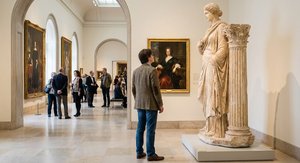
Origins and History of Staatsgalerie Stuttgart
The Staatsgalerie Stuttgart was established in 1843 in Stuttgart, Germany. It began its existence as the Royal Art School and gallery. This foundation provided the institutional basis for a collection that has grown to include 8000 artworks. The institution has functioned as a central point for artistic study and preservation for nearly two centuries.
The history of the site is marked by significant architectural and structural changes. The original building, the Alte Staatsgalerie, was completed in 1843. During World War II, the building sustained damage and required reconstruction between 1945 and 1947. Following this period, the gallery reopened in 1958. The institution's footprint expanded significantly in 1984 with the addition of the Neue Staatsgalerie, which introduced postmodernist design to the site.
The Architecture of the Two Galleries
The museum exists as two distinct architectural entities. The Alte Staatsgalerie was completed in 1843. Its design follows a neoclassical logic, utilizing symmetry and proportion to establish a sense of order. The building's stately façade was intended to reflect the clarity of classical form, providing a structured environment for the collection of German and Dutch works.
In contrast, the Neue Staatsgalerie represents a departure from traditionalism. Designed by British architect James Stirling and constructed between 1979 and 1984, the building is considered the epitome of Post-modernism. The structure utilizes a combination of traditional materials, such as travertine and sandstone, alongside industrial elements like green steel framing. The design incorporates a monumental rotunda and a sculpture garden that connects the interior spaces with the exterior environment. This architectural approach intentionally disrupts the harmonious balance found in classical design through the use of dynamic asymmetry and bright, colored steel handrails in pink and blue.
The Diverse Collections of the Museum
The collection spans eight centuries of European art, organized across the two distinct architectural spaces of the institution. The Alte Staatsgalerie houses works from the Middle Ages through the 19th century. This includes Old German paintings from 1300 to 1550 and Italian paintings dating from 1300 to 1800. The museum also maintains a significant selection of Dutch paintings from the period of 1500 to 1700, alongside German paintings from the Baroque era.
The later centuries are represented by art from 1800 to 1900, with a focus on the movements of Romanticism and Impressionism. These works reflect the shifting aesthetic sensibilities of the 19th century. In the Neue Staatsgalerie, the focus shifts to the 20th century, housing a collection of modern art that defines the contemporary era.
- The crown of thorns (Grey Passion-5), 1500 - Hans Holbein The Elder
- Italian Family - Théodore Géricault
- The Last Supper, 1886 - Fritz von Uhde
- Portrait of Chaim Soutine, 1915 - Amedeo Modigliani
Masterpieces of the Museum Collection
The collection spans a wide range of artistic movements, from the religious iconography of the past to the fragmented realities of the twentieth century. Annibale Carracci’s “Corpse of Christ” is a particularly arresting work, rendered with a focus on anatomical precision. This sense of formal rigor is contrasted by the surreal explorations of Salvador Dalí, which offer a glimpse into the subconscious. The museum also holds significant works by Joseph Beuys, whose practice redefined the relationship between art and society.
Modernity is represented through the evolution of diverse styles. The museum contains works by Pablo Picasso and Henri Matisse, alongside the large-scale presence of Barnett Newman. Max Beckmann’s “Journey on the Fish” is a compelling painting that invites multiple interpretations of reality. These pieces sit alongside a variety of other significant holdings:
- Illustration to "A Week of Kindness", 1934 - Max Ernst
- Violin ''Jolie Eva'', 1912 - Pablo Picasso
- German Maskensouper, 1855 - Adolph von Menzel
- Italian Family - Théodore Géricault
- The crown of thorns (Grey Passion-5), 1500 - Hans Holbein The Elder
- The Last Supper, 1886 - Fritz von Uhde
Major Restitutions and Art History
The collection at the Staatsgalerie Stuttgart spans 800 years of European art history. This timeline includes significant works from the 15th century, such as a Virgin and Child attributed to the Master of Flémalle. These pieces represent the foundational layers of the institution's holdings, tracing the development of artistic expression from the late Middle Ages through the modern era.
The museum's history is also shaped by the complexities of 20th-century provenance. In 2013, the institution returned the Virgin and Child to the estate of Max Stern. Stern was a German-born Jewish dealer who fled the Nazi regime. Such restitutions reflect the ongoing institutional responsibility to address the movement of art during periods of historical upheaval.