


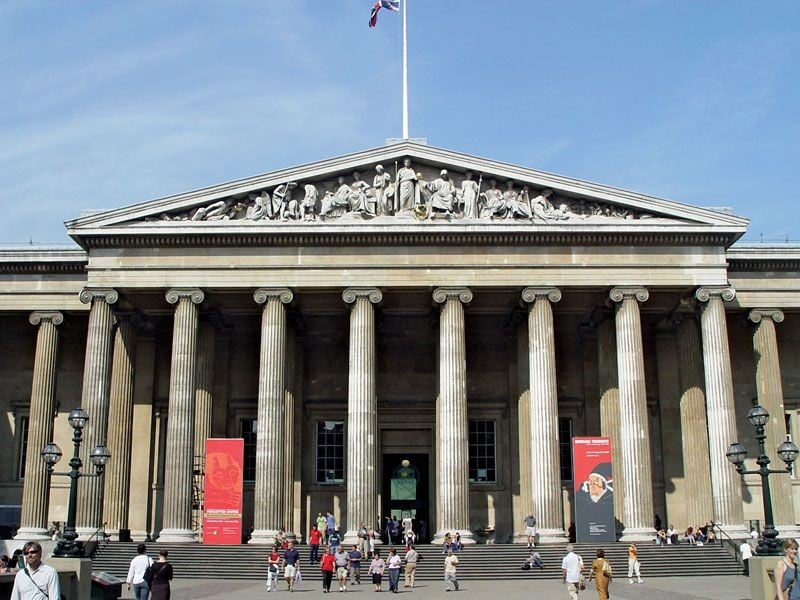
Origins and History of the British Museum
The British Museum was established in 1753 as the first public national museum. Its foundations are rooted in the will of Sir Hans Sloane, an Anglo-Irish physician and scientist. Following his death, his collection of curiosities provided the basis for the institution's early holdings. The museum opened to the public in 1759, initially housed within Montagu House in the Bloomsbury area of London.
The institution is dedicated to human history, art, and culture. Over the subsequent 250 years, the museum expanded its holdings significantly. Much of this growth was a direct result of British colonisation. This expansion transformed the museum from a private cabinet of curiosities into a vast repository of global artifacts. The collection documents human culture from its beginnings to the present day.
The Architecture and the Great Court
The architectural evolution of the institution reflects a transition from classical weight to modern brilliance. The museum was initially housed in Montagu House, a stately Georgian neoclassical residence. This original setting established an aura of scholarly seriousness within the Bloomsbury area of London. The physical space has since undergone significant transformation to accommodate its growing collections.
The redesign by Norman Foster redefined the museum's identity through the creation of the Great Court. This area is a significant feat of engineering, centered around a soaring glass roof. The structure allows natural light to flood the interior, creating a specific interplay of light and shadow across the space. This central hub connects the various galleries and provides a sense of scale to the monumental building.
Treasures of the Permanent Collection
The permanent collection comprises eight million works, making it the largest of its kind. Among these objects, the Rosetta Stone remains a central fixture. This stone provided the key to deciphering ancient Egyptian hieroglyphs, allowing the voices of a long-silent people to be understood once more. The museum also holds Egyptian mummies, which offer direct insight into ancient funerary practices.
Classical antiquity is represented through significant sculptural and ceramic finds. The Parthenon Sculptures are a primary highlight of the Greek collection. Other notable items include the Sophilos Vase from ancient Greece and the Roman sculpture known as Crouching Venus. These objects provide a physical record of the artistic developments of their respective eras.
- The Rosetta Stone
- The Parthenon Sculptures
- Sophilos Vase
- Crouching Venus
Masterpieces of the Collection
The collection contains objects that define our understanding of ancient civilizations. The Rosetta Stone provided the essential key to deciphering Egyptian hieroglyphs, allowing the voices of a long-silent people to be heard once more. Nearby, the golden mask of Tutankhamun offers a direct glimpse into the funerary rituals of ancient Egypt. These artifacts exist alongside the Elgin Marbles, sculptures that represent significant artistic achievement from antiquity.
The museum also preserves works of profound technical skill and historical weight. The Benin Bronzes demonstrate the craftsmanship of the Kingdom of Benin. In the realm of European art, the collection includes Hieronymus Bosch’s The Entombment, an ink and grey wash work from about 1507. These pieces represent the diverse breadth of human expression held within these walls.
- The Entombment, about 1507
Visiting and Modern Engagement
The British Museum maintains a significant presence in London, attracting more than six million visitors each year. In 2025, the institution recorded 6,440,120 visitors. As a non-departmental public body sponsored by the Department for Culture, Media and Sport, the museum remains accessible to the public. Admission is free, though fees apply to specific loan exhibitions.
To bridge the gap between ancient history and contemporary audiences, the museum employs various technological tools. Interactive exhibits utilizing augmented reality allow for a more tactile engagement with the collections. Furthermore, immersive virtual tours provide ways to experience the archives remotely. These digital initiatives ensure that the vast history housed within the building remains accessible to a global audience.


