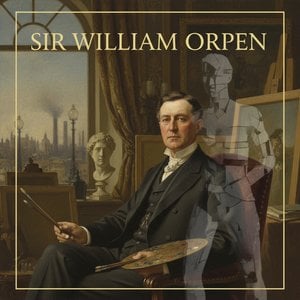
A Legacy of Quiet Dignity: The Life and Art of William Owen
In the grand, often theatrical tapestry of British portraiture during the Georgian era, there existed a subtle, more introspective thread woven by William Owen. Born in 1769 in the historic town of Ludlow, Shropshire, Owen was a painter who eschewed the flamboyant bravado of his contemporaries in favor of a profound, psychological depth. His journey from the provincial landscapes of his youth to the prestigious halls of the Royal Academy is a testament to an innate talent that sought not just to record a likeness, but to capture the very essence of the human spirit. While his early years were shaped by the scholarly atmosphere of Eton and Oxford, it was his move to London in 1786 that truly ignited his artistic destiny, leading him through an apprenticeship with the coach painter Charles Catton before he ascended to the heights of the British art establishment.
The trajectory of Owen’s career was profoundly shaped by the mentorship of Sir Joshua Reynolds, the titan of British portraiture. Under Reynolds' guidance, Owen learned to navigate the complexities of light and shadow, adopting a style that drew inspiration from the classical elegance of Venetian masters. However, where Reynolds often embraced the grand and the dramatic, Owen found his strength in the understated. He mastered the use of chiaroscumn—the delicate interplay of light and dark—to sculpt faces with a soft, lifelike precision. His work is characterized by an exceptional ability to convey subtle expressions, imbuing his subjects with a sense of quiet dignity and inner character that feels remarkably intimate even centuries later.
Mastery of the Portrait and the Royal Academy
As a member of the Royal Academy, Owen became a sought-after chronicler of the British elite. His portfolio serves as a window into the social fabric of his time, featuring portraits of influential figures such as William Pitt the Younger and the future King George IV. These were not merely exercises in status; Owen approached each commission with a meticulous attention to detail and a commitment to psychological truth. Whether depicting the stern resolve of a statesman or the gentle grace of a lady, his brushwork remained refined and purposeful.
Beyond the formal portraits of the aristocracy, Owen’s talent extended into genre painting, where he explored more tender, humanistic themes. His works often captured moments of quiet contemplation or simple, everyday beauty, much like his notable piece Counting Her Change. In these compositions, one sees a painter deeply enamored with the nuances of light hitting fabric and the soft textures of skin, creating scenes that feel both timeless and profoundly grounded in reality. This versatility allowed him to bridge the gap between the high-society portrait and the poetic observation of life's smaller, more poignant moments.
Historical Significance and Artistic Enduring Spirit
Though history occasionally remembers the more ostentatious painters of the late 18th and early 19th centuries, the significance of William Owen lies in his contribution to the refinement of British portraiture. He helped cultivate a tradition of psychological realism that moved away from mere ornamentation toward a deeper exploration of identity. His ability to balance classical training with a sensitive, modern observation of his subjects ensured his place among the respected masters of his age.
The legacy of William Owen remains etched in the collections of great institutions like the National Portrait Gallery and the Tate. To study his work today is to experience the elegance of the Georgian era through a lens of profound empathy. His life, though relatively short, concluded in 1825, leaving behind an oeuvre that continues to resonate with anyone moved by the power of a well-captured glance or the quiet strength found in a beautifully rendered shadow. He remains a vital figure for understanding the evolution of English art, representing a period where technical mastery met a soulful, poetic vision.