The Life and Travels of William Duke
Born in 1814 in County Cork, Ireland, William Charles Duke initially followed his father's footsteps into the trade of carpentry. After marrying Lucy in 1840, he embarked on a journey to Australia, arriving in Sydney aboard the Lady McNaughton. His early career in the colonies saw him working as a scene-painter and mechanist at the Royal Victoria Theatre in Sydney. Following a period in New Zealand, Duke relocated to Hobart, where he served as a scene-painter at the Hobart Town Royal Victoria Theatre. His artistic pursuits eventually led him to the Victorian gold rush, where he continued his work in portrait painting and theatre before his death in Collingwood, Victoria.
Artistic Works and Subject Matter
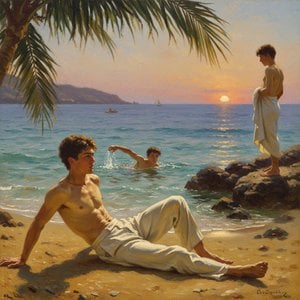
Duke's body of work is characterized by a diverse range of subjects, from maritime scenes to significant portraits. In Hobart, he became known for his lively marine oil paintings of whaling, often commissioned by local shipowners. His notable series includes:
Beyond traditional painting, Duke collaborated on moving, circular cityscape dioramas depicting views of Constantinople, Florence, Jerusalem, and Venice, which were exhibited to audiences in Sydney and Hobart.
Questions & Answers
Is there a 3D virtual tour of William Duke's works?
William Duke's artworks can be seen in a 3D gallery on the artist's 3D Museum page.
What aliases or alternate names does William Duke have?
William Duke appears under the alternate names William Charles Duke, ويليام ديوك.
Can I browse William Duke's works by mood?
The Mood Room of William Duke is a page that arranges the artist's artworks by mood.
What are the birthplace and birth year of William Duke?
William Duke was born in County Cork in 1814.