Portrait of Roy Lichtenstein

Roy Lichtenstein's Most Famous Paintings: All 100, Ranked

Updated October 2026 · ranked by our popularity score (searches, visits and orders for each work) · 382 works by Roy Lichtenstein in our catalogue

In short

The Roy Lichtenstein painting most people know is Whaam! (1963). Right after it come Drowning girl oversize - (1600) and Look Mickey (1961). Out of 382 works by Roy Lichtenstein in our catalogue, these 100 are the best known. Each one comes with its year, its museum and a short note on what makes it stand out.

1923 – 1997, Manhattan Pop art Most works: Art Institute of Chicago

Roy Lichtenstein's top 10: the pieces everyone knows

1
Whaam! (1963) by Roy Lichtenstein

Whaam!

1963 · Acrylic On Canvas

A Defining Moment of Pop Art Roy Lichtenstein’s 1963 masterpiece is an explosive distillation of war, media, and comic book aesthetics. This large-scale work isn't simply a depiction of aerial combat; it’s a powerful commentary on the detached, stylized representation of violence prevalent in mid-20th century American culture. A fighter plane streaks across the canvas, unleashing a fiery attack, rendered with an immediacy that belies its carefully constructed artifice. The…

2
Drowning girl oversize - (1600) by Roy Lichtenstein

Drowning girl oversize -

1600 · Digital Illustration

Subject and Composition This striking artwork captures an emotionally charged moment through the vivid portrayal of a woman submerged in water. Her contemplative expression, accentuated by tears streaming down her face, invites viewers into a narrative of vulnerability, resilience, and inner turmoil. The composition centers on her face and hand, drawing immediate attention to her emotional state, while stylized water swirling around her enhances the sense of chaos and immersion.…

3
Look Mickey (1961) by Roy Lichtenstein

Look Mickey

1961 · Acrylic On Canvas

Roy Lichtenstein's Look Mickey is a seminal work that bridges the artist's transition from abstract expressionism to pop art. Created in 1961, this oil on canvas painting is widely regarded for its ironic humor and aesthetic value, making it a cornerstone of the Pop Art movement. Artistic Technique Lichtenstein employed a limited palette consisting of primary colors and white, along with hand-painted dots to denote tonality in the comic strip…

4
Drowning girl (1963) by Roy Lichtenstein

Drowning girl

1963 · Oil On Canvas

A Masterpiece of Melodrama Roy Lichtenstein's iconic 1963 painting "Drowning Girl" is a quintessential work of Pop Art that captures the essence of emotional turmoil and dramatic storytelling. This vibrant and dynamic piece immediately draws attention with its bold lines, vivid colors, and expressive subject matter. The artwork features a central figure—a woman with striking blue hair—who appears to be in a state of distress or contemplation. Her face and…

5
Girl with ball (1961) by Roy Lichtenstein

Girl with ball

1961 · Acrylic On Canvas

Roy Lichtenstein's "Girl with Ball" is an iconic piece from 1961 that captures the essence of mid-20th century American pop culture. This vibrant and dynamic artwork features a woman playing volleyball, exuding energy and movement. The stylized and expressive approach makes it a standout piece in any collection.

6
Torpedo los (1963) by Roy Lichtenstein

Torpedo los

1963 · Acrylic On Canvas

Dynamic Pop Art Masterpiece Roy Lichtenstein's "Torpedo...Los!" is a vibrant and dynamic piece that captures the essence of the Pop Art movement. Created in 1963, this iconic artwork blends bold colors, striking lines, and a narrative-driven composition to create a visually engaging scene. The painting features a dramatic depiction of a submarine captain, his face pressed against a periscope, with the cryptic command "TORPEDO...LOS!" emblazoned in a speech bubble. This…

7
Roto Broil (1961) by Roy Lichtenstein

Roto Broil

1961 · Acrylic On Canvas

"Roto Broil" (1961) is a quintessential work by Roy Lichtenstein, a pioneer of the Pop Art movement. This vibrant and whimsical piece exemplifies Lichtenstein's unique ability to transform mundane objects into striking artistic statements. The artwork features an oversized kitchen appliance filled with an assortment of shoes, set against a bold orange background. Its playful juxtaposition of everyday items challenges conventional perceptions of art and consumer culture.

8
Blam (1962) by Roy Lichtenstein

Blam

1962 · Acrylic On Canvas

Dynamic Subject and Iconic Imagery This striking artwork captures a moment of explosive action, rendered in the bold, graphic language of comic book art and pop art. At its core, a stylized firearm is depicted mid-firing, with dramatic explosion effects and a commanding "BLAM" sound effect that emphasizes violence, power, and chaos. The composition centers around this intense scene, evoking themes of conflict, rebellion, and the raw energy of modern…

9
Wham (1963) by Roy Lichtenstein

Wham

1963 · Ink On Paper

Dynamic Subject and Iconic Imagery This striking artwork captures a moment of explosive action, vividly illustrating a military aircraft amidst a powerful burst of destruction. The scene is infused with energy and intensity, depicting a missile or projectile unleashing a fiery explosion. The composition symbolizes themes of power, conflict, and the chaos of modern warfare, resonating with viewers who appreciate bold storytelling through visual art. Its dramatic subject matter makes…

10
Untitled Roy Lichtenstein ^ Gian Franco Gorgoni (1988) (1988) by Roy Lichtenstein

Untitled Roy Lichtenstein ^ Gian Franco Gorgoni (1988)

1988 · Mixed Media

Subject and Composition This captivating artwork masterfully captures a solitary rider on horseback traversing a tranquil beachscape at sunset. The silhouette of the rider and horse stands in stark contrast against the vibrant, swirling sky, creating a powerful focal point that evokes a sense of movement and introspection. The expansive seascape, with its shimmering waters and distant horizon, invites viewers to contemplate themes of journey, freedom, and the enduring bond…

Keep exploring Roy Lichtenstein: 11 to 100

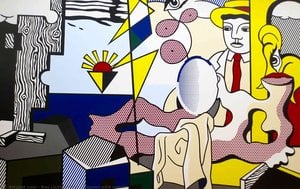
11Hey you - (2402193) by Roy LichtensteinHey you - (2402193) 12NUDE WITH BLUE HAIR (1994) by Roy LichtensteinNUDE WITH BLUE HAIR1994 13M-Maybe (1965) by Roy LichtensteinM-Maybe1965 14We Rose Up Slowly (1964) by Roy LichtensteinWe Rose Up Slowly1964 15Woman in bath (1963) by Roy LichtensteinWoman in bath1963 16Girl hair ribbon (1965) by Roy LichtensteinGirl hair ribbon1965 17In the car (1963) by Roy LichtensteinIn the car1963 18Sinking Sun (1964) by Roy LichtensteinSinking Sun1964 19Drowning girl (1963) by Roy LichtensteinDrowning girl1963 20Hopeless (1963) by Roy LichtensteinHopeless1963 21Spray (1962) by Roy LichtensteinSpray1962 22Frightened (1964) by Roy LichtensteinFrightened1964 23Thinking of him (1963) by Roy LichtensteinThinking of him1963 24Girl in Mirror (1964) by Roy LichtensteinGirl in Mirror1964 25Girl with ball (1961) by Roy LichtensteinGirl with ball1961 26Still Life with Goldfish (and Painting of Golf Ball) (1972) by Roy LichtensteinStill Life with Goldfish (and Painting of Golf Ball)1972 27Crying girl (1964) by Roy LichtensteinCrying girl1964 28Alka Seltzer (1966) by Roy LichtensteinAlka Seltzer1966 29Artist's studio - The dance (1974) by Roy LichtensteinArtist's studio - The dance1974 30Laughing cat (1961) by Roy LichtensteinLaughing cat1961 31Varoom (1963) by Roy LichtensteinVaroom1963 32Figures with sunset by Roy LichtensteinFigures with sunset 33Reclining Bather (1977) by Roy LichtensteinReclining Bather1977 34Pop (1966) by Roy LichtensteinPop1966 35Sunrise (1965) by Roy LichtensteinSunrise1965 36Icansee (1961) by Roy LichtensteinIcansee1961 37Forest scene (1980) by Roy LichtensteinForest scene1980 38Bauhaus stairway (1989) by Roy LichtensteinBauhaus stairway1989 39Brattata (1962) by Roy LichtensteinBrattata1962 40Half Face with Collar (1963) by Roy LichtensteinHalf Face with Collar1963 41Coast Village (1987) by Roy LichtensteinCoast Village1987 42Art (1962) by Roy LichtensteinArt1962 43Face (green nose) (1986) by Roy LichtensteinFace (green nose)1986 44Sleeping Girl (1964) by Roy LichtensteinSleeping Girl1964 45Collage for Landscape with Scholar's Rock by Roy LichtensteinCollage for Landscape with Scholar's Rock 46Ruins (1965) by Roy LichtensteinRuins1965 47Jet pilot by Roy LichtensteinJet pilot 48Cathedral -6 State II (1969) by Roy LichtensteinCathedral -6 State II1969 49Glass and lemon in a mirror (1974) by Roy LichtensteinGlass and lemon in a mirror1974 50The hero's return (1950) by Roy LichtensteinThe hero's return1950 51Landscape (1964) by Roy LichtensteinLandscape1964 52The kiss (1962) by Roy LichtensteinThe kiss1962 53Stretcher Frame with Cross Bars III (1968) by Roy LichtensteinStretcher Frame with Cross Bars III1968 54Reflections Wonder Woman (1989) by Roy LichtensteinReflections Wonder Woman1989 55Kiss by Roy LichtensteinKiss 56Baked potato (1962) by Roy LichtensteinBaked potato1962 57Mr. Bellamy (1961) by Roy LichtensteinMr. Bellamy1961 58Bathroom (1961) by Roy LichtensteinBathroom1961 59Silver Frame (1984) by Roy LichtensteinSilver Frame1984 60Mirror - 7 (1970) by Roy LichtensteinMirror - 71970 61As I opened fire, I knew why tex hadn't buzzed me... if he had (1964) by Roy LichtensteinAs I opened fire, I knew why tex hadn't buzzed me... if he had1964 62Bedroom at Arles (1992) by Roy LichtensteinBedroom at Arles1992 63Refrigerator (1962) by Roy LichtensteinRefrigerator1962 64Modular Painting with Nine Panels (1968) by Roy LichtensteinModular Painting with Nine Panels1968 65The Atom (1975) by Roy LichtensteinThe Atom1975 66House III (1997) by Roy LichtensteinHouse III1997 67Bull Head III (1973) by Roy LichtensteinBull Head III1973 68Donald Duck (1957) by Roy LichtensteinDonald Duck1957 69No - Nox (1962) by Roy LichtensteinNo - Nox1962 70Washington crossing delaware (1951) by Roy LichtensteinWashington crossing delaware1951 71Red Painting (Brushstroke) (1965) by Roy LichtensteinRed Painting (Brushstroke)1965 72Artist's Studio "Foot Medication" (1974) by Roy LichtensteinArtist's Studio "Foot Medication"1974 · Art Institute of Chicago 73Wimpy (Tweet) (1961) by Roy LichtensteinWimpy (Tweet)1961 74Mao (1971) by Roy LichtensteinMao1971 75Brattata (1962) by Roy LichtensteinBrattata1962 762 apples (1981) by Roy Lichtenstein2 apples1981 77The Cowboy (Red) (1951) by Roy LichtensteinThe Cowboy (Red)1951 78Glass (1977) by Roy LichtensteinGlass (1977) 79Live ammo (Ha! Ha! Ha!) (1962) by Roy LichtensteinLive ammo (Ha! Ha! Ha!)1962 80Preparedness (1968) by Roy LichtensteinPreparedness1968 81Crying Girl (1963) by Roy LichtensteinCrying Girl1963 82Sailboats (1985) by Roy LichtensteinSailboats1985 83Live ammo (1962) by Roy LichtensteinLive ammo1962 84Interior with mobile by Roy LichtensteinInterior with mobile 85Despair (1979) by Roy LichtensteinDespair1979 86Magnifying glass (1963) by Roy LichtensteinMagnifying glass1963 87Two Green Apples (1980) by Roy LichtensteinTwo Green Apples1980 88That my ship was below them (1964) by Roy LichtensteinThat my ship was below them1964 89Brustrokes (1970) by Roy LichtensteinBrustrokes1970 90Telaviv mural (1989) by Roy LichtensteinTelaviv mural1989 91Collage for Nude (1997) by Roy LichtensteinCollage for Nude1997 92Modular painting with four panels, #1 (1969) by Roy LichtensteinModular painting with four panels, #11969 · Museum Ludwig 93Small explosion (1965) by Roy LichtensteinSmall explosion1965 94I Love Liberty (1982) by Roy LichtensteinI Love Liberty1982 95Woman (1981) by Roy LichtensteinWoman1981 96Collage for Woman with Mirror (1996) by Roy LichtensteinCollage for Woman with Mirror1996 97Drawing for Seductive Girl (1996) by Roy LichtensteinDrawing for Seductive Girl1996 98Collage for Interior with Ajax (1997) by Roy LichtensteinCollage for Interior with Ajax1997 99Mirror - 2 (1970) by Roy LichtensteinMirror - 21970 100Art Critic (1996) by Roy LichtensteinArt Critic1996

Roy Lichtenstein's paintings, period by period

Early Pop Art

1957 – 1961 · 3 works in this list

What Roy Lichtenstein painted most

The four subjects that come up most often in these pieces, each with its best-known example.

Where you can see Roy Lichtenstein's paintings

The 2 museums that hold the most of the paintings on this page.

Museum City Works by Roy Lichtenstein Paintings from this list
Art Institute of Chicago, ChicagoArt Institute of Chicago Chicago 4 Artist's Studio "Foot Medication"
Museum Ludwig, CologneMuseum Ludwig Cologne 1 Modular painting with four panels, #1

One famous Roy Lichtenstein piece for every decade

Works per decade

Pick a decade to see its standout piece.

Roy Lichtenstein paintings: what people want to know

What painting is Roy Lichtenstein best known for?See the answer

Top of the list is Whaam! (1963). Right behind it: Drowning girl oversize - (1600) and Look Mickey (1961).

How old was Roy Lichtenstein at the time of Whaam!?See the answer

40 years old. Roy Lichtenstein was born in 1923, and Whaam! dates from 1963.

Which 10 Roy Lichtenstein paintings are the most famous?See the answer

Whaam!, Drowning girl oversize -, Look Mickey, Drowning girl, Girl with ball, Torpedo los, Roto Broil, Blam, Wham and Untitled Roy Lichtenstein ^ Gian Franco Gorgoni (1988). You'll find the year and the museum of each in the list above.

How many Roy Lichtenstein works are there?See the answer

We have 382 works by Roy Lichtenstein in our catalogue, dated 1950 to 1997.

Which museums have Roy Lichtenstein's best-known paintings?See the answer

You'll find most of them in Art Institute of Chicago (Chicago) and Museum Ludwig (Cologne). The museum list above has the full breakdown.

When were Roy Lichtenstein's most famous pieces painted?See the answer

In 1960s, more than any other time: 55 of the 100 pieces on this page date from then, Whaam! among them.

What are the oldest and newest famous paintings by Roy Lichtenstein?See the answer

The earliest piece here is The hero's return (1950); the most recent is House III (1997).

What did Roy Lichtenstein paint most?See the answer

Ben-day dots (25), Comic book (13) and Geometric shapes (13), out of the 100 pieces on this page.

What did Roy Lichtenstein usually paint with?See the answer

Acrylic On Canvas, used in 47 of the 100 pieces on this page.

Which art movement is Roy Lichtenstein linked to?See the answer

Pop art, as you can see in the pieces on this page.

Meet Roy Lichtenstein

The Life of Roy Lichtenstein

Manhattan, New York City, October 27, 1923. Roy Lichtenstein enters the world as the son of Milton and Beatrice. The urban energy of the metropolis provides the backdrop for a life that will eventually challenge the boundaries of fine art. He grows up in an upper-middle-class Jewish family, absorbing the cultural rhythms of the city through museums and jazz music.

The trajectory of his career shifts during the mid-twentieth century. He emerges as a leading figure of the Pop Art movement, a period defined by a radical departure from the heavy, emotional brushwork of Abstract Expressionism. Instead of looking inward, he looks outward at the glossy, mechanical surfaces of American mass culture. He finds his subject matter in the most overlooked corners of daily life: the dramatic panels of comic books and the stark, repetitive patterns of commercial advertising.

His work transforms the ephemeral language of print into something monumental. By adopting the visual shorthand of the masses, he forces a confrontation between high-end gallery prestige and the everyday pulse of the street. His presence in the art world is marked by a deliberate detachment, using the very tools of industrial reproduction to redefine what a painting can be.

Early Life, Family and Training

Manhattan, 1923. The city provides the backdrop for Roy Fox Lichtenstein's arrival into an upper-middle-class Jewish family. His father, Milton, works as a real estate broker, while his mother, Beatrice, a trained pianist, introduces him to the cultural rhythms of New York. These early years are marked by a dual immersion in the visual and the auditory; he spends his childhood exploring museums and attending concerts, developing a deep appreciation for jazz music that persists throughout his life.

The trajectory shifts toward formal discipline in 1939. He enters the Art Students League of New York, placing himself under the instruction of Reginald Marsh. Here, the focus remains on the fundamentals of drawing and painting. He moves from these early explorations toward higher education, enrolling at Ohio State University to pursue a degree in fine arts. This academic foundation provides the technical rigor that will eventually underpin his later, more radical departures from traditional representation.

Military Service and Return to Study

The trajectory of Lichtenstein's education shifts abruptly in 1943. The draft pulls him from the classroom and into the United States Army. For two years, the focus moves from the studio to the front lines of Europe. He serves in France, Belgium, and Germany, navigating the chaos of the war years between 1943 and 1945. During this period, he works as an orderly, a draftsman, and an artist, sketching the reality of his surroundings while the conflict reaches its peak.

The war ends, but the transition back to civilian life is not immediate. After the cessation of hostilities in 1945, Lichtenstein remains in France for a time, intending to study at the Sorbonne. This plan dissolves when his father becomes gravely ill, forcing a return to the United States. He heads back to Ohio State University to finish what he started. By 1946, he completes his BFA, ready to re-enter the professional art world as a trained practitioner.

Teaching Career and Early Works

The post-war years find Lichtenstein navigating the academic landscape of the American Midwest and East Coast. He serves as an art instructor at Ohio State University, a position he holds on and off for a decade. During this period, his creative output shifts. He moves away from the heavy, emotional brushwork of Abstract Expressionism. Instead, he begins to experiment with Cubist interpretations and lyrical works inspired by the Bayeux Tapestry. He also explores Western themes, producing series of drawings and paintings that reflect a growing interest in stylized, printed imagery.

The transition toward a more graphic language accelerates through his various academic appointments. In 1957, he moves to the State University of New York, Oswego, to teach industrial design. This role coincides with a period of intense experimentation. He begins to combine cartoon characters, such as Mickey Mouse and Donald Duck, with abstract backgrounds. This hybrid approach marks a departure from traditional fine art. He later serves as an assistant professor at Douglass College, Rutgers, State University of New Jersey, and as an assistant professor at SUNY Oswego. These academic environments provide the stability for him to refine a visual language that rejects the texture of traditional painting in favor of something more mechanical and detached.

Technique and Signature Style

The canvas becomes a site of mechanical precision. Lichtenstein strips away the visible brushstroke, replacing the artist's hand with the cold, calculated language of mass production. He adopts the aesthetics of comic books and advertising, utilizing bold, primary colors and heavy black outlines to define his subjects. The imagery feels detached, mimicking the flat, impersonal quality of a printed page rather than a hand-painted surface.

Texture is achieved through a deliberate, systematic application of Ben-Day dots. These small, colored circles create shading and gradations, replicating the look of cheap commercial printing. He does not paint these dots individually. Instead, he uses stencils made of thin plastic or metal, sweeping a brush or rag across the surface to ensure a uniform, machine-made appearance. This technique turns the act of painting into a process of reproduction, blurring the line between fine art and industrial output.

Key Works and Iconic Paintings

The shift toward his signature style arrives in 1961 with Look Mickey. Here, the appropriation of a Disney character marks a departure from his earlier abstract experiments. He moves away from the heavy, emotional brushwork of the previous decade, opting instead for the mechanical clarity of the comic strip. The work functions as a bridge, translating the language of pulp fiction into a formal, large-scale composition.

By 1963, the scale of his visual interrogation expands. Whaam! explodes across the canvas, utilizing the dramatic, fragmented panels of war comics to capture a moment of high-octane violence. Simultaneously, Drowning Girl presents a different kind of tension. It focuses on a woman submerged in water, her face marked by stylized tears and a speech bubble that expresses a sense of personal defiance. These works do not merely depict scenes; they freeze the melodrama of mass media into static, graphic objects.

The 1964 painting Nurse continues this exploration of the romantic and the dramatic. It utilizes the same high-contrast outlines and Ben-Day dots that define his most recognized period. The subject, a nurse from a comic romance novel, is rendered with a detachment that emphasizes the artificiality of the source material. His output during this era remains focused on the intersection of human emotion and industrial reproduction.

Later Years and Death

The 1960s brought a shift in his personal life when he married Dorothy Herzka in 1968. This period saw him continuing to produce a vast body of work, expanding his reach through various mediums. His output remained prolific, spanning over five thousand works including paintings, sculptures, and murals. He moved beyond the initial shock of his comic-inspired style to explore more complex compositions, including series that referenced classical art and landscapes.

The end came abruptly in the late 1990s. In August 1997, he contracted pneumonia. The illness proved too much for his system. He died from complications of the infection on September 29, 1997. He was 73 years old.

Legacy and Lasting Impact

The boundaries between high art and popular culture dissolve in the wake of his influence. By lifting the visual language of comic strips and advertising into the gallery, he forced a confrontation between fine art and the mass-produced imagery of everyday life. This shift did more than change the subject matter of painting; it challenged the very definition of artistic authorship and originality. His work remains a catalyst for critical dialogue regarding the intersection of art, culture, and commerce.

His presence is felt in major museum collections worldwide. From the halls of the Tate in London to the Museum of Modern Art in New York, his aesthetic remains a fundamental part of the modern canon. The impact of his method extends into graphic design, illustration, and contemporary digital art, where the tension between the mechanical and the hand-painted continues to resonate. He did not merely participate in the Pop Art movement; he helped originate it, establishing a visual vocabulary that remains a primary reference point for how we consume images in a media-saturated age.

All 382 works by Roy Lichtenstein →