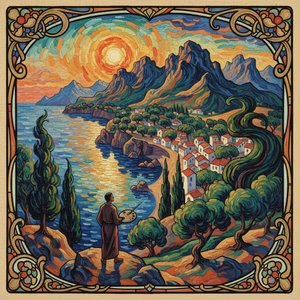
Santiago Rusiñol: A Life in Art and Modernisme
- Born: February 25, 1861, Barcelona, Spain
- Died: June 13, 1931, Aranjuez, Spain
- Nationality: Spanish
- Movement: Catalan Modernisme, Symbolism, Impressionism
Early Life and Artistic Development
- Rusiñol was born into a family of textile industrialists in Manlleu, later moving to Barcelona. Despite familial expectations, he pursued his passion for art from a young age.
- He received initial training at the Centro de Acuarelistas de Barcelona under Tomás Moragas, focusing on watercolour techniques and Realist principles.
- Early works reflected Orientalist themes and historical subjects before transitioning to urban scenes and landscapes in the 1880s.
- His travels throughout Spain significantly influenced his artistic development, exposing him to diverse cultural and architectural settings.
Parisian Influences and Artistic Maturity
- In 1889, Rusiñol moved to Paris, a pivotal moment in his career. He lived in Montmartre alongside fellow artists like Ramon Casas and Ignacio Zuloaga.
- The Parisian art scene exposed him to Impressionism and Symbolism, profoundly shaping his artistic style. He was influenced by artists such as Edgar Degas and Pierre-Auguste Renoir.
- His paintings from this period often depicted urban life, capturing a sense of solitude and melancholy through loose brushstrokes and subdued tones.
- He became involved in literary circles, engaging with Symbolist poets and writers, further enriching his artistic vision.
Return to Catalonia and the Catalan Modernisme Movement
- Rusiñol's return to Catalonia in the 1890s marked a significant chapter in his career and the development of Catalan Modernisme.
- He settled in Sitges, transforming it into a cultural hub for artists and intellectuals. His home, Cau Ferrat, became a renowned artistic salon.
- Rusiñol played a key role in fostering the Modernist movement alongside figures like Pere Romeu and Miquel Utrillo.
- His paintings during this period increasingly focused on landscapes, gardens, and architectural themes, reflecting his deep connection with nature and Catalan identity.
Legacy and Historical Significance
- Santiago Rusiñol is recognized as a leading figure in Catalan Modernisme, significantly contributing to the movement's artistic and cultural development.
- His paintings are celebrated for their blend of Symbolist influences, Impressionistic techniques, and evocative depictions of landscapes and gardens.
- He left behind a legacy of modernist buildings in Sitges, further solidifying his impact on Catalan architecture and urban planning.
- Rusiñol's work continues to inspire artists and art enthusiasts alike, showcasing the beauty and cultural richness of Catalonia during the fin-de-siècle era.
Questions & Answers
Is there an overview of all the subjects Santiago Rusiñol painted?
Santiago Rusiñol's works can be explored by subject on the artist's Subject Atlas page.
Where can I find statistics about Santiago Rusiñol's works?
Statistics about Santiago Rusiñol's works are available on the artist's Stats page.
Where can I see Santiago Rusiñol's artworks in a 3D gallery?
Santiago Rusiñol's artworks can be seen in a 3D gallery on the artist's 3D Museum page.