The Son of a Stonecutter
In the city of Verona, the son of a stonecutter named Gabriele began a life that would eventually drape the grandest halls of Venice in color. Born in 1528, the boy known as Paolo Caliari grew up amidst the heavy, sculpted forms of his father's trade. This early exposure to the permanence of stone likely informed the architectural precision that would later define his canvases. He began his training under Antonio Badile and later studied with Giovanni Francesco Caroto, learning the foundational mechanics of his craft. By the time he moved to Venice in the 1550s, the shimmering waterways and the bustling marketplaces of the Serenissima had already begun to shape his vision. He was not a man of austere spirituality; instead, he sought to capture the abundance of existence, turning the sacred into a spectacle of earthly splendor.
His move to Venice was the catalyst for a transformation. He absorbed the colorism of Titian, yet he refused to simply mimic the masters who came before him. Instead, he synthesized the graceful lines of Raphael and the elegance of Parmigianino into a style that felt uniquely Venetian. His workshop became a place of immense productivity, where his brother Benedetto and his sons, Gabriele and Carlo, helped sustain a legacy of grand scale and meticulous detail. He was a man who understood that a painting could be a window into a world of luxury, where light dances off silk and gold embroidery glitters under the weight of a celebratory feast.
The Spectacle of the Feast
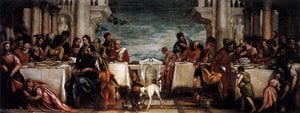
Veronese found his greatest expression in the monumental narrative, particularly those scenes that transformed biblical events into grand Venetian banquets. His 1563 work, The Wedding at Cana, created for the Benedictine monastery of San Giorgio Maggiore, remains a profound example of this approach. Rather than a simple religious illustration, the canvas became a panorama of 16th-century society, filled with elegantly dressed figures and musicians. He had a way of making the divine feel contemporary, as if the miracles of the Bible were occurring in the very palazzi of Venice. This penchant for the theatrical often brought him into conflict with the authorities. When he painted The Feast in the House of Levi, the Inquisition took issue with the inclusion of contemporary figures and the seemingly irreverent atmosphere of the scene. Veronese defended his choices with a bold conviction, arguing that a painter possessed the same creative freedom as a poet or a jester.
His ability to manage complex compositions allowed him to create illusions of depth that drew the viewer into the heart of the scene. He used perspective to build vast, architectural spaces that felt tangible. His mastery of oil painting allowed for a richness of texture, where the weight of a heavy robe or the sheen of a polished surface could be felt through the gaze. He did not merely paint history; he reimagined it through the lens of Venetian wealth and pageantry.
A Legacy of Color and Light
The impact of his work reached far beyond the borders of the Venetian Republic. His dramatic compositions and specific use of color have echoed through the centuries, influencing the development of the Baroque and even finding unexpected life in the visual aesthetics of modern cinema. He was part of the great trio of Venetian painters, alongside Titian and Tintoretto, yet he occupied a space of his own through his sheer exuberance. While others might have focused on the sublime or the profound, Veronese focused on the joy of the visible world.
His influence can be traced through the works of many who followed, from the grandiosity of Rubens to the delicate brushwork of Renoir. Even in his later years, as he worked on intricate portraits like Lucretia, he demonstrated an ability to compress his characteristic grandeur into a single, soulful gaze. He died in 1588, leaving behind a body of work that remains a vital link to the spirit of the Renaissance, a period that sought to find the divine within the beauty of the earthly realm.
Questions & Answers
How many artworks by Paolo Veronese are available to browse?
You can browse 521 artworks by Paolo Veronese on the All Artworks page.
How do I find all works by Paolo Veronese in a given medium?
The All Medium page groups Paolo Veronese's artworks by technique.
Is there an overview of all the subjects Paolo Veronese painted?
The Subject Atlas page maps Paolo Veronese's artworks by subject.