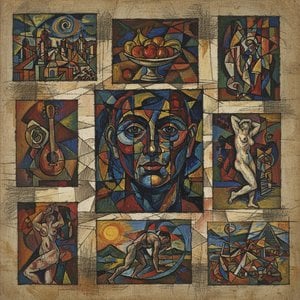
The Quiet Observer of Tradition
Ludvík Kuba lived a life shaped by the sounds and sights of the people around him. Born in Poděbrady, Bohemia, he began his path by studying the organ, a choice that suggests a deep connection to the rhythmic and melodic structures of life. His hands, which learned to play music, eventually learned to hold a brush through private lessons from Bohuslav Schnirch and Karel Liebscher. He moved through the halls of the Academy of Fine Arts and later found himself in the studios of Paris and Munich, absorbing the light and methods of the era.
His work was never about grand gestures. Instead, he looked closely at the landscape of South Bohemia and the specific details of the people who lived there. He was a man who listened. He collected thousands of folk songs, such as those found in Slavonic peoples in their songs, and spent much of his time documenting the customs and history of the Slavic cultures. His eyes were as much on the patterns of a traditional costume as they were on the way light hit a still-life of red begonias or a bowl of pears.
A Life in Color and Song
The movement of his brush followed the principles of Late-Impressionism, focusing on how light and atmosphere define a scene. He did not merely paint a landscape; he captured the feeling of a place through its colors and its people. His travels took him through the Balkans, where he observed the local customs with a meticulous eye. This attention to detail was not just for the canvas. He wrote about what he saw, producing works like the Book about Macedonia and Songs from Bosnia and Herzegovina.
His output was varied, reflecting a mind that could shift from the quietude of a portrait to the complexity of a folk tradition. He was a professor at the Academy of Fine Arts, passing on his observations to others, yet his own work remained grounded in the tangible. Whether it was a portrait of Josef Svatopluk Machar or a simple arrangement of fruit, his focus remained on the essence of the subject.
Questions & Answers
Can I browse Ludvík Kuba's works by color palette?
The By Palettes page groups Ludvík Kuba's artworks by their color palettes.
What other names is Ludvík Kuba known by?
Ludvík Kuba appears under the alternate names Ludwig Kuba, Лудвик Куба, Людвик Куба, Людвік Куба.
Where can I see the color profile of Ludvík Kuba's work?
The Palette Genome of Ludvík Kuba is a page that presents the color profile of the artist's body of work.
Which artworks by Ludvík Kuba are the most viewed?
The Stats page of Ludvík Kuba presents statistics computed from the artist's artworks listed on this website.