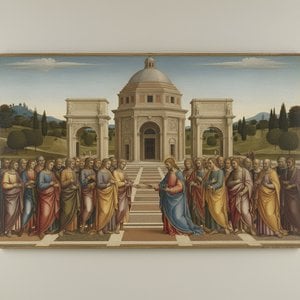
The Hand of Giovanni di Pietro
The name Lo Spagna carries the weight of a traveler's identity, a nod to Spanish origins etched into his Italian life. Born Giovanni di Pietro, he moved through the landscapes of Umbria and the Marches, leaving traces of his brush in places like Perugia, Todi, Trevi, and Spoleto. His presence in Perugia is noted as early as 1470, though by 1492, he was a recognized member of Perugino's workshop. This connection shaped much of what he produced. He worked with the same quiet precision found in the studios of his contemporaries, absorbing the soft lines and balanced compositions that defined the era.
His life followed the rhythms of the local guilds and civic duties. In 1516, he was granted citizenship in Spoleto, a city where he would eventually settle and find professional standing. He even rose to the position of Capitano delle Arti dei Pittori e degli Orefici in 1517. His personal life was tied to the local fabric through his marriage into the Martorelli family. The end of his work came abruptly; while working on a fresco cycle for San Giacomo di Spoleto, the plague took him in 1528, leaving his assistants, Dono Doni and Cecco di Bernardino d'Assisi, to finish the task he had begun.
Lines and Details
To look closely at his panels is to see a specific way of handling cloth and flesh. While the influence of Perugino is visible in his early works, certain habits belong only to him. He used a calligraphic flare in his drapery, creating folds that sometimes seem to follow their own logic rather than the shape of the body beneath. There is a sculptural quality to the faces he painted, particularly the way he modeled an oval face or rendered bee-stung lips and slender, arched eyebrows. Even the small articulations of fingers and toes carry a distinct, careful touch.
His compositions often placed figures against quiet, mountainous landscapes. In these settings, the trees and horizons bear his specific hand, differing from the more standard approaches of his mentors. He also drew subtle inspiration from Raphael, though he remained rooted in the traditions of the Perugino workshop. His work remains a study in these fine, deliberate marks:
- The use of calligraphic drapery that moves with its own internal rhythm.
- A focus on sculptural facial modeling and specific anatomical details like finger articulation.
- The integration of figures into verdant, mountainous backgrounds.
Questions & Answers
How do I find works by Lo Spagna on a specific theme?
To find works by Lo Spagna on a specific theme, use the artist's By Keywords page, which groups the artworks by keyword.
Where can I see the color profile of Lo Spagna's work?
The Palette Genome of Lo Spagna is a page that presents the color profile of the artist's body of work.
Which artworks by Lo Spagna are the most viewed?
Statistics about Lo Spagna's works are available on the artist's Stats page.
What are the birth city and country of Lo Spagna?
Lo Spagna was born in Perugia, in Italy.