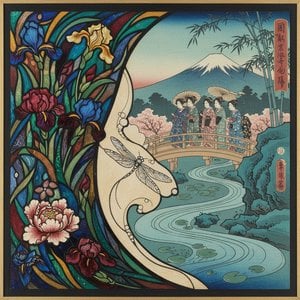
A Luminary of American Art: The Life and Legacy of John La Farge
John La Farge, born in New York City in 1835 to wealthy French parents, emerged as a pivotal figure in the evolution of late 19th and early 20th-century American art. His journey was one of constant exploration and innovation, spanning painting, mural design, stained glass artistry, interior decoration, and insightful writing on his travels—particularly those to Asia. Raised bilingually, La Farge’s upbringing instilled in him a cosmopolitan sensibility that would profoundly shape his artistic vision. He initially pursued legal studies but soon gravitated towards the world of art, studying first at Mount St. Mary's University and then at St. John's College (now Fordham University). A formative period followed with training under Thomas Couture in Paris, where he absorbed European artistic traditions while simultaneously developing a uniquely American aesthetic. This early exposure to both Old World mastery and his own burgeoning originality laid the foundation for a career marked by groundbreaking techniques and a distinctive style.Pioneering Innovation Across Disciplines
La Farge’s artistic output was remarkably diverse, yet consistently characterized by an intense focus on color and light. He began to gain recognition with his illustrations and landscapes, but it was in the realm of mural painting that he first made a significant impact. Commissions for churches like Trinity Church in Boston (1873) and the Church of the Ascension in New York showcased his ability to create luminous, spiritually evocative spaces. However, La Farge’s most enduring legacy lies in his revolutionary work with stained glass. Dissatisfied with the conventional methods of the time, he pioneered a technique involving superimposing multiple layers of colored glass—a process for which he received a patent in 1880. This innovation allowed him to achieve an unprecedented richness and depth of color, transforming stained glass from a merely decorative element into a powerful medium for artistic expression. His stained-glass windows weren’t simply representations; they were immersive experiences of light and hue. Beyond these core disciplines, La Farge also excelled in interior design, creating harmonious environments that integrated his paintings, murals, and decorative arts.The Influence of the East and a Search for New Forms
A defining aspect of La Farge’s artistic development was his fascination with Japanese art and culture. His travels to Asia, beginning in the 1880s, profoundly influenced his aesthetic sensibilities. He meticulously documented his observations in writings and incorporated elements of Japanese design—such as asymmetry, flattened perspectives, and a refined sense of color—into his own work. This embrace of Eastern aesthetics was not merely imitative; La Farge synthesized these influences with his existing artistic vocabulary to create something entirely new. His studio at 51 West 10th Street in Greenwich Village became a hub for artists interested in exploring non-Western art forms, fostering a spirit of experimentation and cross-cultural exchange. He wasn’t alone in this pursuit—artists like James McNeill Whistler were also captivated by Japanese aesthetics—but La Farge distinguished himself through his ability to seamlessly integrate these influences into his diverse artistic practice. The sacred grove, a forested area in Rhode Island where he painted many mythological scenes, became a personal sanctuary reflecting his spiritual and artistic explorations.A Lasting Impact on American Art
John La Farge’s contributions extended beyond his individual artworks; he was also a dedicated advocate for the arts and a vocal critic of academic conservatism. He co-founded the Society of American Artists in 1877 as an alternative to the perceived rigidity of the National Academy of Design, championing artistic freedom and innovation. His influence can be seen in the work of subsequent generations of artists, particularly those associated with the Arts and Crafts movement and Symbolism. La Farge’s emphasis on craftsmanship, his exploration of spiritual themes, and his innovative use of color all resonated with artists seeking to break away from traditional conventions. He served as an instructor at the Metropolitan Museum of Art Schools, nurturing young talent and imparting his knowledge and passion for art. Though he faced challenges—including a protracted legal battle with Louis Comfort Tiffany over stained-glass patents—La Farge remained committed to his artistic vision until his death in 1910. His legacy endures as a testament to the power of innovation, the beauty of color, and the enduring influence of cross-cultural exchange.Beyond the Canvas: Writings and Family
- Literary Contributions: La Farge was not only a visual artist but also a gifted writer. His travelogues, particularly *An Artist’s Letters from Japan* (1897), offered insightful observations on Japanese culture and art, contributing to a growing Western appreciation for Eastern aesthetics.
- Family Legacy: The La Farge family continued to contribute to the arts and humanities. His son, Oliver Hazard Perry La Farge II, became a renowned anthropologist and writer, focusing on Native American cultures and winning a Pulitzer Prize for his novel *Laughing Boy* (1929).
- Final Years: In his later years, La Farge continued to work prolifically, creating murals even into his seventies. He died at Butler Hospital in Providence, Rhode Island, leaving behind a body of work that continues to inspire and captivate audiences today.
- His interment is at Green-Wood Cemetery in Brooklyn, New York.
Questions & Answers
Can I sort John La Farge's artworks by color?
The Spectral Index page organizes John La Farge's artworks by color.
Can I browse John La Farge's works by color palette?
To find works by John La Farge in a specific palette, use the artist's By Palettes page.
Where can I find statistics about John La Farge's works?
Statistics about John La Farge's works are available on the artist's Stats page.