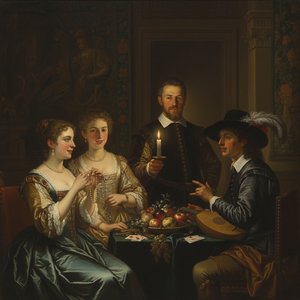
The Life and Patronage of Jan Weesop
Jan Weesop was a portrait painter, presumed to be of Flemish descent, who is primarily known for the works he produced in England during the 1640s. Arriving in the country in 1641, his presence coincided with the era of Van Dyck. Historical accounts suggest that Weesop was a sympathetic figure to the royalist cause, a sentiment reflected in his choice of subjects. His patrons were predominantly prominent members of the royalist aristocracy, including figures such as Elizabeth Murray, Countess of Dysart and later Duchess of Lauderdale, Marmaduke D'Arcy, and members or allies of the Villiers family. Notable subjects attributed to him include Anne Villiers, Countess of Sussex, and a double portrait of Lord Grandison and Mr. Villiers.
Artistic Style and Technique
Weesop’s work is characterized by a style that, while influenced by Van Dyck, maintained its own independence. He was noted as a gifted and sometimes idiosyncratic colourist, distinguished by his specific palette. In his Portrait of Esmé Stuart, Duke of Richmond and Duke of Lennox, his skill is evident in the use of golden amber in the sitter's coat and the red evening light that suffuses the composition. Beyond portraiture, his work demonstrates a strong grasp of landscape painting in the contemporary Dutch tradition. His ability to capture his subjects was such that some of his paintings were catalogued as works by Van Dyck in the 18th century.
Questions & Answers
Which artworks by Jan Weesop are the most viewed?
Statistics about Jan Weesop's works are available on the artist's Stats page.
How can I follow Jan Weesop's work year by year?
A timeline of Jan Weesop's works exists: the artist's Artwork Timeline page orders the artworks by creation date.
Where can I see the color profile of Jan Weesop's work?
The color profile of Jan Weesop's work is shown on the artist's Palette Genome page.