A Life of High Adventure and Sudden Tragedy
Jan Linsen lived a life that seemed to mirror the dramatic themes he chose to paint. Born in Hoorn around 1602 or 1603, this Dutch painter moved through Europe with a restless energy, traveling through France and eventually finding his way to Italy. In Rome, between 1624 and 1626, he became part of the Bentvueghels, an association of Dutch and Flemish artists. It was within this circle that he adopted the nickname Hermafrodito, a name that reflected the spirited, often eccentric culture of the expatriate artist community in the Eternal City.
His travels were marked by more than just artistic pursuit; they were fraught with genuine peril. While sailing from Italy, Linsen was captured by Moorish pirates. The ordeal left him stripped of his possessions and abandoned on the North African coast. He survived this encounter, an event so profound that he later translated the experience onto canvas, depicting the pirate leader in a work that once hung in his native Hoorn. He returned to the Netherlands in 1626, marking the beginning of his documented period of productivity.
The end of Linsen's life was as abrupt and violent as his adventures. In May 1635, at a local inn called "Croon van Sweden" in Hoorn, a dispute over a card game escalated into a fatal confrontation. A friend, driven by the heat of the argument, stabbed him in the stomach. He died shortly after, leaving behind a small but notable body of work that captured the intersection of myth and reality.
The Art of Landscape and Legend
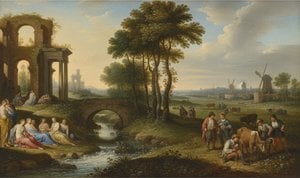
Linsen’s artistic output was concentrated, consisting of approximately ten paintings and a single drawing. His focus remained steadfast on mythological, biblical, and historical subjects, which he frequently placed within expansive, wide landscapes. These works often drew stylistic influence from his contemporaries, specifically Cornelis van Poelenburch and Bartholomeus Breenbergh. He possessed a particular talent for the Italianate river landscape, where figures interact with the natural world in a manner that feels both classical and grounded.
The themes he explored were often grand in scale, yet they retained a sense of human presence. His paintings frequently featured:
- Biblical narratives set against sweeping vistas.
- Mythological figures navigating pastoral settings.
- Historical scenes integrated into detailed landscapes.
- Personal encounters, such as his depiction of the pirate encounter.
Though his known corpus is limited, the surviving pieces demonstrate a clear connection to the Dutch tradition of landscape painting infused with Mediterranean light and subject matter. His ability to weave personal trauma and historical interest into the fabric of his landscapes remains the defining characteristic of his brief career.
Questions & Answers
How do I find all works by Jan Linsen in a given medium?
Jan Linsen's works can be browsed by medium on the artist's All Medium page.
In which historical period did Jan Linsen work?
Jan Linsen worked in the Early-Modern period. The period situates the artist's activity in history.
Is there a timeline of Jan Linsen's works?
Jan Linsen's artworks can be seen in chronological order on the artist's Artwork Timeline page.