Early Life, Family and Training
Jan Brueghel the Elder entered a world defined by the heavy weight of artistic legacy. Born in Brussels in 1568, he was the younger son of the eminent Flemish Renaissance painter Pieter Bruegel the Elder. His family life was shaped by the presence of his mother, Maria, often called Mayken Coecke van Aelst, and his siblings, his brother Pieter Brueghel the Younger and his sister Marie. However, the stability of his early years was short-lived. After his mother passed away in 1578, the family's circumstances shifted, and Jan was raised by his grandmother, Mayken Verhulst.
It was in the care of Verhulst that Jan's technical foundation was laid. She was a skilled artist in her own right and became his first teacher, guiding his young hands through the delicate discipline of drawing. She focused his training on the precise art of watercolour painting of miniatures, a method that required immense patience and a steady eye. This early instruction in small-scale, detailed work would stay with him throughout his life, influencing how he approached the natural world in his later years.
Life and Activity in Antwerp and Italy
By the turn of the seventeenth century, Jan Brueghel the Elder had established himself firmly within the artistic heart of the Low Countries. His presence in Antwerp was officially recognized on 4 October 1601, when he was registered as a burgher of the city. This period marked a significant rise in his professional standing. That same year, he was elected dean of the Guild of Saint Luke, a position of considerable responsibility within the local community. His peers showed their trust in his leadership by re-electing him as dean in 1602.
Seeking to expand his horizons beyond the borders of Flanders, he traveled to Italy. This period of travel brought him into contact with different aesthetic sensibilities and important patrons. While in Milan, he came under the patronage of Cardinal Federico Borromeo. This connection helped secure his reputation outside of his home region. His time in Italy allowed him to absorb new influences that would eventually merge with the traditions he had learned in his youth.
Technique, Style and Artistic Innovations
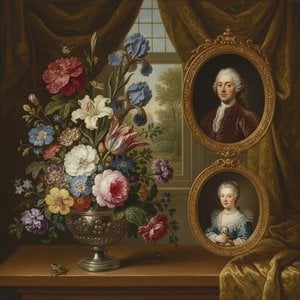
Brueghel possessed a hand so precise that it earned him the nickname "Velvet" Brueghel. This title came from his ability to render the heavy, soft textures of fine fabrics with a realism that felt tangible. He applied a miniaturist technique to the natural world, treating every leaf, insect, and petal as a subject worthy of intense, careful observation. This meticulous approach allowed him to capture the fleeting details of nature with a clarity that few could match.
His fascination with the botanical world led to his reputation as "Flower" Brueghel. He did not merely paint flowers; he helped invent entirely new ways of seeing them on canvas. He was a key figure in the development of garland paintings, where lush arrangements of blossoms frame a central religious or mythological scene. He also created the paradise landscape, a genre that blended the stillness of still life with the expansive scale of a landscape to depict idyllic, heavenly settings.
- Flowers in a Wan-Li Vase
- The Garden of Eden with the Fall of Man
- Still Life with a Tazza, Garland and Bouquet of Flowers in a Porcelain Vase
Collaborations and Professional Circles
Jan Brueghel the Elder moved through the artistic circles of the Spanish Netherlands with a natural ease, often working alongside others to bring complex visions to life. His most significant bond was with Peter Paul Rubens. The two were close friends who developed a seamless way of working together on religious and mythological subjects. In these partnerships, Rubens typically handled the human figures, while Brueghel focused on the intricate landscapes and still life elements that provided the setting.
This spirit of cooperation extended far beyond his friendship with Rubens. He was a frequent collaborator with many of his contemporaries, including Paul Bril, Joos de Momper, Paul Vredeman de Vries, Frans Francken the Younger, Hendrick de Clerck, Pieter van Avont, and Hendrick van Balen the Elder. One notable instance of this shared creativity occurred about 1607-1608, when he worked with Hendrick van Balen to create what is considered the first known garland painting. These works often featured elaborate floral arrangements framing a central scene.
His professional standing was further solidified by his position at the heart of the court. He served as a court painter to the Archduke and Duchess Albrecht and Isabella, the sovereigns of the Spanish Netherlands. This role placed him in direct contact with the highest levels of power and patronage in the region.
Legacy and Artistic Influence
Jan Brueghel the Elder left behind a world shaped by his curiosity. His paintings captured a specific moment in history, reflecting both the rise of scientific observation and the deep religious fervor of the Counter-Reformation. Through his brush, the natural world was documented with a precision that mirrored the changing intellectual landscape of the 17th century. He was a prolific innovator, helping to define new genres such as flower garland paintings, which would influence how artists approached the intersection of botany and devotion.
His influence lived on through the hands of those he taught. He passed his technical knowledge to his son, Jan Brueghel the Younger, and to Daniel Seghers, ensuring his meticulous approach to detail remained a part of the Flemish tradition. His professional standing was such that he was trusted to act as an executor of the last will of Peter Paul Rubens, alongside Hendrick van Balen the Elder, Cornelis Schut, and Paulus van Halmaele.
- The Garden of Eden with the Fall of Man
- Paradise Landscape with the Animals Entering Noah
- Still Life with a Tazza, Garland and Bouquet of Flowers in a Porcelain Vase
Questions & Answers
How do I find works by Jan Brueghel the Elder on a specific theme?
Jan Brueghel the Elder's works can be explored by keyword on the artist's By Keywords page. Each keyword groups the related artworks.
Where can I see Jan Brueghel the Elder's artworks arranged by atmosphere?
Jan Brueghel the Elder's works can be browsed by mood on the artist's Mood Room page, which arranges the artworks by their recorded moods.
What other names is Jan Brueghel the Elder known by?
Jan Brueghel the Elder is also known as Jan (I) Brueghel, Jan Brueghel (I), Old Brueghel, Jan, il vecchio Brucoli, Jan Broeghel.