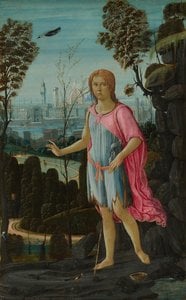
A Florentine Artisan of Grace: The World of Jacopo del Sellaio
Jacopo del Sellaio, a name perhaps less immediately recognized than those of his celebrated contemporaries like Botticelli or Ghirlandaio, nevertheless occupies a vital and enchanting niche within the vibrant tapestry of 15th-century Florentine art. Born in Florence around 1442, Jacopo emerged during a period of extraordinary artistic ferment, a time when the Renaissance was blossoming into full flower. While details surrounding his earliest training remain somewhat elusive, it is known that he entered the world of painting and by 1473 had established a collaborative studio with Filippo di Giuliano – a partnership suggesting a shared dedication to craft and a reciprocal exchange of artistic knowledge. This early association speaks volumes about Jacopo’s ambition and willingness to learn within the dynamic environment of Florentine workshops, where skills were honed through practice and observation. His father was a saddlemaker—hence the nickname “Sellaio,” meaning ‘saddle maker’—a trade that perhaps instilled in him an appreciation for meticulous detail and refined craftsmanship, qualities that would become hallmarks of his artistic style.Cassoni and Devotional Panels: A Synthesis of Skill
Jacopo del Sellaio's artistic output was remarkably diverse, yet he is particularly renowned for his exquisitely decorated *cassoni*, or wedding chests. These weren’t merely functional objects; they were potent symbols of status, family heritage, and the hopes invested in a new union. His most celebrated example, “The Story of Cupid and Psyche,” commissioned for a 15th-century Florentine marriage, is a testament to his narrative skill and delicate artistry. The panels unfold the ancient Roman tale with grace and sensitivity, showcasing Jacopo’s ability to imbue mythological subjects with emotional resonance. Beyond these grand commissions, he also excelled in creating smaller devotional panels featuring saints like Saint Jerome and Saint John the Baptist, works that catered to the growing demand for personal piety among private patrons. These intimate pieces reveal a refined sensibility and an attention to detail that elevates them beyond simple religious iconography. The “Nerli Cassone,” created in collaboration with Zanobi di Domenico and Biagio d'Antonio in 1472, further demonstrates his collaborative spirit and ability to seamlessly integrate his artistic vision within a team effort. His panel "The Banquet of Ahasuerus," part of a larger series, reveals a mastery of complex compositions and narrative storytelling.Echoes of Masters: Influences and Artistic Development
To understand Jacopo del Sellaio’s art is to recognize the subtle yet profound influences that shaped his style. The lyrical grace and elegant figure drawing characteristic of Sandro Botticelli are clearly discernible in many of his compositions, particularly those depicting mythological scenes. He absorbed Botticelli's ability to create figures imbued with a sense of ethereal beauty and emotional depth. Simultaneously, Jacopo drew inspiration from Domenico Ghirlandaio’s realistic portrayals of figures and meticulous attention to detail—a grounding influence that prevented his work from becoming overly stylized or mannered. This synthesis of influences allowed him to develop a distinctive voice, blending traditional techniques with the emerging artistic trends of the Renaissance. He wasn't simply imitating; he was absorbing, adapting, and ultimately transforming these influences into something uniquely his own.A Legacy Within the Florentine Renaissance
Jacopo del Sellaio’s historical significance lies not in achieving superstar status but in representing a crucial segment of the artistic landscape of 15th-century Florence. He embodies the generation of skilled artisans who skillfully balanced tradition with innovation, contributing to the rich and multifaceted character of Florentine art. His work provides invaluable insight into the decorative arts—the *cassoni* being prime examples—and the private devotional practices that flourished during this period. While he may not have garnered the same level of fame as some of his more celebrated peers, his contributions to both cassone painting and religious art are undeniably noteworthy. He passed away in Florence in 1493, leaving behind a legacy of beautifully crafted artworks that continue to captivate and inspire those who encounter them today. His son, Arcangelo di Jacopo del Sellaio, continued the family tradition as a painter, further cementing their place within the artistic heritage of Florence.Questions & Answers
How many artworks by Jacopo del Sellaio are available to browse?
You can browse 40 artworks by Jacopo del Sellaio on the All Artworks page.
What are the birthplace and birth year of Jacopo del Sellaio?
Jacopo del Sellaio was born in Florence in 1442.
How do I find all works by Jacopo del Sellaio in a given medium?
To find all works by Jacopo del Sellaio in a given medium, use the artist's All Medium page.
Where is Jacopo del Sellaio from?
Jacopo del Sellaio was born in Italy.
What moods do Jacopo del Sellaio's artworks express?
The artist's Mood Room page shows Jacopo del Sellaio's artworks arranged by their atmosphere.
Where can I see Jacopo del Sellaio's artworks in a 3D gallery?
Jacopo del Sellaio's artworks can be seen in a 3D gallery on the artist's 3D Museum page.
Is there a timeline of Jacopo del Sellaio's works?
Jacopo del Sellaio's artworks can be seen in chronological order on the artist's Artwork Timeline page.
Can I browse Jacopo del Sellaio's works by movement?
The movements Jacopo del Sellaio worked in can be seen on the artist's All Movements page, which groups the artworks by movement.