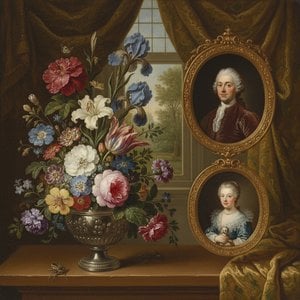
The Delicate Hand of a Miniature Master
In the twilight of the eighteenth century, a period defined by both the rigid structures of monarchy and the burgeoning whispers of romanticism, the name Georg Jonas von Wright emerged as a subtle yet significant presence in the realm of portraiture. Born in the quiet landscapes of Tammela, Finland, around 1754, von Wright’s life was a tapestry woven from the dual threads of military duty and artistic devotion. As an officer, he moved through the disciplined worlds of the Swedish era, yet it was within the intimate, small-scale confines of miniature painting that his true legacy took root. His work does not demand attention through grand, sweeping canvases but rather invites the viewer into a private, whispered conversation with history.
The artistry of von Wright is best understood through the lens of the miniature—a medium that requires an almost superhuman level of precision and a profound patience. Working primarily with gouache on paper, he mastered the ability to capture the essence of a soul within a frame often no larger than a few centimeters. His technique relied on delicate, layered strokes that could simulate the soft texture of skin, the luster of silk, and the piercing clarity of an eye. There is a certain vulnerability in his portraits; because they were intended to be held in the hand or kept close to the heart, they possess an emotional intimacy that larger oil paintings often lack.
A Life Between Borders and Disciplines
The biography of von Wright is one of movement and multifaceted identity. While his roots lay in Finland, his life and career were deeply intertwined with the Swedish crown and its cultural spheres. This duality allowed him to navigate the aristocratic circles that served as the primary patrons for miniature portraitists. His marriage to Ulla von Höpken further embedded him within the social fabric of the era's elite, providing him access to the very subjects whose likenesses he would immortalize. This period of his life was marked by a unique tension between the structured, often harsh reality of military service and the ethereal, meticulous demands of his studio practice.
His development as an artist was likely influenced by the prevailing Neoclassical trends of the late 1700s, which emphasized clarity, order, and a refined elegance. However, in his hands, these principles were softened by a burgeoning sensitivity to character. To look upon a von Wright miniature is to see more than just a formal record of a face; it is to witness an attempt to capture the fleeting vitality of a moment. His ability to render light—the way it catches a lace collar or reflects in a gaze—demonstrates a sophisticated understanding of luminosity that remains captivating even centuries after his death in 1800.
Legacy and Historical Resonance
Though his life was relatively short, the historical significance of Georg Jonas von Wright lies in his contribution to the intimate portrait tradition of Northern Europe. He represents a vital link in the lineage of artists who documented the human condition through the miniature format, a genre that flourished before the advent of photography. His works serve as precious windows into the physiognomy and fashion of the late eighteenth century, preserving the dignity of individuals who might otherwise have been lost to the shadows of time.
Today, his contributions are cherished by institutions such as the Nationalmuseum, where his traces of artistry continue to inspire awe. The enduring charm of his work resides in its ability to bridge the gap between the monumental and the minute. In an age of grand historical narratives, von Wright reminds us that the most profound truths are often found in the smallest details—in a single brushstroke, a subtle shadow, or the quiet, captured gaze of a stranger from the past.
Questions & Answers
Where is Georg Jonas Von Wright from?
Georg Jonas Von Wright was born in Finland.
Which artworks by Georg Jonas Von Wright are the most viewed?
A Stats page exists for Georg Jonas Von Wright, presenting statistics about the artist's artworks on this website.
What moods do Georg Jonas Von Wright's artworks express?
Georg Jonas Von Wright's works can be browsed by mood on the artist's Mood Room page, which arranges the artworks by their recorded moods.
Is there a 3D virtual tour of Georg Jonas Von Wright's works?
A virtual visit is possible: the 3D Museum page of Georg Jonas Von Wright presents the artist's works in a three-dimensional gallery.