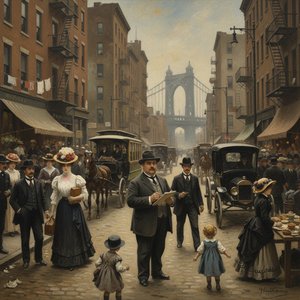
A Chronicler of Urban Life: The World of Everett Shinn
Everett Shinn, born in Woodstown, New Jersey, in 1876, wasn’t simply a painter; he was a visual poet of the burgeoning metropolis. He captured the raw energy, the vibrant spectacle, and often, the underlying grit of early 20th-century America with an immediacy that set him apart. From his beginnings as a newspaper illustrator to his prominence within the Ashcan School, Shinn’s artistic journey reflects a commitment to portraying life as it was lived – unvarnished, compellingly real. Art historian Sam Hunter affectionately dubbed him “the dandy of the realists,” a moniker reflecting both his refined aesthetic and his embrace of the city's pleasures. His early training at the Spring Garden Institute and later, the Pennsylvania Academy of the Fine Arts in Philadelphia, provided a solid foundation, but it was his work as an artist-reporter for Philadelphia newspapers – the *Press*, the *Inquirer*, and the *Ledger* – that truly honed his observational skills. This experience instilled in him a fascination with urban life and a knack for capturing fleeting moments before they vanished.From Philadelphia Streets to New York Stages
The move to New York City in 1897 marked a turning point. Shinn quickly found work as an illustrator, contributing to publications like *Harper’s Weekly*, but it was his burgeoning friendships with fellow artists – George Luks, John Sloan, William J. Glackens, and Robert Henri – that truly shaped his artistic direction. These connections led him to the heart of the Ashcan School, a group dedicated to depicting the everyday realities of urban existence, often focusing on scenes overlooked by more traditional art circles. While many of his peers embraced oil paints, Shinn distinguished himself through his masterful use of pastels, a medium that allowed for a unique blend of spontaneity and delicate detail. He found particular inspiration in the city’s theaters, captivated by their dazzling displays of light, color, and performance. Works like “Olympic Theater” and “Revue” are not simply depictions of entertainment; they are vibrant studies of human interaction, capturing the energy and excitement of a night out in the city. The theatrical world offered Shinn a stage for exploring themes of illusion, spectacle, and the complex relationship between performer and audience. He wasn’t merely recording what he saw; he was interpreting it through a lens of dramatic flair and psychological insight.The Ashcan School and Beyond
Shinn's association with the Ashcan School was crucial to his artistic development, challenging academic conventions and rejecting idealized representations in favor of honest portrayals of urban life – its poverty, its vibrancy, its struggles, and its joys. Their work often focused on working-class neighborhoods, saloons, and dance halls, subjects previously considered unworthy of serious artistic attention. Shinn’s participation in the landmark exhibition “The Eight” in 1908 solidified his position within this movement, though he always maintained a slightly more refined aesthetic than some of his colleagues. He wasn't solely focused on social commentary; he was equally interested in capturing the spectacle and allure of modern life. His versatility extended beyond painting, as demonstrated by his murals for private homes and public spaces, including those at the Stuyvesant Theatre and the Plaza Hotel. Even as his work evolved beyond the strict tenets of the Ashcan School, a commitment to realism and an acute observation of human behavior remained central to his artistic vision. He continued to explore themes of urban life, but with an increasing emphasis on its glamour and theatricality.A Life Marked by Passion and Turmoil
Everett Shinn’s personal life was as dynamic and complex as the scenes he depicted in his art. He experienced multiple marriages – four in total – and a reputation for enjoying the pleasures of city life, contributing to his “dandy” persona. These personal challenges often intersected with his artistic pursuits, influencing his subject matter and adding layers of emotional depth to his work. Despite periods of financial hardship, particularly during the Depression, Shinn continued to paint and exhibit, receiving recognition from institutions like the National Academy of Design and the American Academy of Arts and Letters later in his career. He passed away in 1953, leaving behind a legacy that continues to resonate with audiences today. His life was a testament to the power of artistic vision and the enduring appeal of capturing life as it truly is, even amidst personal struggles and societal changes.Enduring Legacy
Everett Shinn’s influence on American art remains significant.- Influence on American Realism: Shinn’s work significantly contributed to the development of American realism, paving the way for future generations of artists who sought to depict everyday life with honesty and authenticity.
- Capturing a Moment in Time: His paintings and pastels offer invaluable insights into the social and cultural landscape of early 20th-century America, providing a visual record of a rapidly changing world.
- Masterful Technique: Shinn’s innovative use of pastel as a fine art medium expanded the possibilities of this often-underappreciated technique.
- Theatricality and Spectacle: His depictions of theater scenes are not merely representations of entertainment; they are explorations of human psychology, social dynamics, and the allure of illusion.
Questions & Answers
Is there a chronological account of Everett Shinn?
A chronological account of Everett Shinn's work is available on the artist's Chronicle page, where the artworks pass in order of creation, chapter by chapter.
What are the birthplace and birth year of Everett Shinn?
Everett Shinn was born in Woodstown in 1876.
What colors did Everett Shinn use most often?
The color profile of Everett Shinn's work is shown on the artist's Palette Genome page.