The Life and Artistic Journey of Alphonse Asselbergs
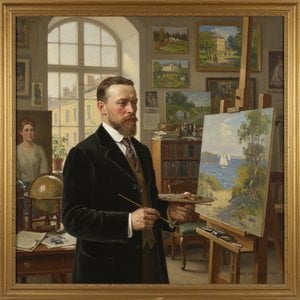
Born in Brussels, Belgium, Alphonse Asselbergs was the son of Henri Asselbergs, a successful merchant in the paper trade. After attending the local atheneum, he initially entered the family business at the age of twenty. However, his life took a transformative turn following a chance meeting with the landscape painter Edouard Huberti. This encounter sparked a deep interest in art, leading him to create his first paintings of the Kempen in 1861. For several years, he navigated a dual existence, vacillating between his comfortable, upper-class life as a businessman and the inherent risks of pursuing a career as an artist.
Asselbergs' artistic training was heavily influenced by Huberti, with whom he traveled through the area around Namur. During these excursions, he befriended Théodore T'Scharner, and together they embarked on painting expeditions in the Ardennes. A pivotal moment occurred in the summer of 1866 during an extended trip with Huberti to the artists' colony at Anseremme, where Asselbergs was first exposed to the concept of painting en plein aire. By 1869, he was exhibiting his work in Brussels.
Exhibitions and Later Years
Asselbergs' commitment to his craft led him to join the painters at the artists' colony in Tervuren, where he stayed regularly until 1871. This group, known as the Tervuren School, became the Belgian equivalent of the Barbizon School. His recognition grew as he received good reviews at the salon in Ghent by 1868, and he became a co-founder of the Société Libre des Beaux-Arts. His travels also took him to Algeria from 1873 to 1874 alongside the watercolorist Arthur Bouvier, a journey that resulted in a series of Orientalist canvases.
In his later years, Asselbergs lived near the artists' colony in Genk and made excursions to the forests of Fontainebleau. He eventually moved to Uccle, where he maintained a studio with a round tower. Throughout the 1880s, he held exhibitions at the Salon in Paris. His contributions to society were recognized when he was named an officer in the Order of Leopold, receiving a second commission in 1896. He died in Uccle in 1916.
Questions & Answers
Where are Alphonse Asselbergs's artworks grouped by technique?
Alphonse Asselbergs's works can be browsed by medium on the artist's All Medium page.
Can I browse Alphonse Asselbergs's works by mood?
The artist's Mood Room page shows Alphonse Asselbergs's artworks arranged by their atmosphere.
How many artworks by Alphonse Asselbergs are available to browse?
You can browse 6 artworks by Alphonse Asselbergs on the All Artworks page.