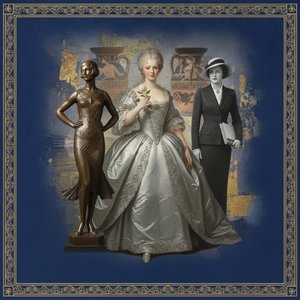
The eternal feminine (German: das Ewig-Weibliche), a concept first introduced by Johann Wolfgang von Goethe at the end of his play Faust (1832), is a transcendental ideality of the feminine or womanly abstracted from the attributes, traits and behavi...
True elegance is rarely found in the loud or the transient. It exists instead in a state of quiet strength, a refusal to be hurried by the chaotic whims of time. To look upon a work of art that embodies poise is to encounter a sense of eternal calm, where beauty is synonymous with an unusual effectiveness and a refined simplicity. This quality does not rely on excess; rather, it is found in the deliberate stillness of a hand or the harmonious balance of a silhouette against a landscape.
In the late 18th century, the concept of the "eternal feminine" began to take shape in the literary imagination of Goethe, suggesting a transcendental ideality that moves us toward something higher. This ideal is not merely about physical appearance but involves a moral beauty and a sense of transcendence. When we observe the masters, we see this pursuit of poise as an emblem of civilization itself, offering a sanctuary of order in a world often marked by disorder.
Introduction Step into a quiet corner of the eighteenth century, where the soft glow of candlelight meets the refined elegance of British high society. To wander through the works of George Romney is to embark on an intimate journey through the souls...
A single expression can convey strength, vulnerability, or a secret joy across centuries. In the realm of portraiture, the gaze is perhaps the most profound tool at an artist's disposal. It creates a psychological depth that bridges the gap between the sitter and the observer. Consider the works of George Romney, who possessed a rare ability to move beyond mere likeness to capture the very soul of his subjects. Through the delicate interplay of shadow and silk, he rendered gazes that felt remarkably alive.
In his 1773 portrait of Mrs. Verelst, Romney utilizes a masterful chiarosc_uro to sculpt the subject against a grand architectural backdrop. There is a haunting tension in her downward gaze—a blend of modesty and aristocratic composure that feels strikingly modern. This quiet dignity reminds us that true presence is often communicated through what is left unsaid, a silent dialogue held in the soft light of a painted eye.
A Moment of Ethereal Grace: Botticelli's *Detail Of One Of The Three Graces* Sandro Botticelli’s “Detail Of One Of The Three Graces, From The Primavera” offers a captivating glimpse into the heart of Renaissance Florence – a world where classical ide...
The architecture of elegance is built upon the mastery of line and form. Artists throughout history have used the fluidity of drapery to lend movement and life to their figures, creating an illusion of three-dimensionality through careful shading. In the Early Renaissance, Sandro Botticelli achieved this through a signature linear quality that emphasized contours, making the delicate forms of his subjects appear almost weightless.
This mastery of form finds a different expression in the Neoclassical era. Jean-Baptiste Regnault’s 1793 depiction of The Three Graces utilizes poses reminiscent of classical sculpture, echoing the ideals of proportion and symmetry. Here, the bodies are intertwined yet distinct, each radiating an individual aura of serenity. By adhering to these disciplined structures, the artist captures a sense of inner harmony that transcends the physical, much like the structured beauty found in the works of Poussin.
The Language of Detail: Symbolism in Ornamentation
A Portrait of Grace: Anthony Sandys’s Pre-Raphaelite Vision Anthony Frederick Augustus Sandys's “Grace Rose,” painted in 1866, is more than just a portrait; it’s a meticulously crafted tableau vivant, a shimmering glimpse into the opulent world of Vi...
Every carefully chosen motif contributes to a larger narrative of refinement. In portraiture, the subtle curve of a lace collar or the shimmer of a pearl is never merely decorative; these details ground the subject within a tradition of status and lineage. Anthony Frederick Augustus Sandys, in his 1866 portrait of Grace Rose, utilized such elements to create a tableau of Victorian opulence. The delicate lace trim and shimmering pearls work alongside an antique vase to weave a story of beauty and the allure of antiquity.
This use of symbolism extends to the natural world as well. In many works, the inclusion of flora—such as the roses in Sandys’s composition—speaks to themes of love and the fleeting nature of youth. Even in the more intimate settings of Bartolomé Esteban Murillo, such as his 1660 work Two Women at a Window, small details like a strawberry-red bow or a rose-pink skirt serve to emphasize the refinement of the Sevillian elite. These small, tactile elements invite the viewer to linger and discover the layers of meaning hidden within the surface.
Atmospheric Grace: Light as the Architect of Presence
Bartolomé Esteban Murillo’s *Two Women at a Window*: A Portrait of Andalusian Grace Bartolomé Esteban Murillo's *Two Women at a Window*, painted in 1660, is more than just a depiction of two women; it’s a poignant meditation on beauty, innocence, and...
Light is the final element required to breathe life into the concept of poise. It is the tool that sculpts form and creates atmosphere, transforming a flat canvas into a window of profound depth. Whether through the soft, diffused light of a Renaissance garden or the dramatic shadows of the Baroque, light dictates the emotional temperature of the work.
In the Neoclassical style, a delicate sfumato effect can blur edges to create a dreamlike softness, while in the hands of a master like Murillo, light and shadow create an intimacy that draws the viewer directly into the domestic scene. This command of illumination allows the artist to highlight the texture of silk or the warmth of skin, imbuing each scene with a quiet drama. Ultimately, when we find art that captures this atmospheric grace, we find a way to connect with the enduring power of the human spirit, preserved through the meticulous application of oil and light.
At ArtsDot.com, we celebrate this enduring pursuit of beauty. Whether you are looking for a hand-painted reproduction of a classical era or seeking to transform a personal memory into a custom masterpiece via our professional digital mockup service, our mission is to help you find art that resonates with your own sense of grace.
Explore the exquisite world of Rococo art! Discover its history, masters (Watteau, Boucher & more), and defining elegance. Expert insights for collectors seeking museum-quality reproductions & custom portraits.
Discover the profound beauty of timeless grace through a curated selection of masterworks. From Renaissance elegance to Neo-Classical allure, explore captivating portraits of women that define sophistication for the discerning art collector and luxury interior designer.
Explore the exquisite world of Rococo art – its history, masters, & defining elegance. Discover how this refined aesthetic shaped Europe and continues to inspire collectors today. Expert insights for discerning buyers.
Step into the elegance of 18th-century Britain with our curated guide to George Romney's top 25 masterpieces. Explore iconic portraits and timeless techniques through museum-quality art reproductions and decor inspiration. Discover all masterpieces on ArtsDot.com.
Journey through the ethereal beauty of Sandro Botticelli's greatest works. From The Birth of Venus to his mythic Renaissance masterpieces, explore the stories and techniques behind these icons. Find museum-quality art reproductions for your decor. Discover all masterpieces on ArtsDot.com



 Mastering Elegance: The Top 25 Iconic Portraits by George Romney
 Detail Of One Of The Three Graces, From The Primavera
 Grace Rose
 Two Women at a Window