Preview
 Send
Send Share
Share
 Details
 Guide
Guide

 Download
 Similars
 X-Ray
X-Ray Diaporama
 Q&A
Q&A Stats
StatsThe Pumpkin Patch


 Read More
Giclée / Art Print
Museum-quality giclée or canvas print with fast production and flexible finish options. ( Buy Hand Made Painting Switch to Digital Image)




P118B $10

P118H $10

P118W $10

P438Z $10

P508JH $12

P508YH $12

P805H $10

P805Z $10

P919BZ $10

P919G $10

P919XJ $10

P959ZH $10

P968JZ $12

W106C $8

W218G $10

W218JH $8

W218Y $10

W307PJ $10

W316G $10

W316PJ $8

W316Y $10

W398PJ $8

W4111J $10

W500HY $15

W500JH $15

W692G $12

W849H $8

W940BG $15

W953PJ $8




Pick from our preset sizes that match the artwork's original proportions.

Type the width and the height you need, to fit your frame or your wall. A print can only be cut, never made bigger than the picture, so a size with a different shape loses a part of the image. We send you a digital mockup to approve before we print anything. The picture shown on this page does not show the real cut — only the mockup does.
Worldwide Delivery () in 2 weeks instead of standard 4/5 weeks. (12 November)

Free Worldwide Express Shipping

High-Quality Linen Canvas

Full Shipping Insurance

Customs Tax Refund Guarantee

True Color Matching Guarantee

100-Day Return Policy (Defects Only)

100% Money-Back Guarantee

Bulk Discount Offer
 Glass option is only available in size under 110 CM

The Pumpkin Patch
Giclée / Art Print
Reproduction Size
-


Total Price
$ 63
A Moment Frozen in Time: The Significance of Winslow Homer’s “The Pumpkin Patch”
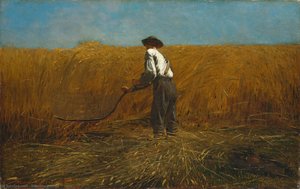
Winslow Homer's "The Pumpkin Patch," painted in 1878, isn’t merely a depiction of autumnal labor; it’s a poignant snapshot of rural America at the cusp of profound change. This watercolor masterpiece, currently residing within the Canajoharie Library and Art Gallery, invites us into a scene brimming with quiet industry, community spirit, and a subtle undercurrent of nostalgia for a disappearing way of life. Homer, a master of capturing the essence of everyday American experience, skillfully employs his signature technique—a delicate balance between observation and expressive brushwork—to create an atmosphere both warm and deeply resonant.
The painting immediately draws the eye to the group of figures engaged in the harvest – men and women working together with a shared purpose. Their postures, rendered with remarkable sensitivity, suggest not just physical exertion but also a sense of camaraderie and mutual respect. Homer’s use of earthy tones—russets, ochres, and deep greens—dominates the palette, mirroring the landscape itself and grounding the scene in the tangible realities of rural life. The soft, diffused light, characteristic of his watercolor style, lends an almost dreamlike quality to the composition, softening the edges and creating a sense of intimacy.
The Artist’s Approach: Watercolor as a Vehicle for Emotion
Homer's choice of watercolor is crucial to understanding the painting’s impact. Unlike the bolder strokes of oil paint, watercolor allows for a remarkable degree of transparency and luminosity. This technique perfectly suits Homer’s aim—to capture not just the appearance of the scene but also its emotional atmosphere. The subtle gradations of color, achieved through layering washes and delicate brushstrokes, evoke a sense of warmth and comfort, while simultaneously hinting at the hard work involved in the harvest.
Furthermore, Homer’s meticulous attention to detail—the individual pumpkins scattered across the field, the worn clothing of the workers, the subtle expressions on their faces—adds layers of complexity to the scene. He doesn't shy away from depicting the realities of rural labor, yet he does so with a remarkable degree of empathy and respect for his subjects.
A Window into 19th-Century America
"The Pumpkin Patch" offers a valuable glimpse into American life during the late 19th century. It reflects a period of rapid industrialization and urbanization, which were fundamentally altering the social fabric of the nation. The painting celebrates the enduring values of community, hard work, and self-sufficiency—qualities that were increasingly threatened by these changes. The scene speaks to a time when agriculture remained central to American identity, and families relied on each other for support and sustenance.
Beyond its immediate depiction of rural labor, the painting also carries symbolic weight. The abundance of pumpkins – a symbol of harvest, prosperity, and gratitude – suggests a celebration of the bounty of the land. The collective effort of the workers underscores the importance of community and shared responsibility. It’s a quiet testament to the dignity of honest work and the beauty of simple living.
Bringing Homer's Vision Home: High-Quality Reproductions
ArtsDot offers meticulously crafted, handmade oil paintings reproductions of “The Pumpkin Patch,” allowing art lovers to experience the artistry and emotional depth of this iconic American painting in their own homes. Our skilled artists utilize only the finest materials—traditional oils on canvas—to faithfully recreate every detail of Homer’s original work. We strive to preserve not just the visual appearance but also the spirit and atmosphere of the painting, ensuring that it remains a timeless treasure for generations to come.
Explore the full beauty of “The Pumpkin Patch” – and discover other exceptional reproductions by Winslow Homer – at ArtsDot.com. Let this evocative image transport you back to a simpler time, reminding us of the enduring values that shaped American culture.
Questions & Answers
How saturated is the palette of "The Pumpkin Patch"?
"The Pumpkin Patch" by Winslow Homer is recorded with a muted saturation.
What colors dominate "The Pumpkin Patch" by Winslow Homer?
The color identity of "The Pumpkin Patch" by Winslow Homer: a neutrals palette, dominated by putty (#cac5c3).
Where does "The Pumpkin Patch" stand among Winslow Homer's recurring subjects?
Winslow Homer's recurring themes include hudson river school, realist tradition, american pastoralism, watercolor techniques, early rural series, domestic scenes, working class life, homer's regional focus; "The Pumpkin Patch" focuses on pumpkin patch, rural america, harvest, community, 19th century, watercolor, american art.
Related Artworks


Artist Biography
The Life and Origins of Winslow Homer
Winslow Homer arrived in Boston, Massachusetts, on February 24, 1836. He was the second of three sons born to Charles Savage Homer and Henrietta Maria Benson. His father, a merchant, eventually left the family to seek a fortune in the California gold rush. This departure left the household to be shaped by the presence of his mother, Henrietta Maria Benson Homer. She was a gifted amateur watercolorist who became his first teacher, passing on a way of seeing the world through the delicate application of color.
The boy grew up in a household where the quiet work of art was a known presence. While his father pursued distant opportunities, the influence of his mother’s watercolors remained. This early exposure to the medium helped form the foundation of his later work. His childhood in rural Cambridge, Massachusetts, provided a backdrop of steady, observant life before he moved toward the more frantic pace of commercial work.
Early Life, Family and Training
Growing up in the rural stretches of Cambridge, Massachusetts, provided a quiet backdrop to his early years. He began sketching at the age of eleven, finding his way through the simple act of drawing. His mother, a watercolorist who painted studies of plants and flowers, was his first teacher. She shared a close relationship with him, passing down both her artistic talent and a certain temperament. His father, a merchant, was a restless man who eventually left the family to seek fortune in the California gold rush and later in Europe.
At nineteen, he entered a two-year apprenticeship with J. H. Bufford, a commercial lithographer in Boston. It was a repetitive, treadmill experience. He spent his days working on sheet music covers, a task that required a specific kind of discipline and a steady hand. This period of commercial work helped develop the clarity and detail that would later define his vision. He eventually moved toward formal study, attending classes at the National Academy of Design until 1863. During this time, he also spent a brief period studying with Frederic Rondel.
The Freelance Illustrator and War Correspondent
By 1857, the independence of a freelance career was already underway, following a decision to decline a position at Harper's Weekly. He opened his own studio in Boston, spending nearly twenty years working as an illustrator. His drawings appeared in various publications, including Ballou's Pictorial. In 1859, he moved to New York City, a shift that placed him at the center of the country's publishing activity.
The outbreak of the American Civil War changed the nature of his observations. Harper's sent him to the front lines between 1861 and 1865. As a "special artist," he was assigned to chronicle the lives of Union troops in Virginia. He spent his time sketching the realities of camp life and the scenes of battle. These sketches were not merely drawings; they were records of the movement and the quiet, often heavy moments of the soldiers.
- Sharpshooter on Picket Duty (1862)
- Home, Sweet Home (1863)
- Prisoners from the Front (1866)
Artistic Development in New York and Europe
In 1859, Homer moved to New York City and opened a studio in the Tenth Street Studio Building. This move marked a shift from his earlier freelance work toward a more focused pursuit of painting. He spent time studying at the National Academy of Design until 1863, taking lessons from Frédéric Rondel. During these years, he began to move away from the simple outlines of his commercial engravings and toward the weight of oil painting. His work from this period often dealt with the realities of the era, including the effects of war on the home front.
The years that followed saw him traveling through New York State, Virginia, and Massachusetts. In 1867, he spent a year in France and visited Europe, an experience that coincided with his growing interest in the landscape. By the 1870s, his focus had shifted toward scenes of childhood and young women, reflecting a certain nostalgia for simpler times. He was developing a style that was objective and true to what he observed, avoiding the polished refinements often found in the academies of the time.
In 1881, he began a two-year stay in England, living in Cullercoats, near Newcastle. This period of living near the coast would influence the way he approached the sea in his later years. He was no longer just an illustrator of social scenes; he was becoming a painter of the elements.
The Maine Years and Tropical Travels
In 1884, Homer moved to Prout's Neck, Maine. He stayed there for the next three decades, living and painting in a studio that had been expanded and altered to suit his needs. The building sat on a stretch of coast where the Atlantic was a constant presence. He spent much of his time there, often painting from a balcony that overlooked the water, even during the winter months.
The heavy Maine winters prompted a change in scenery. Between 1884 and 1905, he made several trips from the coast of Maine to the tropics. He traveled to the Bahamas, Florida, Cuba, and Bermuda. These excursions took him to the Caribbean and the Adirondacks, as well as through Canada. In these warmer places, he used watercolors to capture the light and the different textures of the landscape.
- Natural Bridge, Bahamas (1898)
- Woman Standing by a Gate, Bahamas (1885)
- Spanish Moss at Tampa (1886)
Technique, Style and Artistic Mastery
His early work in commercial engravings relied on clean outlines and simplified forms. He used a dramatic contrast of light and dark to define his subjects. This graphic clarity carried over into his later paintings. In his major studio works in oil, the paint carries a sense of weight and density. He often employed chiaroscuro, using the interplay of light and shadow to sculpt form and build atmosphere on the canvas.
He was equally prolific in watercolor. His approach to the medium was fluid and direct. When painting the Caribbean, he used the inherent transparency of the watercolor to replicate the crystalline clarity of the Bahamian sea. This ability to handle both the heavy application of oil and the delicate washes of watercolor allowed him to capture different aspects of the natural world.
Key Works and Masterpieces
His early work shows a focus on the small details of domestic life. In Lady Wearing Spectacles, painted about 1840, the subject sits in a chair, her glasses catching the light. This period of his work reflects a quiet observation of the people around him. As the years passed and he moved toward the front lines of the Civil War, the subject matter shifted. He produced Sharpshooter on Picket Duty in 1862 and Home, Sweet Home in 1863, works that captured the reality of the conflict through his sketches and paintings.
The sea became a constant presence in his later years. Breezing Up, painted about 1876, captures the movement of a boat catching a fair wind. By 1885, his focus had turned to the struggle of the fisherman in The Fog Warning, Halibut Fishing. He often returned to the rugged coast of Maine, where the weight of the paint and the texture of the canvas mirrored the heavy, salt-soaked atmosphere of the Atlantic. In 1896, The Lookout - "All's Well" presented a view from the edge of the land, looking out toward the horizon.
His final years were spent watching the tide and the elements. The Gulf Stream, created in 1906, shows a man facing the vastness of the ocean. His last completed work, Driftwood, was painted in 1909. These late paintings carry a sense of the physical world—the spray of the water, the grit of the sand, and the relentless pull of the currents.
- Lady Wearing Spectacles, about 1840
- Sharpshooter on Picket Duty, 1862
- Home, Sweet Home, 1863
- Breezing Up, about 1876
- The Fog Warning, Halibut Fishing, 1885
- The Lookout - "All's Well", 1896
Later Years and Death
The studio at Prout's Neck became the center of his world. From 1884 until the end, he lived and painted within those walls, a space that had been expanded and altered to suit his needs. He spent his final decades there, working through the seasons and finding a rhythm in the coastal light. The building, a two-story structure of 2,200 square feet, held his life and his work in a quiet, steady presence.
He died in Maine in 1910. The end came in his studio on September 30, 1910. He was a man who had spent his life observing the movement of the sea and the weight of the air, and he remained in that space until the very end. His remains were laid to rest at Mount Auburn, in Lot 563 on Lily Path.
Legacy and Historical Significance
Homer remains a central figure in the development of American Realism. His work provides a window into the 19th-century American experience, capturing a nation in the midst of rapid change. He did not look for the polished, academic styles of Europe, but instead focused on the honest, often difficult realities of his own country. This commitment to seeing things as they were—from the aftermath of the Civil War to the shifting landscapes of the coast—ensures his place among the most important artists in the American tradition.
His ability to document the tension between human life and the natural world continues to influence the way contemporary artists approach their subjects. He moved away from the idyllic scenes of his youth to confront the elemental forces of the sea and the quiet resilience of people facing hardship. This shift from pastoral views to a more direct, observational style helped define a uniquely American way of seeing. His paintings do not offer a romanticized version of history; they offer a record of it.
- The Gulf Stream (1906)
- Breezing Up (1876)
- The Fog Warning (1885)
- Undertow (1886)
- Driftwood (1909)
Where to See the Works Today
Tracing the physical presence of his work requires visiting several major institutions across the United States. The Metropolitan Museum of Art in New York holds 26 of his pieces. Nearby, the Brooklyn Museum in New York City maintains a collection of 17 works. For those looking toward the capital, the National Gallery of Art in Washington holds 23 paintings and drawings.
In the Northeast, the Museum of Fine Arts in Boston keeps 16 works in its collection. Further south, the Sterling and Francine Clark Art Institute in Williamsburg holds 12 pieces. These collections offer a way to see the evolution of his hand, from the early sketches of the Civil War to the heavy textures of his later years.
- The Fog Warning, Halibut Fishing (1885)
- The Gulf Stream (1906)
- Driftwood (1909)
- Breezing Up (A Fair Wind) (1876)
- Old Settlers (1892)

Winslow Homer
1836 - 1910 , United States
Quick Facts
- Artistic Movement Or Style: American Realism
- Artists Or Movements Influenced By This Artist: ['American Realism']
- Artists Who Influenced This Artist:
- Courbet
- Millet
- Full Name: Winslow Homer
- Nationality: American
- Notable Artworks:
- Breezing Up (A Fair Wind)
- The Gulf Stream
- Innocence
- Man of Science
- The Fog Warning
- Place Of Birth: Boston, United States of America
- Date Of Birth: 1836
- Date Of Death: 1910
Related Articles

Winslow Homer's Masterpieces: 25 Iconic Paintings & Their Enduring Legacy | ArtsDot
Explore 25 iconic Winslow Homer paintings – from dramatic seascapes to poignant genre scenes. Discover the stories behind American realism's master & find museum-quality reproductions for your home at ArtsDot.com.

19th Century Masterpieces: 10 Paintings That Defined an Era | ArtsDot
Journey through 19th century art with ArtsDot! Explore 10 iconic paintings – from Monet & Renoir to Courbet – and discover the stories behind Romanticism, Realism & Impressionism. Find museum-quality reproductions for your home decor. Explore the full collection online!

American Realism: Social Commentary & Artistic Representation in Early 20th-Century Painting
Explore the powerful social commentary & artistic representation of American Realism. Discover key artists like Bellows & Sloan, and understand the movement's lasting impact on 20th-century art history.

10 Masterpieces of American Impressionism That Captured Light and Motion
Experience the light of American Impressionism through 10 iconic works. Explore the full collection online at ArtsDot.com.
The Allure of Authenticity: Hand-Painted Reproductions as Investments in Texture, Depth & Artisanal Value
Discover museum-quality hand-painted art reproductions & custom portraits at ArtsDot. Elevate your home with timeless beauty, expert craftsmanship, and a 100% satisfaction guarantee. Invest in artistry that lasts.